Unlocking the Maya Code
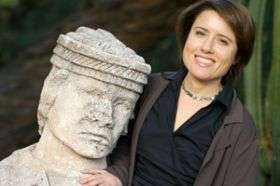
Think of Megan O’Neil’s scholarly work as forensic art history. She’s not looking to solve crimes, although she uncovers plenty of murder and mayhem.
She’s looking for something far more universal: how ancient civilizations depicted their own histories. By studying monumental Maya stone sculptures from the fifth through eighth centuries in Mexico and Central America, she looks for clues to how civilizations put their own spin on the past for religious, political or other reasons.
O’Neil, an assistant professor of art history in USC College, wants to know what happened to public art of the past, particularly sculptures commissioned by royalty.
“Moving these sculptures, burying them, digging them up, breaking them, putting them in new places — what fascinates me are all the ways people were able to create, display and modify their histories,” she said. “For the Maya, we see moments of warfare in which sculptures were broken. We have examples in which they weren’t cleaned up and other examples in which they were, and those pieces were then taken and buried as if they were human bodies.”
Sometimes, she said, snakes were offered and fires lit in front of the broken sculptures before they were buried.
How these icons were handled “brings up questions about communal memory and historical memory,” she said.
O’Neil, who came to USC College three years ago after earning her Ph.D. in art history from Yale University, has brought new classes and areas of scholarship to campus. She has taught “Ancient Maya Arts and Writing,” “Conquest of Mexico in Art” and “Literature From the 16th Century to the Present,” survey and upper-division classes that deal with ancient Mesoamerica and Peru. One experimental class, “History of World Arts in Los Angeles,” that turned into a favorite.
That class, for freshman and sophomores, involved going on a bus every week to a different museum in the city.
Said O’Neil: “In traditional art history survey classes, you study art of the West, European art and American art. You don’t touch Asia. That’s another class. And you don’t touch the ancient Americas. That’s another class. And you don’t look at what the Chicanos are doing. I wanted to do all this in one class as an experiment.”
It was a glorious experience, she said. “What you really end up learning is all the neighborhoods of Los Angeles and different parts of Los Angeles history and Los Angeles interacting with what New York and Europe are doing.”
It says something about this engaging, enthusiastic scholar that she switched from undergraduate study on the Aztecs to graduate work on the Maya because she knew it would be harder. There are fewer primary sources in European languages for the Maya, for one, and learning to decipher Maya hieroglyphics “takes a very, very, very long time — essentially your whole life,” she said.
O’Neil began her graduate studies with the late Linda Schele of the University of Texas, who was an evangelist for teaching Maya hieroglyphs. The symbols are complicated because scribes prized creativity. For example, O’Neil said, the word for “jaguar” (balam in Maya) can be written 10 different ways. Further complicating — and enriching — decipherment is the fact that signs can stand for syllables or words.
Decipherment is a relatively new field, having begun during the Cold War when a Russian linguist demonstrated how a manuscript from a 16th century Spanish friar held the key to the code, a story told by Michael Coe, one of O’Neil’s undergraduate professors, in his 1992 book, Breaking the Maya Code.
O’Neil thinks the fact that there is still much to be discovered is part of the allure of the Maya.
“I tell my students ‘there is still a lot to do.’ That’s really exciting. As an undergraduate, I could feel that — that there’s room for me to make a contribution. And it’s also that these places where the sculptures are found are beautiful. It’s amazing the kind of buildings that could be built and the sculptures made with no metal tools, no pack animals and no wheels. There’s the fascination of how did they do that?”
The freestanding sculptures she studies are called stelae (pronounced steel-ee), a word taken from Greek studies. “I’m pretty sure we use the term wrong and pronounce it wrong,” she admitted. “The intellectual history comes with a lot of assumptions and desires to establish an antiquity for the New World that’s as rich and deep as the Old World.”
O’Neil remembered exactly the sculpture that started her off on the scholarly quest that continues today. She was given a drawing of a monument from 593 A.D. that showed a king, dressed as a warrior, holding a shield with a depiction of an older warrior on it. The monument had been taken out of Chiapas, Mexico, in the late 1950s, and the drawing appeared in an obscure 1957 book by a Danish scholar. That led her to search for a photograph.
In a 1966 sales catalog from a Paris gallery, she found a photograph of a piece of the monument. On a trip to Paris, she tracked down the actual stone fragment, which had never been sold and was still in a warehouse.
“I like to joke that they blindfolded me and took me in a car, but they didn’t really,” O’Neil said with a laugh. The other pieces were left in Mexico, “simply tossed on the ground,” she said. “I’m sure archaeologists are going to find the missing parts someday.”
She is currently on leave this year, writing a book with the working title Ancient Maya Objects of History. The research takes her to archives in Mexico City and Guatemala City, and fieldwork leads to the jungle in Chiapas, Mexico, and the Peten region of northern Guatemala. Her work is supported by a J. Paul Getty Foundation Postdoctoral Research Fellowship and a USC Advancing Scholarship in the Humanities and Social Science award.
Her Yale dissertation adviser, the distinguished Maya scholar Mary Miller, said that the uniqueness of O’Neil’s work is recognizing the historic self-knowledge of Maya art.
“Her work is the first to lay out systematically how the Maya used their own historical works to recall earlier eras, in both style and detail, as if a modern-day U.S. president were to don Abraham Lincoln’s clothes and be recorded by daguerreotype,” Miller said. “O’Neil’s recognition of this imaginative and self-reflective work, this highly visual work, gives us greater admiration for the artfulness of the ancient Maya while simultaneously bringing their ancient sculptures to life.”
O’Neil, who recognizes that “as an academic, you can end up anywhere,” is thrilled to be at USC. “Of the jobs that have been available since I entered graduate school, this was the job I wanted. It really is a dream come true.”
Source: USC


