Yale scientists visualize the machinery of mRNA splicing
April 5, 2008
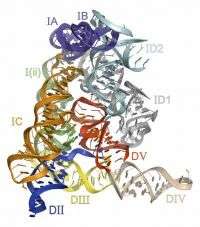
Ribbon reconstruction view of the crystal structure of an RNA group II intron -- red domain is the active site. Credit: Pyle / Yale
Recent research at Yale provided a glimpse of the ancient mechanism that helped diversify our genomes; it illuminated a relationship between gene processing in humans and the most primitive organisms by creating the first crystal structure of a crucial self-splicing region of RNA.
Genes of higher organisms code for production of proteins through intermediary RNA molecules. But, after transcription from the DNA, these RNAs must be cut into pieces and patched together before they are ready for translation into protein. Stretches of the RNA sequence that code for protein are kept, and the intervening sequences, or introns, are spliced out of the transcript.
This work, published in Science, highlights a 16-year quest by Anna Marie Pyle, the William Edward Gilbert Professor of Molecular Biophysics & Biochemistry at Yale, and her research team into the nature of “group II” introns, a particular type of intron within gene transcripts that catalyzes its own removal during the maturation of RNA.
Group II introns are found throughout nature, in all forms of living organisms. Although much has been learned about their structure and how they work through biochemical and computational analysis, until now there have been no high-resolution crystal structures available. The resulting images have provided both confirmation of the earlier work and new information on the three-dimensional structure of RNA and the mechanism of splicing.
“One of the most exciting aspects of this work was that we did not need to do anything disruptive to these molecules to prepare them for structural analysis,” said Pyle. “The molecules showed us their structure, their active site and their activity — all in a natural state. We were even able to visualize their associated ions.”
According to Pyle, the crystal structure revealed some unexpected features — showing two sections that were most implicated as key elements of the active site and strengthening a theory that the process of splicing in humans “shares a close evolutionary heritage” with ancient forms of bacteria.
Looking to future applications of the work, Pyle said, “Group II introns hold promise in the future as agents of gene therapy. A free intron is an infectious element that is special because it targets DNA sites very specifically. We hope that further knowledge of these structures may lead to the development of new genetic tools and therapeutics.”
Citation: Science 320 , 77-82 (April 4, 2008). [DOI: 10.1126/science.1153803]
Source: Yale University
-
Evolutionarily young protein helps ancient RNA get into shape
Oct 13, 2010 |
5 / 5 (1) |
0
-
Trichoplax genome sequenced -- 'rosetta stone' for understanding evolution
Sep 03, 2008 |
4.9 / 5 (34) |
2
-
Genome of simplest animal reveals ancient lineage, confounding array of complex capabilities
Aug 22, 2008 |
4.8 / 5 (8) |
0
-
Engineers build first sub-10-nm carbon nanotube transistor
Feb 01, 2012 |
4.9 / 5 (31) |
30
-
Something old, something new: Evolution and the structural divergence of duplicate genes
Jan 31, 2012 |
4.6 / 5 (7) |
1
-
The hidden nanoworld of ice crystals: Revealing the dynamic behavior of quasi-liquid layers
Jan 30, 2012 |
5 / 5 (3) |
1
-
Stock market network reveals investor clustering
Jan 27, 2012 |
3.9 / 5 (23) |
8
-
Of microchemistry and molecules: Electronic microfluidic device synthesizes biocompatible probes
Jan 26, 2012 |
5 / 5 (1) |
0
More news stories
Entire genome of extinct human decoded from fossil
(PhysOrg.com) -- In 2010, Svante Pääbo and his colleagues presented a draft version of the genome from a small fragment of a human finger bone discovered in Denisova Cave in southern Siberia. The ...
Feb 07, 2012 |
4.7 / 5 (58) |
47
|
Why are there so few fish in the Earth's oceans?
(PhysOrg.com) -- A Stony Brook University researcher has found that, contrary to popular belief, there are not plenty of fish in the sea.
Feb 08, 2012 |
4.3 / 5 (17) |
26
|
Miami battling invasion of giant African snails
No one knows how they got there. But an invasion of African giant snails has southern Florida in a panic over potential crop damage, disease and general yuckiness surrounding the slimy gastropods.
Feb 10, 2012 |
4.5 / 5 (2) |
5
Deciding to go left or right: Researchers use device to determine that lower animals can navigate too
For decades, scientists have associated binary decision making opting to go left or right with higher-ranking animals, including humans. A team of Harvard researchers, however, is rewriting that ...
Feb 09, 2012 |
4 / 5 (1) |
4
|
Study shows chimps able to understand needs of others
(PhysOrg.com) -- By setting up a unique experiment, a small team of researchers has found that chimpanzees are able to understand need in other chimps, despite their general disinclination to offer aid when ...
Injured boomers beware: Know when to see doctor
(AP) -- It happened to nurse Jane Byron years after an in-line skating fall, business owner Haralee Weintraub while doing "men's" push-ups, and avid cyclist Gene Wilberg while lifting a heavy box.
Google might launch Drive for cloud storage soon
(PhysOrg.com) -- Google's next big move, according to the Wall Street Journal, is a cloud storage service called Drive. Hardly first to the plate, Google is simply catching up to introducing its cloud reposi ...
Latin America mining boom clashes with conservation
Latin America is experiencing a mining boom as prices rise fuelled by a hike in global demand, but the region is also being hit by a wave of violent protests, strikes and rallies by environmentalists.
Love a click away in Indonesia's Twitter Republic
He was a geeky kid from Yogyakarta, she a glamorous city girl in Jakarta. In a country with one of the world's most vibrant social networking scenes they fell in love on Twitter.
Europeans protest controversial Internet pact
Tens of thousands of people marched in protests in more than a dozen European cities Saturday against a controversial anti-online piracy pact that critics say could curtail Internet freedom.
Walney offshore wind farm is world's biggest (for now)
(PhysOrg.com) -- The Walney wind farm on the Irish Sea--characterized by high tides, waves and windy weather--officially opened this week. The farm is treated in the press as a very big deal as the Walney ...