Meteorites delivered the 'seeds' of Earth's left-hand life
April 6, 2008
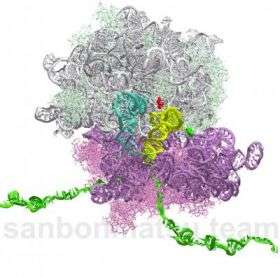
A simulated ribosome (white and purple subunits) processing an amino acid (green). Courtesy Los Alamos National Laboratory
Flash back three or four billion years — Earth is a hot, dry and lifeless place. All is still. Without warning, a meteor slams into the desert plains at over ten thousand miles per hour. With it, this violent collision may have planted the chemical seeds of life on Earth.
Scientists presented evidence today that desert heat, a little water, and meteorite impacts may have been enough to cook up one of the first prerequisites for life: The dominance of “left-handed” amino acids, the building blocks of life on this planet.
In a report at the 235th national meeting of the American Chemical Society, Ronald Breslow, Ph.D., University Professor, Columbia University, and former ACS President, described how our amino acid signature came from outer space.
Chains of amino acids make up the protein found in people, plants, and all other forms of life on Earth. There are two orientations of amino acids, left and right, which mirror each other in the same way your hands do. This is known as “chirality.” In order for life to arise, proteins must contain only one chiral form of amino acids, left or right, Breslow noted.
“If you mix up chirality, a protein’s properties change enormously. Life couldn’t operate with just random mixtures of stuff,” he said.
With the exception of a few right-handed amino acid-based bacteria, left-handed “L-amino acids” dominate on earth. The Columbia University chemistry professor said that amino acids delivered to Earth by meteorite bombardments left us with those left-handed protein units.
“These meteorites were bringing in what I call the ‘seeds of chirality,’” stated Breslow. “If you have a universe that was just the mirror image of the one we know about, then in fact, presumably it would have right-handed amino acids. That’s why I’m only half kidding when I say there is a guy on the other side of the universe with his heart on the right hand side.”
These amino acids “seeds” formed in interstellar space, possibly on asteroids as they careened through space. At the outset, they have equal amounts of left and right-handed amino acids. But as these rocks soar past neutron stars, their light rays trigger the selective destruction of one form of amino acid. The stars emit circularly polarized light—in one direction, its rays are polarized to the right. 180 degrees in the other direction, the star emits left-polarized light.
All earthbound meteors catch an excess of one of the two polarized rays. Breslow said that previous experiments confirmed that circularly polarized light selectively destroys one chiral form of amino acids over the other. The end result is a five to ten percent excess of one form, in this case, L-amino acids. Evidence of this left-handed excess was found on the surfaces of these meteorites, which have crashed into Earth even within the last hundred years, landing in Australia and Tennessee.
Breslow simulated what occurred after the dust settled following a meteor bombardment, when the amino acids on the meteor mixed with the primordial soup. Under “credible prebiotic conditions”— desert-like temperatures and a little bit of water — he exposed amino acid chemical precursors to those amino acids found on meteorites.
Breslow and Columbia chemistry grad student Mindy Levine found that these cosmic amino acids could directly transfer their chirality to simple amino acids found in living things. Thus far, Breslow’s team is the first to demonstrate that this kind of handedness transfer is possible under these conditions.
On the prebiotic Earth, this transfer left a slight excess of left-handed amino acids, Breslow said. His next experiment replicated the chemistry that led to the amplification and eventual dominance of left-handed amino acids. He started with a five percent excess of one form of amino acid in water and dissolved it.
Breslow found that the left and right-handed amino acids would bind together as they crystallized from water. The left-right bound amino acids left the solution as water evaporated, leaving behind increasing amounts of the left-amino acid in solution. Eventually, the amino acid in excess became ubiquitous as it was used selectively by living organisms.
Other theories have been put forth to explain the dominance of L-amino acids. One, for instance, suggests polarized light from neutron stars traveled all the way to earth to “zap” right-handed amino acids directly. “But the evidence that these materials are being formed out there and brought to us on meteorites is overwhelming,” said Breslow.
The steps afterward that led towards the genesis of life are shrouded in mystery. Breslow hopes to shine more light on prebiotic Earth as he turns his attention to nucleic acids, the chemical units of DNA and its more primitive cousin RNA.
“This work is related to the probability that there is life somewhere else,” said Breslow. “Everything that is going on on Earth occurred because the meteorites happened to land here. But they are obviously landing in other places. If there is another planet that has the water and all of the things that are needed for life, you should be able to get the same process rolling.”
Source: American Chemical Society
-
Study proves plausibility of new pathway to life's chemical building blocks
Jan 31, 2012 |
5 / 5 (5) |
6
-
Avalanche of reactions at the origin of life
Jan 19, 2012 |
4.8 / 5 (6) |
2
-
Genetic fingerprint reveals new efficient maize cultivars
Jan 16, 2012 |
5 / 5 (6) |
0
-
Researchers identify molecular 'culprit' in rise of planetary oxygen
Jan 10, 2012 |
5 / 5 (2) |
7
-
Simpler times: Did an earlier genetic molecule predate DNA and RNA?
Jan 09, 2012 |
4.8 / 5 (28) |
117
-
Engineers build first sub-10-nm carbon nanotube transistor
Feb 01, 2012 |
4.9 / 5 (29) |
30
-
Something old, something new: Evolution and the structural divergence of duplicate genes
Jan 31, 2012 |
4.6 / 5 (7) |
1
-
The hidden nanoworld of ice crystals: Revealing the dynamic behavior of quasi-liquid layers
Jan 30, 2012 |
5 / 5 (3) |
1
-
Stock market network reveals investor clustering
Jan 27, 2012 |
4 / 5 (22) |
8
-
Of microchemistry and molecules: Electronic microfluidic device synthesizes biocompatible probes
Jan 26, 2012 |
5 / 5 (1) |
0
More news stories
Scientists develop biological computer to encrypt and decipher images
Scientists at The Scripps Research Institute in California and the TechnionIsrael Institute of Technology have developed a "biological computer" made entirely from biomolecules that is capable of deciphering ...
11 hours ago |
4.5 / 5 (8) |
2
|
New form of hafnium oxide developed
(PhysOrg.com) -- A novel material developed by researchers at the University of Cambridge is opening up new possibilities for next generation electronic and optoelectronic devices, and paving the way for further ...
20 hours ago |
4.6 / 5 (5) |
4
|
All foamed up: Synthesis of macroporous polystyrene through polymerization of foamed emulsions
(PhysOrg.com) -- Packaging, insulation, and impact protection are examples of commercial uses of polymer foams. Depending on the intended application, the properties required of these foams can differ greatly. In the journal ...
15 hours ago |
not rated yet |
0
|
Learning about material integrity from statistical data
Whether it protects space satellites or sequesters nuclear waste, scientists want to understand tiny features that could significantly alter how a material behaves. Locating microscopic defects can be done ...
19 hours ago |
not rated yet |
0
PolyU scientist finds novel use of African mushroom in cancer research
A young scientist from The Hong Kong Polytechnic University (PolyU)'s Food Safety and Technology Research Centre (FSTRC) has successfully prepared highly stable selenium nanoparticles by using the polysaccharide-protein ...
22 hours ago |
5 / 5 (1) |
0
Scared of a younger rival? Not for some male songbirds
When mature male white-crowned sparrows duel to win a mate or a nesting territory, a young bird just doesn't get much respect.
Tiny primate 'talks' in ultrasound
One of the world's smallest primates, the Philippine tarsier, communicates in a range of ultrasound inaudible to predator and prey alike, according to a study published on Wednesday.
Playing school sports affects youths' smoking
Young people's choices about using drugs and alcohol are influenced by peersnot only close friends, but also sports teammates. A new study of middle schoolers and their social networks has found that teammates' smoking ...
New study: Adolescents suffering from depression more likely to be bullied
A new study provides evidence that adolescents who suffer from depression are more likely to develop difficulty in peer relationships including being bullied at school.
Preventing bacteria from falling in with the wrong crowd could help stop gum disease
Stripping some mouth bacteria of their access key to gangs of other pathogenic oral bacteria could help prevent gum disease and tooth loss. The study, published in the journal Microbiology suggests that t ...
New study sheds light on genetics of rice metabolism
A large-scale study analyzing metabolic compounds in rice grains conducted by researchers at the RIKEN Plant Science Center (PSC) and their collaborators has identified 131 rice metabolites and clarified the ...
Apr 07, 2008
Rank: 1 / 5 (2)
Apr 07, 2008
Rank: 2 / 5 (2)
Apr 07, 2008
Rank: 3.7 / 5 (3)
Apr 07, 2008
Rank: 3.3 / 5 (3)
anyway the fact is that BOTH LH and RH forms of life exist - so how does that happen? sounds like two emergences from the soup, or two distinct miracles are required.
Apr 07, 2008
Rank: 3 / 5 (3)
Apr 07, 2008
Rank: 2 / 5 (2)
Chirality In Life, The Earliest Surviving Darwinian Evolution Product
http://www.physfo...ic=14988&st=180entry327715
A. From "...key to life before its origin on Earth?"
http://www.physor...html#tab
When scientists synthesize these molecules in the laboratory, half of a sample turns out to be %u201Cleft-handed%u201D and the other half %u201Cright-handed.%u201D But the amino acids that are the building blocks of terrestrial proteins are all %u201Cleft-handed,%u201D while the sugars of DNA and RNA are %u201Cright-handed.%u201D The mystery as to why this is the case, %u201Cparallels in many of its queries those that surround the origin of life...%u201D
Thanks to the pristine nature of this meteorite, we were able to demonstrate that other extraterrestrial amino acids carry the left-handed excesses in meteorites and, above all, that these excesses appear to signify that their precursor molecules, the aldehydes, also carried such excesses,%u201D Pizzarello said. %u201CIn other words, a molecular trait that defines life seems to have broader distribution as well as a long cosmic lineage.%u201D
B. From "Allosteric, chiral-selective drug binding to DNA"
http://www.pnas.o...2032.pdf
(Allosteric: of, relating to, undergoing, or being a change in the shape and activity of a protein, as an enzyme, that results from combination with another substance at a point other than the chemically active site)
DNA is polymorphic and exists in a variety of distinct conformations. Duplex DNA can adopt a variety of sequence-dependent secondary structures that range from the canonical right-handed B form through the left-handed Z conformation. Multistranded triplex and tetraplex structures are now known to exist. All of these unique conformations may play important functional roles in gene expression.
C. Chirality in life still awaits elucidation
First, reasearch findings should be stated scientifically correctly. In A above NOT "a molecular trait that defines life seems to have broader distribution as well as a long cosmic lineage%u201D, but YES "a molecular conformation dominant in Earth life may have broader distribution and additional cosmic presence.%u201D
Next, re in A above "the mystery as to why this is the case":
My conjecture about the probable reasons for the prevailing chirality:
Darwinian evolution started at life's day one, with the genesis of the first organisms, the replicating oligomers, pre-archaea genes. It started under yet-unknown energetic conditions, by a serendipitous occurrence, with oligomeric (RNA?) conformations, in a soup containing all their essential molecular progenitors. These conformations happened to absorb the amounts of energy enabling their polymerization, to lengths precipitated as determined by the nature and conditions of the soup.
The sugars and the nitrogen-based compounds that, together with the phosphates, are the components of the genes-organisms, are chiral. There probably is an energetic advantage in homochirality and chiral homogeneity for the self-replication of biopolymers.
This serendipitous occurrence set up a matrix-field of energy with a potential extended between its source, the sun radiation and the precipitating organisms. This was the genesis of the ongoing formation and maintenance of Earth's biosphere.
And since the biosphere thus started it could only evolve in more favorable energetic directions and towards stabler components. Survival was the direction. After all, this was already Earth-life's evolution.
But this is also a conjecture , even if a scientifically sound one . Chirality in life still awaits elucidation...
Dov Henis
http://blog.360.y...Q--?cq=1
Apr 07, 2008
Rank: 1 / 5 (3)
Apr 10, 2008
Rank: 3 / 5 (2)
Apr 11, 2008
Rank: not rated yet