Nuclear scientists eye future landfall on a second 'island of stability'
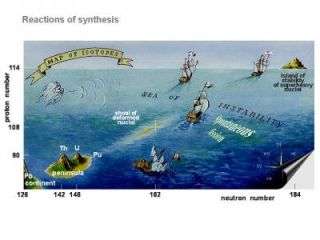
Modern-day scientific Magellans and Columbus’s, exploring the uncharted seas at the fringes of the Periodic Table of the Elements, have landed on one long-sought island — the fabled Island of Stability, home of a new genre of superheavy chemical elements sought for more than three decades.
In a presentation at the 235th national meeting of the American Chemical Society, one of the captains of these expeditions into the unknown, described how researchers now are eying other islands on the more-distant fringes of the periodic table.
“Now that it has been shown that the ‘island of stability’ of superheavy elements exists, it would be interesting to predict the position of other islands,” said Yuri Oganessian, Ph.D., of Russia’s Joint Institute for Nuclear Research in Dubna. He is the scientific leader at the Institute’s Flerov Laboratory of Nuclear Reactions.
The discovery of superheavy elements at the beginning of this century by Oganessian’s group also confirmed the existence of the Island of Stability, a theoretical region of the
periodic table, which distinguished chemist and Nobel laureate Glenn Seaborg considered
as one of the keystones of fundamental science. The “sea-and-island” analogy arose because these superheavy elements lie in an area of the periodic table where other elements are unstable, disappearing in much less than the blink of an eye. The superheavies, in contrast, are somewhat more stable than their shorter-lived cousins.
Oganessian’s group has teamed with California’s Lawrence Livermore Laboratory to synthesize five new elements (113, 114, 115, 116, and 118) over the past six years. Such superheavy elements do not exist in nature and can only be created by smashing lighter elements together at tremendous speeds obtained by means of highly sophisticated particle accelerators.
The periodic table, a fixture on the walls of science classrooms around the world, lists all the chemical elements. These materials make up everything in the universe, from human beings, medicines, and food to stars and swirling clouds of gas a billion light-years across the universe. Click here (pubs.acs.org/cen/80th/elements.html) to view the ACS’s interactive Periodic Table of the Elements.
The first 92 elements on the table exist naturally. The rest – which now extend to element 118 – were created by scientists in atomic nuclei collision with the aid of particle accelerators. Aptly named, these machines accelerate atoms to nearly 1/10 the speed of light and smash them into other so-called “target” atoms. Sometimes the nuclei of two colliding atoms fuse and a new element is formed.
Oganessian and his colleagues are currently using Dubna’s particle accelerator in an attempt to synthesize yet another superheavy element, No. 120, to add more territory to the island of stability. Strikingly, Oganessian believes that another, more distant, island of stability lies further out in that sea at the periodic table’s fringes.
“The next island is located very far from the first one,” said Oganessian. How far away might that next island be" In terms of numbers on the periodic table, it could lie around atomic number 164, as some theorists predicted, certainly a long way from where researchers are exploring today in hopes of discovering element 120.
But reaching the shores of the next island of stability will require a more deep understanding of the processes of element formation and a newer, more sophisticated particle accelerator, Oganessian believes.
In order to study the physical and chemical properties of the current and yet-to-be discovered superheavy elements, the researchers will need to produce many more nuclides than they have been able to do so far, according to Oganessian.
“For this purpose, we need to increase the beam intensity, which will demand a new accelerator,” Oganessian said.
It is difficult to anticipate what practical uses might come out of the search for new superheavy elements. For now, the focus is on discovery, not application. However, some previously synthesized elements have yielded tremendous benefits for people. One example, element 95 – Americium – discovered in 1944, is used in smoke detectors and in medical and industrial radiography.
Oganessian declined to speculate on potential uses of future superheavy elements, but noted that it will take revolutionary new technology to produce large enough amounts of these elements to make them of practical use. Although he said it is hard for him to imagine such a technology, he expressed faith in the abilities of future researchers.
“I don’t want to fantasize, but if they can devise a method for the production of
superheavy elements in large quantities, I am sure they can find some worthy application for these elements,” Oganessian said.
Source: American Chemical Society


