As nanotech goes mainstream, 'toxic socks' raise concerns
April 7, 2008 Silver Nanoparticles Biosensor

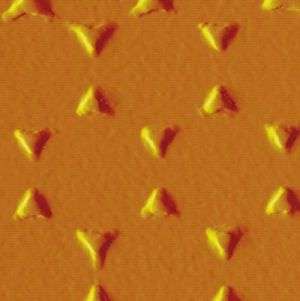
A biosensor made from an array of silver nanoparticles deposited on glass. Credit: Courtesy of the National Science Foundation

Nanotechnology is now available in a store near you. Valued for it’s antibacterial and odor-fighting properties, nanoparticle silver is becoming the star attraction in a range of products from socks to bandages to washing machines. But as silver’s benefits propel it to the forefront of consumer nanomaterials, scientists are recommending a closer examination of the unforeseen environmental and health consequences of nanosilver.

“The general public needs to be aware that there are unknown risks associated with the products they buy containing nanomaterials,” researchers Paul Westerhoff and Troy M. Benn said in a report scheduled for the 235th national meeting of the American Chemical Society (ACS).

Westerhoff and Benn report that ordinary laundering can wash off substantial amounts of the nanosilver particles from socks impregnated with the material. The Arizona State researchers suggest that the particles, intended to prevent foot odor, could travel through a wastewater treatment system and enter natural waterways where they might have unwanted effects on aquatic organisms living in the water and possibly humans, too.

“This is the first report of anyone looking at the release of silver from this type of manufactured clothing product,” said the authors.

Behind those concerns lies a very simple experiment. Benn and Westerhoff bought six pairs of name brand anti-odor socks impregnated with nanosilver. They soaked them in a jar of room temperature distilled water, shook the contents for an hour and tested the water for two types of silver — the harmful “ionic” form and the less-studied nanoparticle variety.

“From what we saw, different socks released silver at different rates, suggesting that there may be a manufacturing process that will keep the silver in the socks better,” said Benn. “Some of the sock materials released all of the silver in the first few washings, others gradually released it. Some didn’t release any silver.” The researchers will present the specific brands they studied at their ACS presentation.

If sufficient nanosilver leeches out of these socks and escapes waste water treatment systems into nearby lakes, rivers and streams, it could damage aquatic ecosystems, said Benn. Ionic silver, the dissolved form of the element, does not just attack odor-causing bacteria. It can also hijack chemical processes essential for life in other microbes and aquatic animals.

“If you start releasing ionic silver, it is detrimental to all aquatic biota. Once the silver ions get into the gills of fish, it’s a pretty efficient killer,” said Benn. Ionic silver is only toxic to humans at very high levels. The toxicity of nanoparticle silver, said Westerhoff, has yet to be determined.

Westerhoff and Benn did not intend to establish the toxicity of silver. “The history of silver and silver regulation has been set for decades by the U. S. Environmental Protection Agency — we’re not trying to reexamine or reinvent that,” said Westerhoff.

They do hope to spark a broader examination of the environmental and health consequences of nanomaterials, as well as increasing awareness of nanotechnology’s role in everyday consumer goods.

Silver has been used historically since ancient roman times, though its nanoparticle form has only recently appeared in consumer products. Beyond socks, nanosilver appears in certain bandages, athletic wear and cleaning products. Benn suggested that most consumers are unaware of these nano-additions.

“I’ve spoken with a lot of people who don’t necessarily know what nanotechnology is but they are out there buying products with nanoparticles in them. If the public doesn’t know the possible environmental disadvantages of using these nanomaterials, they cannot make an informed decision on why or why not to buy a product containing nanomaterials,” said Benn.

To that end, the researchers suggest that improved product labeling could help. Westerhoff proposes that clothing labels could become like the back of a food packaging, complete with a list of “ingredients” like nanosilver.

Westerhoff and Benn expect to expand their leeching experiments to other consumer products imbued with nanomaterials. They hope to find the moment in each product’s lifecycle when nanomaterials could be released into the environment, as well as developing better detection methods to characterize nanoparticles in water and air samples.

“Our work suggests that consumer groups need to start thinking about these things,” said Benn. “Should there be other standards for these products?”

Source: American Chemical Society


print this article email this article download pdf blog this article bookmark this article     Stumble it Digg this share on Facebook retweet share on Reddit add to delicious
Rate this story - 4.4 /5 (39 votes)

Rank Filter

Move the slider to adjust rank threshold, so that you can hide some of the comments.


Display comments: newest first

  • jcummins - Apr 07, 2008
    • Rank: 2.3 / 5 (3)
    Investigation of products is admirable, but to investigate in the realm of MAYBE and MIGHT is like wondering if a person jumps off a 1000 foot cliff if any bones will be damaged.

    Nano-elements have been around in the food, water and air far longer than any scientist can conceive. Thus, for green scientists to spout unsupportable claims that one form of silver MIGHT be harmful to the environment is bad science at best or just plain propaganda designed to get them taxpayer funding to study their created scenarios.

    Articles like this have no place in responsible reporting of science discoveries unless this type of article is shouting to the green choir.
  • albert - Apr 08, 2008
    • Rank: 4.5 / 5 (2)
    I disagree...articles "like this" are vital to people like me...people who are concerned about renegade megacorporations and profits. Nano particles are extremely dangerous, penetrate the blood brain barrier as one would walk through the goal line of a football field, without any defensive team present. This technology should be highly scrutinized if there is even the slightest HINT OF WATER OR AIR CONTAMINATION. Nanofibers/tubes are so small that, once infiltration takes place, their removal is impossible. Reason doesn't seem to be part of the mindset of unstoppable greed, as is evidenced by the scientists themselves proclaiming, when asked what the effects of nanoparticles would be in the environment and human body, "We simply don't know." "Nuff said.
  • Argiod - Apr 08, 2008
    • Rank: 2 / 5 (1)
    We can trust the 'scientists' about as much as we can trust the big corporations that fund their research, and the government agencies that regulate them. It's a big job, with big pay, and big investment in time/money for the education to acheive it. And how many of the scientists will bite the hands that feed them?
  • StevenL - Apr 11, 2008
    • Rank: not rated yet
    It isn't a question of trusting a 'scientist's' conclusion. More research needs to be done and result made accessible so other scientist can study the results and decide for themselves and provide responses and guidance.

    Having opinions one way or the other at this point is counterproductive. This leads to making a decision and then researching to find support for what point you want to make. Making your mind up and then refusing to listen or see reality is dangerous to yourself and others.

    As far as scientists willingness to "bite the hand that feeds them", companies should look into danger first, not because of law, but as a practice to prevent law suits and costs of having a product pulled off the market.
  • superhuman - Apr 28, 2008
    • Rank: not rated yet
    I happen to trust scientists more then any other profession, although I agree that there are some who work for corporations serving them the best they can, but they are small minority.

    Silver has been in environment since forever but not in its nanoparticle form. It might be poisnous, terratogenic or inflamatory or it might be perfectly safe, but we have to find out which is the case!
    If you are happy to use anything that corporations throw at you thats fine, but some of us would like to make informed decisions so we need to know the risks and how are we supposed to get that information if not from scientists?

    Research into safety of nanoparticles should be at least as if not more important than research into nanoparticles themselves!

April 7, 2008 all stories

Comments: 5

4.4 /5 (39 votes)
  • Stumble this up

  • Digg this

  • share this

  • hide
  • Related Stories

  • Nanotechnology: A risky frontier?
    created Nov 05, 2009 | popularity not rated yet | comments 0
  • Knocking nanoparticles off the socks
    created Oct 28, 2009 | popularity not rated yet | comments 0
  • Japanese astronaut tests endurance -- of his undies
    created Jul 30, 2009 | popularity not rated yet | comments 0
  • Researcher looking for nano environmental footprint
    created Jul 08, 2009 | popularity not rated yet | comments 0
  • Nanoscale silver: No silver lining?
    created Sep 09, 2008 | popularity not rated yet | comments 0


  • hide
  • Relevant PhysicsForums posts

Other News

Findings show nanomedicine promising for treating spinal cord injuries

Findings show nanomedicine promising for treating spinal cord injuries

Nanotechnology / Bio & Medicine

created 19 hours ago | popularity 4.5 / 5 (4) | comments 0

(PhysOrg.com) -- Researchers at Purdue University have discovered a new approach for repairing damaged nerve fibers in spinal cord injuries using nano-spheres that could be injected into the blood shortly ...


New Digital 'Electronics' Concept May Continue Moore's Law

New Digital 'Electronics' Concept May Continue Moore's Law

Nanotechnology / Nanophysics

created Nov 05, 2009 | popularity 4.6 / 5 (55) | comments 9

(PhysOrg.com) -- Computers of the future could be operating not on electrons, but on tiny waves traveling through an electron "fluid," if a new proposal is successful. The new circuit design, recently introduced ...


Nanoparticles for gene therapy improve

Nanoparticles for gene therapy improve

Nanotechnology / Bio & Medicine

created Nov 06, 2009 | popularity 5 / 5 (4) | comments 3

(PhysOrg.com) -- About five years ago, Professor Janet Sawicki at the Lankenau Institute in Pennsylvania read an article about nanoparticles developed by MIT's Robert Langer for gene therapy, the insertion ...


Breakthrough in industrial-scale nanotube processing

Breakthrough in industrial-scale nanotube processing

Nanotechnology / Nanomaterials

created Nov 02, 2009 | popularity 4.9 / 5 (20) | comments 3

(PhysOrg.com) -- Rice University scientists today unveiled a method for the industrial-scale processing of pure carbon-nanotube fibers that could lead to revolutionary advances in materials science, power ...


Nanoparticles may cause DNA damage across a cellular barrier

Nanoparticles may cause DNA damage across a cellular barrier

Nanotechnology / Bio & Medicine

created Nov 05, 2009 | popularity 4.3 / 5 (9) | comments 1

(PhysOrg.com) -- Scientists have shown in the laboratory that metal nanoparticles damaged the DNA in cells on the other side of a cellular barrier. The research, by the University of Bristol, is published ...