'Healing clays' show promise for fighting deadly MRSA superbug infections, other diseases
April 7, 2008
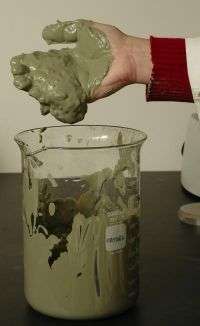
Minerals from clay could provide a source of powerful antimicrobials for fighting deadly MRSA infections and other diseases. Photo credit: Arizona State University, John C. Phillips
Mud may be coming to a medicine cabinet or pharmacy near you. Scientists in Arizona report that minerals from clay could form the basis of a new generation of inexpensive, highly-effective antimicrobials for fighting MRSA infections that are moving out of health care settings and into the community. These “superbugs” are increasingly resistant to multiple antibiotics and cause thousands of deaths each year.
Unlike conventional antibiotics that are often administered by injection or pills, the so-called “healing clays” could be used as rub-on creams or ointments to keep MRSA infections from spreading, the researchers say. The clays also show promise against a wide range of other harmful bacteria, including those that cause skin infections and food poisoning, the scientists add. Their study, one of the first to explore the antimicrobial activity of natural clays in detail, was presented today at the 235th national meeting of the American Chemical Society.
Clays have been used for thousands of years as a remedy for infected wounds, indigestion, and other health problems, either by applying clay to the skin or eating it. Today, clays are commonly used at health spas in the form of mud baths and facials. Armed with new investigative tools, researchers are beginning to explore their health claims scientifically.
“Clays are little chemical drug-stores in a packet,” said study co-leader Lynda Williams, Ph.D., a geochemist at Arizona State University in Tempe. “They contain literally hundreds of elements. Some of these compounds are beneficial but others aren’t. Our goal is to find out what nature is doing and see if we can find a better way to kill harmful bacteria.”
In the new study, funded by the National Institutes of Health, Willams and her colleagues collected more than 20 different clay samples from around the world to investigate their antibacterial activities. In collaboration with study co-leader Shelley Haydel, Ph.D., a microbiologist with Arizona State, the researchers tested each of the clays against several different bacteria known to cause human diseases. These bacteria include MRSA (methicillin-resistant Staphylococcus aureus), Mycobacterium ulcerans (a microbe related to the tuberculosis bacterium that causes a flesh-eating disease known as Buruli ulcer), as well as E. coli and Salmonella (which cause food poisoning). The researchers identified at least three clays that killed or significantly reduced the growth of these bacteria.
The researchers are working to identify the specific compounds in the clays that may be responsible for its antibacterial activity. Using electron and ion microscopy, the researchers are also exploring how these antibacterial clays interact with the cell membranes of the bacteria in order to find out how they kill.
Williams and Haydel are continuing to test new clay samples from around the world to determine their germ-fighting potential. They hope that the more promising clays will be developed into a skin ointment or pill to fight a variety of bacterial infections or possibly as an agricultural wash to prevent food poisoning. Several companies have expressed interest in forming partnerships to develop the clays as antimicrobial agents, the scientists say.
But ordinary mud can contain dangerous bacteria as well as toxic minerals like arsenic and mercury, the researchers point out. Until healing clays are developed that are scientifically proven, which could take several years, handwashing and other proper hygiene techniques may be your best bet for keeping MRSA and other harmful bacteria at bay, they say.
Source: American Chemical Society
-
Engineers build first sub-10-nm carbon nanotube transistor
Feb 01, 2012 |
4.9 / 5 (33) |
30
-
Something old, something new: Evolution and the structural divergence of duplicate genes
Jan 31, 2012 |
4.6 / 5 (7) |
1
-
The hidden nanoworld of ice crystals: Revealing the dynamic behavior of quasi-liquid layers
Jan 30, 2012 |
5 / 5 (5) |
1
-
Stock market network reveals investor clustering
Jan 27, 2012 |
3.9 / 5 (23) |
8
-
Of microchemistry and molecules: Electronic microfluidic device synthesizes biocompatible probes
Jan 26, 2012 |
5 / 5 (2) |
0
-
Is Everyday Technology Killing Us?
Feb 08, 2012
-
Exercise and weight loss
Feb 08, 2012
-
Why do we have head aches? Our brains can't feel anything.
Feb 07, 2012
-
"The end of diseases" by David Agus, interview from Daily Show with Jon Stewart
Feb 04, 2012
-
Oncolytic adenovirus
Feb 04, 2012
-
Nutrition label stuffs and diets
Feb 02, 2012
- More from Physics Forums - Medical Sciences
More news stories
Social psychologist: Lust makes you smarter and evidence that seven deadly sins are good for you
(Medical Xpress) -- Good news for lovers on Valentine’s Day - the seven deadly sins, including Lust, are good for you. University of Melbourne social psychologist Dr Simon Laham uses modern research to make a compelling ...
Medicine & Health / Psychology & Psychiatry
12 minutes ago |
not rated yet |
0
Research finds injuries to professional athletes from routine play or practice often reported as 'freak accidents' in me
(Medical Xpress) -- A new report from the Johns Hopkins Center for Injury Research and Policy finds injuries to professional athletes from routine play or practice are often characterized as freak accidents in ...
7 minutes ago |
not rated yet |
0
Researchers find rate of follow-up surgeries after partial mastectomy varies greatly
(Medical Xpress) -- A study conducted at the University of Vermont/Fletcher Allen Health Care and three other sites and published in the February 1 issue of the Journal of the American Medical Association found significant ...
21 minutes ago |
not rated yet |
0
Cognitive impairment in older adults often unrecognized in the primary care setting
A new study published in the Journal of the American Geriatrics Society reveals that brief cognitive screenings combined with offering further evaluation increased new diagnoses of cognitive impairment in older veterans two to ...
2 hours ago |
not rated yet |
0
Botox developer rues missing out on billions
Botox developer Alan Scott says he rues the day he handed over rights to the best-selling wrinkle-smoothing drug to a US company for just $4.5 million, saying he might have become a billionaire.
Medicine & Health / Medications
3 hours ago |
not rated yet |
0
New molecule has potential to help treat genetic diseases and HIV
(PhysOrg.com) -- Chemists at The University of Texas at Austin have created a molecule that's so good at tangling itself inside the double helix of a DNA sequence that it can stay there for up to 16 days before ...
Researchers' paper wins Best Paper Award for 2011
A paper written by Dr. Paul Gratz and his graduate student, Reena Panda, from the Department of Electrical and Computer Engineering at Texas A&M University was selected as one of the best papers from IEEE Computer Architecture ...
New European rocket lifts off on maiden flight
A new lightweight rocket, Vega, lifted off from Europe's space base Monday carrying nine satellites on its inaugural flight, mission control said.
Ordered planar polymers created for the first time
(PhysOrg.com) -- Scientists under the direction of ETH Zurich have created a minor sensation in synthetic chemistry. They succeeded for the first time in producing regularly ordered planar polymers that form ...
Microsoft India retail site down after 'cyber attack'
Microsoft India's retail website was down on Monday after reportedly being hacked by a Chinese group calling itself Evil Shadow Team.
Chinese city seizes Apple iPads in name dispute
(AP) -- Authorities have seized Apple iPads from retailers in a city in northern China due to a dispute with a domestic company that says it owns the iPad name, an official said Monday. The Chinese company said it is asking ...