Newly discovered 'superinsulators' promise to transform materials research, electronics design
Superinsulation may sound like a marketing gimmick for a drafty attic or winter coat. But it is actually a newly discovered fundamental state of matter created by scientists at the U.S. Department of Energy's Argonne National Laboratory in collaboration with several European institutions. This discovery opens new directions of inquiry in condensed matter physics and breaks ground for a new generation of microelectronics.
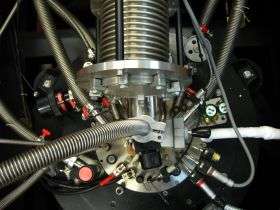
Led by Argonne senior scientist Valerii Vinokur and Russian scientist Tatyana Baturina, an international team of scientists from Argonne, Germany, Russia and Belgium fashioned a thin film of titanium nitride which they then chilled to near absolute zero. When they tried to pass a current through the material, the researchers noticed that its resistance suddenly increased by a factor of 100,000 once the temperature dropped below a certain threshold. The same sudden change also occurred when the researchers decreased the external magnetic field.
Like superconductors, which have applications in many different areas of physics, from accelerators to magnetic-levitation (maglev) trains to MRI machines, superinsulators could eventually find their way into a number of products, including circuits, sensors and battery shields.
If, for example, a battery is left exposed to the air, the charge will eventually drain from it in a matter of days or weeks because the air is not a perfect insulator, according to Vinokur. "If you pass a current through a superconductor, then it will carry the current forever; conversely, if you have a superinsulator, then it will hold a charge forever," he said.
"Titanium nitride films, as well as films prepared from some other materials, can be either superconductors or insulators depending on the thickness of the film," Vinokur said. "If you take the film which is just on the insulating side of the transition and decrease the temperature or magnetic field, then the film all of a sudden becomes a superinsulator."
Scientists could eventually form superinsulators that would encapsulate superconducting wires, creating an optimally efficient electrical pathway with almost no energy lost as heat. A miniature version of these superinsulated superconducting wires could find their way into more efficient electrical circuits.
Titanium nitride's sudden transition to a superinsulator occurs because the electrons in the material join together in twosomes called Cooper pairs. When these Cooper pairs of electrons join together in long chains, they enable the unrestricted motion of electrons and the easy flow of current, creating a superconductor. In superinsulators, however, the Cooper pairs stay separate from each other, forming self-locking roadblocks.
"In superinsulators, Cooper pairs avoid each other, creating enormous electric forces that oppose penetration of the current into the material," Vinokur said. "It's exactly the opposite of the superconductor," he added.
The theory behind the experiment stemmed from Argonne's Materials Theory Institute, which Vinokur organized six years ago in the laboratory's Materials Science Division. The MTI hosts a handful of visiting scholars from around the world to perform cutting-edge research on the most pressing questions in condensed matter physics. Upon completion of their tenure at Argonne, these scientists return to their home institutions but continue to collaborate on the joint projects. The MTI attracts the world's best condensed matter scientists, including Russian "experimental star" Tatyana Baturina, who, according to Vinokur, "became a driving force in our work on superinsulators."
Scientists from the Institute of Semiconductor Physics in Novosibirsk, Russia, Regensburg and Bochum universities in Germany and Interuniversity Microelectronics Centre in Leuven, Belgium, also participated in the research.
The research appears in the April 3 issue of Nature.
Source: Argonne National Laboratory


