'Revolutionary' CO2 maps zoom in on greenhouse gas sources
April 7th, 2008 'Revolutionary' CO2 maps zoom in on greenhouse gas sources

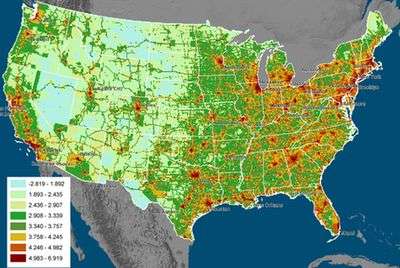
Researchers now have a better view of where carbon dioxide is being emitted thanks to Vulcan, a research project led by Kevin Gurney, an assistant professor at Purdue. This map shows where CO2 is being emitted in the continental United States in 10-kilometer grids and combines data from sources including factories, automobiles on highways and power plants. The map offers more than 100 times the detail of previous inventories of carbon dioxide. The image displays metric tons of carbon per year per grid in a logarithmic base-10 scale. (Purdue University image/Kevin Gurney)

A new, high- resolution, interactive map of U.S. carbon dioxide emissions from fossil fuels has found that the emissions aren't all where we thought.

"For example, we've been attributing too many emissions to the northeastern United States, and it's looking like the southeastern U.S. is a much larger source than we had estimated previously," says Kevin Gurney, an assistant professor of earth and atmospheric science at Purdue University and leader of the project.

The maps and system, called Vulcan, show CO2 emissions at more than 100 times more detail than was available before. Until now, data on carbon dioxide emissions were reported, in the best cases, monthly at the level of an entire state. The Vulcan model examines CO2 emissions at local levels on an hourly basis.

Researchers say the maps also are more accurate than previous data because they are based on greenhouse gas emissions instead of estimates based on population in areas of the United States.

To create the Vulcan maps, the research team developed a method to extract the CO2 information by transforming data on local air pollution, such as carbon monoxide and nitrous oxide emissions, which are tracked by the Environmental Protection Agency, the U.S. Department of Energy and other governmental agencies.

"These pollutants are important to determine the ozone levels and air quality in major cities, and they are tracked on an hourly basis," Gurney says. "We've been able to leverage that data to determine the levels of CO2 being produced."

Carbon dioxide is the most important human-produced gas contributing to global climate change. The United States accounts for about 25 percent of global CO2 emissions.

The increased detail and accuracy of Vulcan will help lawmakers create policies to reduce CO2 emissions while also increasing scientists' understanding of the sources and fate of carbon dioxide, researchers say.

"Before now the only thing policy-makers could do was take a big blunt tool and bang the U.S. economy with it," Gurney says. "Now we have more quantifiable information about what is happening in neighborhoods, on roads and in industrial areas, and track the CO2 by the hour. This offers policy-makers something akin to a scalpel instead."

Gurney says the inventory system, which is named for the Roman god of fire, quantifies all of the CO2 that results from the burning of fossil fuels such as coal and gasoline. It also tracks the hourly outputs at the level of factories, power plants, roadways, neighborhoods and commercial districts.

A preliminary analysis of the Vulcan data suggests that previous maps of U.S. fossil fuel emissions were inadequate for current scientific and policy-making needs, Gurney says.

"When you compare the old inventories to Vulcan, the new data show atmospheric CO2 differences that are as large as five parts per million in some U.S. regions in the late winter," he says. "The levels in the global atmosphere only rise one and a half part per million every year, so this is the equivalent of three years of global emissions in the atmosphere that isn't where we thought it was. This will be important for policy-makers and is enormous from a scientific point of view. It's shocking."

Gurney says this change isn't only due to people moving to the southeast, but also because of the approximations of previous estimates.

James Hansen, director of NASA's Goddard Institute for Space Studies, says Vulcan provides a "check" to judge the accuracy of existing satellite data.

"The high-resolution map from Vulcan also provides a picture of emission sources in a way that the public and policy-makers can understand, which may be helpful in discussing what we will do about the climate problem," Hansen says.

The three-year project, which was funded by NASA and the U.S. Department of Energy under the North American Carbon Program, involved researchers from Purdue University, Colorado State University and Lawrence Berkeley National Laboratory.

Robert Andres, a senior researcher with the Carbon Dioxide Information Analysis Center at the U.S. Department of Energy's Oak Ridge National Laboratory who is not affiliated with the project, says Vulcan will provide scientists with many insights into the global carbon cycle and climate change.

"Vulcan will be revolutionary in carbon cycle research," he says. "It is the next generation in our understanding of fossil fuel emissions. The implications for climate science, carbon trading and climate change mitigation work are tremendous."

To extract the CO2 information from the data on other pollutants, research scientists in the Office of Information Technology at Purdue developed a computational system to apply Gurney's methods to existing information.

Once the data was converted to determine the CO2 emissions, it was combined with geographic information systems (GIS) data to layer the emissions onto roads and other infrastructure at the Earth's surface. The current emissions are based on information from 2002, but the Vulcan system will soon expand to more recent years.

Gerry McCartney, vice president for information technology and chief information officer at Purdue, says the digital data conversion developed by Gurney and IT research scientists at Purdue will advance both climate science and information technology.

"This was an important project that required a massive amount of data and a large number of people with highly technical skills," McCartney says. "Vulcan is a part of a larger vision for tracking greenhouse gas emissions around the world, eventually even in real time, and we are pleased that Purdue possesses the resources and technical ability to take on a project of this scale."

Vulcan is expected to complement NASA's planned December 2008 launch of the Orbital Carbon Observatory satellite, which will measure the concentration of CO2 in the Earth's atmosphere.

"Our understanding of atmospheric CO2 we gain from Vulcan and from NASA's satellite will be enhanced tremendously by combining them," Gurney says. "It's like the old photographs found in stereoscopes or View-Masters. Each image is nice, but when you put them together you achieve a 3-D view that gives you much more information."

The Vulcan data is available for anyone to download from the Web site at http://www.eas.purdue.edu/carbon/vulcan . Smaller summary data sets that offer a slice of the data and are easier to download also are available for non-scientists on the Vulcan Web site. These can be broken down into emission categories, such as industrial, residential, transportation, power producers, by fuel type, and are available by state, county, or cells as small as six miles (10 kilometers) across.

A video of the maps and simulations of the atmospheric fate of fossil fuel CO2 also can be viewed on YouTube at http://www.youtube.com/watch?v=eJpj8UUMTaI .

The animation was created by Bedrich Benes, assistant professor of computer graphics technology and a research scientist in Purdue's Envision Center for Data Perceptualization, and computer science graduate student Nathan Andrysco. The animation required a year to produce, and the rendering of the animation (the video equivalent of printing) required nine hours to produce the 2,000 images that make up the 60-second video.

"To do this, we built from scratch a software program that is specifically tailored to visualize greenhouse gases," Benes says.

Although Vulcan can be used to pinpoint CO2 emissions down to the levels previously unseen, Gurney says the tool should not be used to affix blame.

"Ten years ago there might have been resistance to the notion of examining who is responsible for the CO2 emissions in such a visually detailed way," Gurney says. "However, what Vulcan makes utterly clear is that CO2 emissions cannot be exclusively affixed to SUV drivers, manufacturers or large power producers; everybody is responsible. We need to look for real solutions, and have a deeper discussion about energy use. It's not about politics. It's about doing good science and solving the problem, and we can all be a part of that."

Source: Purdue University


print this article email this article download pdf blog this article bookmark this article     Digg this Stumble it share on Facebook share on Reddit add to delicious save to Yahoo! bookmarks
3.8/5 after 46 votes

Rank Filter

Move the slider to adjust rank threshold, so that you can hide some of the comments.


Display comments: newest first

  • NotParker - Apr 07, 2008
    • Rank: 1.8 / 5 (5)
    The interesting thing is that the are with the st CO2 is actually cooling.

  • jcummins - Apr 08, 2008
    • Rank: 2.8 / 5 (8)
    This so-called new map is simply dressed-up propaganda.

    If these so-called green scientists were so smart why don't they have natural solutions instead of rules and regs?

    If their past facts weren't all that great, why is their new data wonderful and not full of holes?

    Leveraging data is the same foolishness speculators do when leveraging money, which has resulted in the current fiscal mess.

    The greens never end their anti-civilization campaigns and are constantly polluting man's environment with computer generated maps legitimizing legislation to justify stopping man's quest for a better life through industry.

    I submit that the greens are intellectually challenged because they offer no solution to their hypothetical problems. For instance: the greens got the govt to force the public to use catalytic converters to change the chemistry of tail-pipe emissions. Trouble is, in the process they created more of the green house gases that they now want everyone to pay for cleaning-up their mess.

    When examining the historical facts -- greens are anti-human and want the people to be robotic servants content to have nothing but to work for the benefit of the green priests who bow to their green god Gaia that is being taught in academia..

    The article concludes by indicating that blaming or politics is not their agenda. What blatant nonsense -- their plan is politics and to capture the huge volumes of money coming their way as they supposedly fix the problems they helped create.

    If there is a global pollution problem it is the green agenda that needs elimination before the last semblances of individual freedom is destroyed.
  • polydore - Apr 08, 2008
    • Rank: 3.3 / 5 (3)
    Mind you, if you walk in a ditch next to a road in the US you won't suffocate. You'd have to go to Africa for that. And generally be shorter than 4 feet high. If you drop something don't search for it on your hands and knees. Carrying your children should be safe. Throw dogs and pets across the ditch.
  • lillia - Apr 08, 2008
    • Rank: 2.7 / 5 (3)
    OK, I CAN'T HELP MYSELF BUT TO RESPOND TO THESE COMMENTS;

    This so-called new map is simply dressed-up propaganda.

    If these so-called green scientists were so smart why don't they have natural solutions instead of rules and regs?
    AREN'T THERE SOME SOLUTIONS? WIND POWER COMES TO MIND...
    I KNOW IT'S DEPRESSING WHEN THERE ARE LOTS OF PROBLEMS AND NO INSTANT/GUARANTEED SOLUTIONS.

    If their past facts weren't all that great, why is their new data wonderful and not full of holes?
    YOU HAVE HIGH EXPECTATIONS. LEARNING IS A PROCESS.

    Leveraging data is the same foolishness speculators do when leveraging money, which has resulted in the current fiscal mess.
    SO YOU THINK WE SHOULD JUST TOSS IT ALL OUT?
    IF THEY ARE RIGHT, AND WE IGNORE THEM, WHAT'S THE DOWNSIDE? WHAT IF THEY ARE SORTA RIGHT- AND WE IGNORE THEM- WHAT'S THE CONSEQUENCES? DO YOU REALLY THINK THEY'RE ALL TOTALLY WRONG, OR DO YOU JUST WANT AN EXCUSE TO IGNORE THEM?

    The greens never end their anti-civilization campaigns and are constantly polluting man's environment with computer generated maps legitimizing legislation to justify stopping man's quest for a better life through industry.
    WHAT EXACTLY IS A BETTER LIFE? YOUR COMMENTS SOUND PRETTY SELFISH ACTUALLY.

    I submit that the greens are intellectually challenged because they offer no solution to their hypothetical problems. MAYBE THE 'GREENS' SERVE A PURPOSE IN SOCIETY TO HELP POINT OUT THE PROBLEMS AND IT'S EVERYBODY'S RESPONSIBILITY TO HELP ANSWER THEM
    For instance: the greens got the govt to force the public to use catalytic converters to change the chemistry of tail-pipe emissions. Trouble is, in the process they created more of the green house gases that they now want everyone to pay for cleaning-up their mess.

    When examining the historical facts -- greens are anti-human and want the people to be robotic servants content to have nothing but to work for the benefit of the green priests who bow to their green god Gaia that is being taught in academia..
    PRETTY EXTREME...

    The article concludes by indicating that blaming or politics is not their agenda. What blatant nonsense -- their plan is politics and to capture the huge volumes of money coming their way as they supposedly fix the problems they helped create.
    AND EXACTLY HOW ARE THE GREENS GOING TO CAPTURE HUGE VOLUMES OF MONEY? WHAT ABOUT THE POLITICS OF GASOLINE, MY FRIEND- IS THAT A BETTER SOLUTION? WHO IS CAPTURING THE HUGE VOLUMES OF $$ FROM THAT? HOW ARE THE POLITICS OF OIL AFFECTING THE BEHAVIOR OF THE WORLD? (HINT: IRAQ)

    If there is a global pollution problem it is the green agenda that needs elimination before the last semblances of individual freedom is destroyed.
    NOT EXACTLY SURE HOW YOUR INDIVIDUAL FREEDOM IS BEING DESTROYED...

    IS THERE NOT A MIDDLE GROUND HERE WHERE WE CAN WORK AS A TEAMMEMBER OF THE WORLD TO LEAVE OUR CHILDREN WITH A WORLD WORTH LIVING IN? THIS INCLUDES SUSTAINABILITY, BUT ALSO PROGRESS ON COUNTLESS FRONTS. PROGRESS TO HELP US SUSTAIN
  • jeb532 - Apr 08, 2008
    • Rank: 2.6 / 5 (5)
    1. Anthropogenic CO2 is a mere 3.5% of the total CO2 occuring in the world.

    2. CO2 contributes less than 4% of the total heat entrapment mechanism that makes earth liveable.

    3. Thus, anthropogenic CO2 contributes less than 0.2% of the total heat entrapment that makes earth liveable.

    4. So, show me a graphic that includes the other 99.8% of the heat entrapment sources and I might be inclined to listen.
  • SDMike - Apr 09, 2008
    • Rank: 2 / 5 (4)
    The "map" appears to be sat data but is not. It is a computer generated rehash of "pollution" monitors. The "map" implies a much higher level of detail than actually exists. More crap science.
  • fallout11 - Apr 10, 2008
    • Rank: 4 / 5 (2)
    The commentators here obviously all flunked junior high science.
    CO2 is a byproduct of combustion. Combustion produces waste heat (basic thermodynamics, or better yet, burn something, then touch it...ouch, it's hot!). Therefore, Co2 concentrations indicate massive quantities of waste heat being released via artificial means, i.e. entropy.
    Heat => Warming.

    Small amounts of CO2 are good for plants.
    Excessive amounts are harmful, and actually promote the growth of undesirable vegetation (weeds, for instance), in addition to changing local growing conditions. Not good.
  • Egnite - Apr 15, 2008
    • Rank: 1 / 5 (1)
    the solution for the CO2 problem is simple:

    USE MORE PAPER!! Don't be stupid and think saving paper saves trees. It's the opposite, make a higher demand for paper and they will plant more trees to compensate the demand. So waste as much paper as possible so we can see forrests reappear and CO2 lvls decrease...maybe

    And can anyone tell me why we carbonate drinks? What's the point and do they manufacture this CO2 for the drinks or extract it from the atmosphere? Seems like a silly way of adding more CO2 to our environment to me.
  • carwaterguide - Dec 01, 2008
    • Rank: not rated yet
    it's has review many sites like gas for free,run your car on water etc.

    http://carwatergu...spot.com

April 7th, 2008 all stories
Space & Earth / Earth Sciences

Comments: 9
Rank: 3.8/5 after 46 votes

  • Stumble this up

  • Digg this

  • Share it:
  • share on Facebook
  • share on MySpace
  • share on Slashdot
  • rss-newsfeed
  • share on Google
  • share on Reddit
  • add to delicious
  • save to Yahoo! bookmarks
  • share on Windows Live
  • Add to Mixx!
Rating: 3.8/5 after 46 votes


Tags


  • Physicists Demonstrate Quantum Memory with Matter Qubits
    Physicists Demonstrate Quantum Memory with Matter Qubits
    Physics / General Physics
    created Jul 03, 2009 | popularity 4.4 / 5 (17) | comments 1
  • 'Holey' Nanosheets for Wastewater Dye Removal
    Nanotechnology / Nanomaterials
    created Jul 01, 2009 | popularity 5 / 5 (5) | comments 1
  • Jellyfish Robot Swims Like its Biological Counterpart
    Jellyfish Robot Swims Like its Biological Counterpart
    Electronics / Robotics
    created Jun 26, 2009 | popularity 4.4 / 5 (8) | comments 1
  • Could Maxwell's Demon Exist in Nanoscale Systems?
    Could Maxwell's Demon Exist in Nanoscale Systems?
    Physics / General Physics
    created Jun 24, 2009 | popularity 4.4 / 5 (18) | comments 29
  • Living Safely with Robots, Beyond Asimov's Laws
    Living Safely with Robots, Beyond Asimov's Laws
    Electronics / Robotics
    created Jun 22, 2009 | popularity 4.6 / 5 (52) | comments 40
  • Other News

    Forty years ago man first walked on the moon

    Space & Earth / Space Exploration

    created 15 hours ago | popularity 5 / 5 (2) | comments 1

    Forty years ago on July 20, 1969, American astronaut Neil Armstrong realized the oldest dream of human civilizations when he became the first man to walk on the moon.


    The least sea ice in 800 years

    The least sea ice in 800 years

    Space & Earth / Earth Sciences

    created Jul 01, 2009 | popularity 4.2 / 5 (62) | comments 56

    New research, which reconstructs the extent of ice in the sea between Greenland and Svalbard from the 13th century to the present indicates that there has never been so little sea ice as there is now. The ...


    Gas around young galaxy

    Intense heat killed the Universe's would-be galaxies, researchers say

    Space & Earth / Astronomy

    created Jul 01, 2009 | popularity 3.4 / 5 (21) | comments 27

    (PhysOrg.com) -- Our Milky Way galaxy only survived because it was already immersed in a large clump of dark matter which trapped gases inside it, scientists led by Durham University's Institute for Computational ...


    Scientists' Drill Hits Magma: Only Third Time on Record

    Scientists' Drill Hits Magma: Only Third Time on Record

    Space & Earth / Earth Sciences

    created Jun 29, 2009 | popularity 4.7 / 5 (22) | comments 19

    (PhysOrg.com) -- Scientists drilling a borehole deep into Iceland’s rocky crust to explore new methods of using geothermal energy hit a major roadblock on Thursday: Their drill ran into molten rock at a depth ...


    NASA manager pitches a cheaper return-to-moon plan

    Space & Earth / Space Exploration

    created Jun 30, 2009 | popularity 4 / 5 (7) | comments 18

    (AP) -- Like a car salesman pushing a luxury vehicle that the customer no longer can afford, NASA has pulled out of its back pocket a deal for a cheaper ride to the moon.