Regional nuclear conflict would create near-global ozone hole, says CU-Boulder study
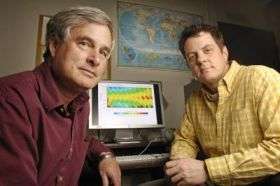
April 7, 2008 Brian Toon and Michael Mills

A new computer modeling study led by CU-Boulder scientists Brian Toon, left, and Michael Mills, right, indicates a limited nuclear weapons exchange in the Middle East would create a near-global ozone hole, impacting human and ecosystem health for a decade or more. Image courtesy Glenn Asakawa, University of Colorado

A limited nuclear weapons exchange between Pakistan and India using their current arsenals could create a near-global ozone hole, triggering human health problems and wreaking environmental havoc for at least a decade, according to a study led by the University of Colorado at Boulder.

The computer-modeling study showed a nuclear war between the two countries involving 50 Hiroshima-sized nuclear devices on each side would cause massive urban fires and loft as much as 5 million metric tons of soot about 50 miles into the stratosphere, said CU-Boulder Research Associate Michael Mills, chief study author. The soot would absorb enough solar radiation to heat surrounding gases, setting in motion a series of chemical reactions that would break down the stratospheric ozone layer protecting Earth from harmful ultraviolet radiation, said Mills.

“We would see a dramatic drop in ozone levels that would persist for many years,” said Mills of CU-Boulder’s Laboratory for Atmospheric and Space Physics. “At mid- latitudes the ozone decrease would be up to 40 percent, which could have huge effects on human health and on terrestrial, aquatic and marine ecosystems.”

A paper on the subject, titled “Massive Global Ozone Loss Predicted Following A Regional Nuclear Conflict,” appeared the week of April 7 in the Proceedings of the National Academy of Sciences. Co-authors on the study include CU-Boulder Professor Brian Toon, UCLA Professor Richard Turco and National Center for Atmospheric Research scientists Douglas Kinnison and Rolando Garcia.

According to the computer simulations, fires ignited in large cities by nuclear explosions would send several million metric tons of soot into the upper stratosphere, which would be heated by massive smoke injections. Higher temperatures would accelerate catalytic reaction cycles in the stratosphere, particularly reactions of nitrogen oxide gases known collectively as NOx that destroy ozone, Mills said.

In addition to ozone losses of 25 percent to 40 percent at mid-latitudes, the models show a 50 percent to 70 percent ozone loss at northern high latitudes, said Mills. “The models show this magnitude of ozone loss would persist for five years, and we would see substantial losses continuing for at least another five years,” he said.

The ozone losses predicted in the study are much larger than losses estimated in previous “nuclear winter” and “ultraviolet spring” scenario calculations following nuclear conflicts, said Toon, chair of CU-Boulder’s oceanic and atmospheric sciences department. A 1985 National Research Council Report predicted a global nuclear exchange involving thousands of megatons of explosions, rather than the 1.5 megatons assumed in the PNAS study, would deplete only 17 percent of the Northern Hemisphere’s stratospheric ozone, which would recover by half in three years.

“The missing piece back then was that the models at the time could not account for the rise of the smoke plume and consequent heating of the stratosphere,” said Toon. “The big surprise is that this study demonstrates that a small-scale, regional nuclear conflict is capable of triggering ozone losses even larger than losses that were predicted following a full-scale nuclear war.”

Human health ailments like cataracts and skin cancer, as well as damage to plants, animals and ecosystems at mid-latitudes would likely rise sharply as ozone levels decreased and allowed more harmful UV light to reach Earth, according to the PNAS study. “By adopting the Montreal Protocol in 1987, society demonstrated it was unwilling to tolerate a small percentage of ozone loss because of serious health risks,” said Toon. “But ozone loss from a limited nuclear exchange would be more than an order of magnitude larger than ozone loss from the release of gases like CFCs.”

UV radiation has been shown to be particularly damaging to inhabitants of aquatic ecosystems, including amphibians, shrimp, fish and phytoplankton, said Mills. “Most organisms can do little to avoid UV exposure, so one of the big unanswered questions is how the biota would respond to these big UV increases triggered by a nuclear exchange.”

The team used a cluster of computer processors at LASP to run three separate 10-year simulations -- each more than 300 hours long -- linking the urban fire nuclear scenario to climate and atmospheric chemistry processes. The team coupled NCAR’s Whole Atmosphere Community Climate Model 3 with the Community Aerosol and Radiation Model for Atmospheres developed by CU-Boulder and NASA Ames.

Two 2006 studies led by Toon and involving UCLA and Rutgers University showed that such a small-scale regional nuclear war could produce as many fatalities as all of World War II and disrupt global climate for a decade or more. Of the eight nations known to possess nuclear weapons, even those with the smallest nuclear arsenals, like Pakistan and India, are believed to have 50 or more Hiroshima-sized weapons.

In addition, about 40 countries possess enough plutonium, uranium or a combination of both to construct substantial nuclear arsenals, said Toon. A nuclear exchange involving 100 15-kiloton, Hiroshima-type weapons is only 0.03 percent of the total explosive power of the world’s nuclear arsenal, he said.

“We hope other research groups repeat our calculations and undertake their own scientific studies on this issue,” said Toon. “The world has become a far more dangerous place when the actions of two countries on the other side of the world could have such a drastic impact on the planet.” The study was funded by CU-Boulder.

Source: University of Colorado at Boulder


Rate this story - 3.7 /5 (32 votes)

Rank Filter

Move the slider to adjust rank threshold, so that you can hide some of the comments.


Display comments: newest first

  • zevkirsh - Apr 07, 2008
    • Rank: 2.2 / 5 (13)
    stupidest most offensive research ever. how about: who cares about the ozone hole if there is a holocaust like conflict killing millions of relatively innocent people? in this one sentence question i have dispatched with this silly research. shame on you idiots.
  • itistoday - Apr 07, 2008
    • Rank: 3.2 / 5 (11)
    zevkirsh - you are stupidest most offensive commenter ever. How about everyone refrains from lashing out (like those in the middle east), and act intelligently and level-headedly instead? Or is that too much to ask of the internet...
  • plaasjaapie - Apr 07, 2008
    • Rank: 2.8 / 5 (10)
    Why does Physorg persist in publishing crypto-religious doomsday articles like this? The Pinatubo eruption back in th 1990's created this big an ozone loss at mid-latitudes and no ill-effects were documented. Mind, the ozone loss from the Pinatubo eruption dwarfed the "ozone hole" in the Antarctic, but that didn't get much in the way of press, either.
  • zevkirsh - Apr 08, 2008
    • Rank: 2.8 / 5 (11)
    itistoday...i lash out because physorg keeps on posting articles that arent' post worthy. he who controls the knowledge has the power. the power should be wielded intelligently, not to worry about the ozone effects of a nuclear holocaust. honestly...does anyone care if the entire solar system explodes if the human race is unaffected? conversely, if the solar system never explodes but the human race is affected by something else...like the price of oil...then do we care? yes....and we are homosapien centric...and this is ok.
  • DGBEACH - Apr 08, 2008
    • Rank: 3.7 / 5 (10)
    zevkirsh- The reason for releasing a study such as this is obviously to make the powers that be think good and hard about the ramifications of their actions...and if you don't like the articles that physorg posts then you are more than welcome to go somewhere else.

    If there is a nuclear war, then the survivors will obviously have to deal with the depleted ozone layer, if the homosapien-centric-race (as you call us) is to continue. There's nothing wrong with having a contingency plan- in fact we mandate it from our politicians. So stop whining and let our democratically elected officials get the data they need to do their jobs!
  • Modernmystic - Apr 08, 2008
    • Rank: 3 / 5 (4)
    As someone said earlier volcanic eruptions have done far more damage to the upper atmosphere in the past. About 70,000 years ago there was a supereruption and guess what....we're still here.

    I think they tend to blow the global impact of such events way out of proportion in this article, the focus should be on the totally devestating local effects such a conflict would have.

    It's getting to the point that I totally ignore any studies or "science" coming from any university in colorado.
  • mikiwud - Apr 08, 2008
    • Rank: 1 / 5 (3)
    Another paid for IF!
    If the dog had not stopped for a s**t,It would have caught the rabbit!
  • CaptSpaulding - Apr 09, 2008
    • Rank: 2.7 / 5 (3)
    So, how does this compare to the numerous, much larger, devices that were detonated montly by the US, USSR, China, UK, and France during the cold war? Their model only shows a total of 0.75 Mt worth of nukes. There were multiple air and high level air bursts, as well as large debris ground level bursts, during the 1940s-1960s, including the massive Castle Bravo (15 Mt) and Tsar Bomba (50 Mt). Since the entire biosphere didn't die from those tests, how can we have any confidence that this "research" is anything but flawed?
  • fsmith - Apr 20, 2008
    • Rank: 5 / 5 (1)
    How come the bombing of Germany and Japan during WWII didn't cause this?

April 7, 2008 all stories

Comments: 9

3.7 /5 (32 votes)

  • hide
  • Related Stories

  • Report examines hidden costs of energy production and use
    created Oct 19, 2009 | popularity not rated yet | comments 0
  • Expert: Lift taboo on Earth engineering
    created Sep 23, 2009 | popularity not rated yet | comments 0
  • Regional nuclear war could devastate global climate
    created Dec 11, 2006 | popularity not rated yet | comments 0
  • Researchers Working to Keep Airliner Air Quality Healthy, Safe
    created Aug 15, 2006 | popularity not rated yet | comments 0
  • Rationing could be key to war on climate change
    created Jul 28, 2006 | popularity not rated yet | comments 0


  • hide
  • Relevant PhysicsForums posts

  • Carbon Dioxide emissions question
    created Feb 08, 2010
  • Photosynthesis vs. carbonization
    created Feb 07, 2010
  • Sheep's footprints
    created Feb 05, 2010
  • How did Victorians estimate the ages of fossils?
    created Feb 03, 2010
  • How can we defeat pollution as individuals?
    created Jan 29, 2010
  • Formation of lava fields on Lanzarote
    created Jan 27, 2010
  • More from Physics Forums - Earth

Other News

Space shuttle Endeavour pulls in at space station (AP)

Space shuttle Endeavour pulls in at space station

Space & Earth / Space Exploration

created 4 hours ago | popularity not rated yet | comments 0

(AP) -- Shuttle Endeavour arrived to a warm welcome at the International Space Station early Wednesday, delivering a new room and observation deck that will come close to completing construction 200 miles ...


Climate 'Tipping Points' May Arrive Without Warning, Says Top Forecaster

Space & Earth / Environment

created 14 hours ago | popularity 3 / 5 (8) | comments 10 | with audio podcast

(PhysOrg.com) -- A new University of California, Davis, study by a top ecological forecaster says it is harder than experts thought to predict when sudden shifts in Earth's natural systems will occur -- a worrisome finding ...


38 percent of world's surface in danger of desertification

38 percent of world's surface in danger of desertification

Space & Earth / Environment

created 11 hours ago | popularity 2 / 5 (4) | comments 5

A team of Spanish researchers has measured the degradation of the planet's soil using the Life Cycle Assessment (LCA), a scientific methodology that analyses the environmental impact of human activities, and ...


A new 3-D map of the interstellar gas within 300 parsecs from the sun

A new 3D map of the interstellar gas within 300 parsecs from the Sun

Space & Earth / Astronomy

created 17 hours ago | popularity 5 / 5 (5) | comments 0 | with audio podcast

(PhysOrg.com) -- Astronomy & Astrophysics is publishing new 3D maps of the interstellar gas in the local area around our Sun. A French-American team of astronomers presents new absorption measurements toward ...


URI researcher calls for global effort to monitor marine pollutants

Space & Earth / Environment

created 15 hours ago | popularity 3 / 5 (2) | comments 1

A University of Rhode Island researcher who studies chemical pollutants in the marine environment has called on colleagues around the world to establish a global monitoring network to verify that the chemicals banned by the ...