How fast can a rat smell?
April 8, 2008 How fast can a rat smell?

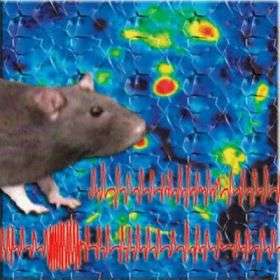
Odor perception begins with an inhalation of odor molecules (odorants) to the olfactory receptor sheet within the nose. Increasing evidence is pointing towards the importance of sniffing behavior in olfactory coding. This image shows the respiratory trace (red) of a rat recorded during odor discriminations, overlaid on a main olfactory bulb calcium response map of the odorant eugenol. Credit: Daniel Wesson et. al.

Using an ethologically relevant task—exploratory sniffing—Daniel Wesson and colleagues from Boston University discovered that rats are able to discriminate odors much more quickly than previously thought, in as little as 140 ms. Their results are published this week in the open-access online journal PLoS Biology.

In addition to using this natural behavioral task, the authors simultaneously used optical imaging to measure responses of neurons in the olfactory bulb, where odor signals sent from the nose are processed.

Measurements of neural responses confirm that very little processing takes place in these neurons. The timing of behavioral responses to odors shows that odor discrimination must take place before the activity pattern in the olfactory bulb has fully developed.

These results led the authors to conclude that odorant identity is likely to be encoded by the sequence of responses in the olfactory bulb (rather than the pattern of peak activation or later temporal features). Alternatively, the earliest-activated glomeruli within the olfactory bulb, which are not necessarily the most strongly activated overall, might contribute preferentially to the coding of odorant identity.

Citation: Wesson DW, Carey RM, Verhagen JV, Wachowiak M (2008) Rapid encoding and perception of novel odors in the rat. PLoS Biol 6(4): e82. doi:10.1371/journal.pbio. 0060082

Source: Public Library of Science


print this article email this article download pdf blog this article bookmark this article     Stumble it Digg this share on Facebook retweet share on Reddit add to delicious
Rate this story - 5 /5 (1 vote)


April 8, 2008 all stories

Comments: 0

5 /5 (1 vote)
  • Stumble this up

  • Digg this

  • share this

  • hide
  • Related Stories

  • Neural mapping paints a haphazard picture of odor receptors
    created Feb 03, 2009 | popularity not rated yet | comments 0
  • Nano vaccine for hepatitis B shows promise for third world
    created Aug 13, 2008 | popularity not rated yet | comments 0
  • Study on olfactory nerve cells shows why we smell better when we sniff
    created Mar 13, 2007 | popularity not rated yet | comments 0
  • Polyphenols and polyunsaturated fatty acids boost the birth of new neurons
    created 14 hours ago | popularity not rated yet | comments 0
  • New discovery about the formation of new brain cells
    created Nov 23, 2009 | popularity not rated yet | comments 0


Other News

Asian carp may have breached barrier protecting Lake Michigan

Biology / Ecology

created 2 hours ago | popularity 5 / 5 (2) | comments 0

Two feared species of Asian carp have zoomed beyond the $9 million electric barriers built to keep them out of Lake Michigan. Now, the only thing left between the carp and the Great Lakes is a lock and dam in southern Chicago.


Got a pain? -- Have a cup of Brazilian mint

Biology / Plants & Animals

created 4 hours ago | popularity 4.6 / 5 (5) | comments 0

For thousands of years it has been prescribed by traditional healers in Brazil to treat a range of ailments from headaches and stomach pain to fever and flu.


Opposites attract: Monkeys choose mating partners with different genes

Biology / Evolution

created 4 hours ago | popularity 5 / 5 (1) | comments 0

The world's largest species of monkey 'chooses' mates with genes that are different from their own to guarantee healthy and strong offspring, according to a new research study.


When is a stem cell really a stem cell?

When is a stem cell really a stem cell?

Biology / Biotechnology

created 5 hours ago | popularity 4.7 / 5 (3) | comments 0

(PhysOrg.com) -- Induced pluripotent stem (iPS) cells -- adult cells reprogrammed to look and function like versatile embryonic stem cells -- are of growing interest in medicine. They may provide a way to ...


Ice Cold: Cooler Than Being Cool

Ice Cold: Cooler Than Being Cool

Biology / Cell & Microbiology

created 6 hours ago | popularity 4.1 / 5 (7) | comments 0

(PhysOrg.com) -- Water expands when it freezes. Anyone who has ever left a can of soda or bottle of water in the freezer too long has witnessed this first hand. So how do plants and animals survive severe ...