Most powerful laser in the world fires up
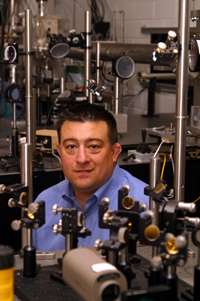
April 8, 2008 Dr. Todd Ditmire directs the Texas Petawatt project.

Dr. Todd Ditmire directs the Texas Petawatt project.

The Texas Petawatt laser reached greater than one petawatt of laser power on Monday morning, March 31, making it the highest powered laser in the world, Todd Ditmire, a physicist at The University of Texas at Austin, said.

The Texas Petawatt is the only operating petawatt laser in the United States.

Ditmire says that when the laser is turned on, it has the power output of more than 2,000 times the output of all power plants in the United States. (A petawatt is one quadrillion watts.) The laser is brighter than sunlight on the surface of the sun, but it only lasts for an instant, a 10th of a trillionth of a second (0.0000000000001 second).

Ditmire and his colleagues at the Texas Center for High-Intensity Laser Science will use the laser to create and study matter at some of the most extreme conditions in the universe, including gases at temperatures greater than those in the sun and solids at pressures of many billions of atmospheres.

This will allow them to explore many astronomical phenomena in miniature. They will create mini-supernovas, tabletop stars and very high-density plasmas that mimic exotic stellar objects known as brown dwarfs.

“We can learn about these large astronomical objects from tiny reactions in the lab because of the similarity of the mathematical equations that describe the events,” said Ditmire, director of the center.

Such a powerful laser will also allow them to study advanced ideas for creating energy by controlled fusion.

Source: University of Texas at Austin


print this article email this article download pdf blog this article bookmark this article     Stumble it Digg this share on Facebook retweet share on Reddit add to delicious
Rate this story - 4.3 /5 (55 votes)

Rank Filter

Move the slider to adjust rank threshold, so that you can hide some of the comments.


Display comments: newest first

  • zevkirsh - Apr 08, 2008
    • Rank: 3.3 / 5 (3)
    freaking awesome. totally awesome. how do they compress all that power into such a small slice of time?
  • Soylent - Apr 08, 2008
    • Rank: 3.5 / 5 (2)
    The process is known as chirped pulse amplification.

    Roughly what they do is generate a very short low power pulse. Since it's very short it can't be monochromatic; this is a result from fourier analysis. Consider a bell curve in the frequency domain, the only way all those sine curves can give a large net contribution is if their phases are roughly aligned at some point, this is at the center of the pulse. Turns out that the smaller the pulse is in time, the broader the range of frequencies involved must be to quickly cancel out at either end of the pulse.

    Since the initial pulse contains a spread of frequencies you can use gratings or prisms to get different frequency components to arrive at a power amplifier at different times(this is known as the strecher); the amplified pulse can then be compressed again when it comes out the other end using prisms or gratings.

April 8, 2008 all stories

Comments: 2

4.3 /5 (55 votes)
  • Stumble this up

  • Digg this

  • share this

  • hide
  • Related Stories

  • Electron self-injection into an evolving plasma bubble
    created Nov 02, 2009 | popularity not rated yet | comments 0
  • Laser Fusion and Exawatt Lasers
    created Oct 01, 2009 | popularity not rated yet | comments 0
  • Scientists visualize how bacteria talk to one another
    created 8 hours ago | popularity not rated yet | comments 0
  • Portable 3-D laser technology preserves Texas dinosaur's rare footprint
    created Nov 04, 2009 | popularity not rated yet | comments 0
  • Powerful laser sheds light on fast ignition and high energy density physics
    created Nov 02, 2009 | popularity not rated yet | comments 0


  • hide
  • Relevant PhysicsForums posts

  • Drop of Water
    created 32 minutes ago
  • Generalized Coordinate Systems
    created 50 minutes ago
  • Electromagnet design
    created 2 hours ago
  • Physics practice, please help me!
    created 3 hours ago
  • More from Physics Forums - General Physics

Other News

Stars Fueled by Dark Matter Could Hold Secrets to the Universe

Stars Fueled by Dark Matter Could Hold Secrets to the Universe

Physics / General Physics

created Nov 03, 2009 | popularity 4.5 / 5 (51) | comments 41

(PhysOrg.com) -- The first stars in the universe may have been very different from the stars we see today, yet they may hold clues to understanding some of the mysterious features of the universe. These "dark ...


Second Law of Thermodynamics May Explain Economic Evolution

Second Law of Thermodynamics May Explain Economic Evolution

Physics / General Physics

created Nov 02, 2009 | popularity 4.3 / 5 (30) | comments 28

(PhysOrg.com) -- Terms such as the "invisible hand," laissez-faire policy, and free-market principles suggest that economic growth and decline in capitalist societies seem to be somehow self-regulated. Now, ...


High-performance plasmas may make reliable, efficient fusion power a reality

High-performance plasmas may make reliable, efficient fusion power a reality

Physics / Plasma Physics

created Nov 02, 2009 | popularity 4.7 / 5 (39) | comments 33

In the quest to produce nuclear fusion energy, researchers from the DIII-D National Fusion Facility have recently confirmed long-standing theoretical predictions that performance, efficiency and reliability ...


'Teapot effect' solved

Solving Teapot Effect

Physics / General Physics

created Nov 02, 2009 | popularity 4.9 / 5 (11) | comments 10

(PhysOrg.com) -- A team of scientists from France have worked out why teapots dribble at low flow rates, and how to stop them. The effect is called the "teapot effect", and solving it could finally put an ...


Laser accelerated protons to the highest energies so far

Researchers use trident laser to accelerate protons to record energies

Physics / General Physics

created Nov 02, 2009 | popularity 4.7 / 5 (6) | comments 10

An international team of physicists at Los Alamos National Laboratory has succeeded in using intense laser light to accelerate protons to energies never before achieved. Using this technique, scientists can ...