Needle-size device created to track tumors, radiation dose
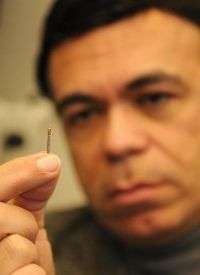
April 8th, 2008 Babak Ziaie Shows the Prototype Wireless Device

Purdue engineer Babak Ziaie shows the prototype wireless device he has developed with doctoral student Chulwoo Son at the university's Birck Nanotechnology Center. The device fits inside a hypodermic needle to be injected into tumors to tell doctors the precise dose of radiation being received through therapy. The technology will eventually be shrunk to the size of a rice grain and also will be able to locate a tumor's exact position in real-time. (Purdue News Service photo/David Umberger)

Engineers at Purdue University are creating a wireless device designed to be injected into tumors to tell doctors the precise dose of radiation received and locate the exact position of tumors during treatment.

The information would help to more effectively kill tumors, said Babak Ziaie, an associate professor in the School of Electrical and Computer Engineering and a researcher at Purdue's Birck Nanotechnology Center.

Ziaie is leading a team that has tested a prototype "wireless implantable passive micro-dosimeter" and said the device could be in clinical trials in 2010.

"Because organs and tumors shift inside the body during treatment, a new technology is needed to tell doctors the exact dosage of radiation received by a tumor," Ziaie said.

The prototype is enclosed in a glass capillary small enough to inject into a tumor with a syringe, said Ziaie, who has a dual appointment in Purdue's Weldon School of Biomedical Engineering.

Research findings are detailed in a paper appearing in the June issue of IEEE Transactions On Biomedical Engineering. The paper was written by doctoral student Chulwoo Son and Ziaie.

Whereas conventional imaging systems can provide a three-dimensional fix on a tumor's shifting position during therapy, these methods are difficult to use during radiation therapy, are costly and sometimes require X-rays, which can damage tissue when used repeatedly, Ziaie said.

The new device uses radio frequency identification, or RFID, technology, which does not emit damaging X-rays.

The device, which has no batteries and will be activated with electrical coils placed next to the patient, contains a miniature version of dosimeters worn by workers in occupations involving radioactivity. The tiny dosimeter could provide up-to-date information about the cumulative dose a tumor is receiving over time.

"It's a radiation dosimeter and a tracking device in the same capsule and will be hermetically sealed so that it will not have to be removed from the body," Ziaie said.

The same researchers in 2006 reported findings on the first such miniature device. However, the earlier prototype lacked adequate sensitivity, was too large and not suitable for easy implantation, Ziaie said.

New findings detail the development of a miniaturized and more sensitive dosimeter that can be implanted using a hypodermic needle. Researchers tested the prototype with radioactive cobalt.

The researchers have been funded by the National Science Foundation and recently received a two-year grant from the National Institutes of Health to continue the work. Over that time, the research team will work to simplify the fabrication process so that the devices could be manufactured inexpensively.

A key advantage of the technology is that it does not require intricate circuitry, which could make the device easier and less expensive to manufacture than more complex designs. The system consists of simple electronic devices called capacitors and coils.

The device has a diameter of about 2.5 millimeters, or thousandths of a meter, and is about 2 centimeters long, making it small enough to fit inside a large-diameter needle for injection with a syringe. The current size is small enough to be used in tumors, but researchers will work to shrink the device to about half a millimeter in diameter and half its current length, roughly the size of a rice grain, said Ziaie, who is working with Byunghoo Jung, a Purdue assistant professor of electrical and computer engineering.

Source: Purdue University


print this article email this article download pdf blog this article bookmark this article     Digg this Stumble it share on Facebook share on Reddit add to delicious save to Yahoo! bookmarks
4.3/5 after 6 votes


April 8th, 2008 all stories
Technology / Engineering

Comments: 0
Rank: 4.3/5 after 6 votes

  • Stumble this up

  • Digg this

  • Share it:
  • share on Facebook
  • share on MySpace
  • share on Slashdot
  • rss-newsfeed
  • share on Google
  • share on Reddit
  • add to delicious
  • save to Yahoo! bookmarks
  • share on Windows Live
  • Add to Mixx!
Rating: 4.3/5 after 6 votes

  • Related Stories

  • Wireless cancer treatment device developed
    created Apr 18, 2006 | popularity not rated yet | comments 0
  • First acoustic metamaterial 'superlens' created
    created Jun 24, 2009 | popularity not rated yet | comments 0
  • Implant monitors tumors
    created May 13, 2009 | popularity not rated yet | comments 0
  • Worldwide success in treatment of liver tumors
    created May 12, 2009 | popularity not rated yet | comments 0
  • Compact cancer-therapy particle-delivery system patented
    created May 12, 2009 | popularity not rated yet | comments 0

Tags


  • Physicists Demonstrate Quantum Memory with Matter Qubits
    Physicists Demonstrate Quantum Memory with Matter Qubits
    Physics / General Physics
    created Jul 03, 2009 | popularity 4.4 / 5 (16) | comments 1
  • 'Holey' Nanosheets for Wastewater Dye Removal
    Nanotechnology / Nanomaterials
    created Jul 01, 2009 | popularity 5 / 5 (5) | comments 1
  • Jellyfish Robot Swims Like its Biological Counterpart
    Jellyfish Robot Swims Like its Biological Counterpart
    Electronics / Robotics
    created Jun 26, 2009 | popularity 4.4 / 5 (7) | comments 1
  • Could Maxwell's Demon Exist in Nanoscale Systems?
    Could Maxwell's Demon Exist in Nanoscale Systems?
    Physics / General Physics
    created Jun 24, 2009 | popularity 4.4 / 5 (18) | comments 29
  • Living Safely with Robots, Beyond Asimov's Laws
    Living Safely with Robots, Beyond Asimov's Laws
    Electronics / Robotics
    created Jun 22, 2009 | popularity 4.6 / 5 (52) | comments 40
  • Other News

    Japan demands 119 million dlrs in tax from Amazon: report

    Technology / Business

    created 1hour ago | popularity not rated yet | comments 0

    Japanese authorities told a sales affiliate of US retail giant Amazon.com to pay about 119 million dollars in tax for unreported income over a three-year period, a newspaper said Sunday.


    Iconic skyscrapers find new luster by going green (AP)

    Iconic skyscrapers find new luster by going green

    Technology / Energy

    created 3 hours ago | popularity not rated yet | comments 0

    (AP) -- When owners of the Empire State Building decided to blanket its towering facade this year with thousands of insulating windows, they were only partly interested in saving energy. They also needed ...


    Downturn dating: Hearts flutter as markets stutter (AP)

    Downturn dating: Hearts flutter as markets stutter

    Technology / Internet

    created 3 hours ago | popularity not rated yet | comments 0

    (AP) -- Credit the recession for "staycations" and bringing us more game-night parties at home. But also give it a shout for spurring more first dates.


    UK spy chief's family details posted on Facebook

    Technology / Internet

    created 3 hours ago | popularity not rated yet | comments 0

    (AP) -- He's the spy who came in from the beach.


    Omg! Positive tone boosts Yahoo celeb site to top

    Technology / Internet

    created 22 hours ago | popularity 2.5 / 5 (2) | comments 0

    (AP) -- Think of the most popular brands in celebrity news, and you'll probably come up with a small list that includes Entertainment Tonight, US Weekly and People.