Unraveling the Mercury mystery: Boldly going where no one has gone before
April 9, 2008 MESSENGER at Mercury

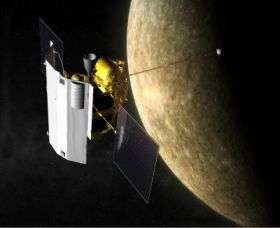
Artist's concept of the NASA's MESSENGER spaceraft at Mercury. Credit: NASA

Twelve years ago Sean Solomon put a proposal in front of NASA to develop the first probe to orbit Mercury. His tenacity has finally paid off. Three months ago his spacecraft, named Messenger (Mercury surface, space environment, geochemistry and ranging), made its first flyby of Mercury, recording never-before-seen images of the mysterious planet.

Mercury could be called the planet of extremes. It is the smallest, the densest, has the oldest surface, and the largest daily variations in surface temperature, which fluctuate by as much as 600 degrees Celsius. It is also the least explored.

Until now.

"The mission will make three flybys," explained Solomon, mission principle investigator and director of the Department of Terrestrial Magnetism at the Carnegie Institution of Washington in Washington, D.C. "The probe will eventually be inserted into an orbit around Mercury in March 2011."

Scientists hope data collected will answer questions about the terrestrial planet, which was only briefly explored in the mid-1970s by the Mariner 10 probe. That mission revealed that Mercury- unlike Venus, Mars and the moon-has a weak magnetic field.

"Although Mercury's magnetic field is thought to be a miniature version of Earth's, Mariner 10 didn't measure it well enough to characterize it," said Solomon. "These basic uncertainties in the nature of its magnetic field have led to uncertainties in understanding the source of the magnetic field. Messenger's magnetometer will characterize Mercury's magnetic field in detail from orbit over four Mercury years (each Mercury year equals 88 Earth days) to determine its exact strength and how its strength varies with position and altitude."

On his first Canadian visit since the Messenger mission flyby, Solomon revealed images of an intriguing feature that has left scientists scratching their heads.

There appears to be more than 100 "narrow, flat-floored troughs radiating from a complex central region," in the middle of the Caloris basin, a large impact crater measuring approximately 1,550 km in diameter. The full extent of the basin was only revealed by the first Messenger flyby.

In addition, Solomon and his team are hoping data collected will provide answers to why the tiny planet is so dense (its iron core takes up nearly 60 per cent of its total mass), as well as the nature of the planet's thin atmosphere and the composition of the permanently shadowed and very cold polar craters.

Solomon's visit to campus was hosted by the physics department and the University of Alberta Institute for Space Science, Exploration and Technology. Moritz Heimpel, geophysics associate professor, studies the geophysics of Mercury and has applied his numerical dynamo models to help explain Mercury's weak magnetic field.

While Heimpel has collaborated on a few research papers with Solomon, perhaps his strongest connection to him and the Messenger mission is through his former graduate student, Natalia Gomez Perez, who was hired by Solomon as a Messenger postdoctoral fellow.

With two flybys to come and an intensive orbital mission to follow, it is safe to say Messenger will boldly be going where no one has gone before.

Source: University of Alberta


print this article email this article download pdf blog this article bookmark this article     Stumble it Digg this share on Facebook retweet share on Reddit add to delicious
Rate this story - 4.4 /5 (19 votes)


April 9, 2008 all stories

Comments: 0

4.4 /5 (19 votes)
  • Stumble this up

  • Digg this

  • share this

  • hide
  • Related Stories

  • Space scientists set for final spacecraft flyby of Mercury
    created Sep 28, 2009 | popularity not rated yet | comments 0
  • Magnesium detected in MESSENGER flyby of Mercury (w/Video)
    created Apr 30, 2009 | popularity not rated yet | comments 0
  • MESSENGER Spacecraft Reveals More Hidden Territory on Mercury
    created Oct 29, 2008 | popularity not rated yet | comments 0
  • NASA's Messenger Spacecraft Returns To Mercury
    created Oct 01, 2008 | popularity not rated yet | comments 0
  • NASA Spacecraft Streams Back Surprises From Mercury
    created Jan 31, 2008 | popularity not rated yet | comments 0


  • hide
  • Relevant PhysicsForums posts

  • The shape of our solar system's orbits.
    created Nov 07, 2009
  • Above or Below the Line of Nodes
    created Nov 07, 2009
  • Supernova vs. Nova?
    created Nov 07, 2009
  • Supernova's Gamma Rays and Comets
    created Nov 06, 2009
  • More from Physics Forums - General Astronomy

Other News

Deep creep means milder, more frequent earthquakes along Southern California's San Jacinto fault

Deep creep means milder, more frequent earthquakes along Southern California's San Jacinto fault

Space & Earth / Earth Sciences

created 19 hours ago | popularity 4.5 / 5 (4) | comments 0

With an average of four mini-earthquakes per day, Southern California's San Jacinto fault constantly adjusts to make it a less likely candidate for a major earthquake than its quiet neighbor to the east, the ...


Success in 'space elevator' competition (AP)

Success in 'space elevator' competition (Update 3)

Space & Earth / Space Exploration

created Nov 05, 2009 | popularity 4.3 / 5 (33) | comments 50

(AP) -- A robot powered by a ground-based laser beam climbed a long cable dangling from a helicopter on Wednesday to qualify for prize money in a $2 million competition to test the potential reality of the ...


In a Galaxy Far, Far Away...

In a Galaxy Far, Far Away...

Space & Earth / Astronomy

created Nov 06, 2009 | popularity 4.8 / 5 (5) | comments 17

(PhysOrg.com) -- Astronomers have published the discovery of the farthest known object in the cosmos: a star that exploded when the universe was only 630 million years old -- only 4.6% of its current age. ...


'Dropouts' pinpoint earliest galaxies

'Dropouts' pinpoint earliest galaxies

Space & Earth / Astronomy

created Nov 06, 2009 | popularity 4.2 / 5 (10) | comments 13

Astronomers, conducting the broadest survey to date of galaxies from about 800 million years after the Big Bang, have found 22 early galaxies and confirmed the age of one by its characteristic hydrogen signature ...


Space hotel taking bookings for 2012 opening

Space hotel taking bookings for 2012 opening

Space & Earth / Space Exploration

created Nov 05, 2009 | popularity 4.4 / 5 (21) | comments 11

(PhysOrg.com) -- The first orbiting space hotel is on track to open for its first customers in 2012, but hurry, as bookings are filling fast.