The largest synthesized telescope in Europe doubles its surface
April 9th, 2008 The largest synthesized telescope in Europe doubles its surface

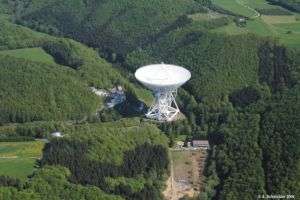
Effelsberg Radio Observatory: Aerial view with the 100m telescope and the prepared LOFAR field in the foreground, seen from the south. The fast data connection starts towards northeast (across the state border to Rhineland Palatinate) and covers a total of 35 km to reach Bonn. Image: Andreas Schmickler, Bad Neuenahr.

The 100m Radio Telescope Effelsberg enters operations of the e-EVN network, enhancing its sensitivity to detect the radio sky providing the sharpest images in nearby real time. The European radio interferometric network e-EVN almost doubles its sensitivity with the addition of the largest radio telescope in Europe.

With the "First Light" on April 1, 2008, Effelsberg has joined another six radio telescopes spread over Europe with the completion of a 35 km optical fibre link to the information highway, built by the Max Planck Institute for Radio Astronomy. Thus e-EVN becomes not only the fastest radio interferometric network in the world, but also reaches a very high sensitivity to detect extremely faint radio objects in the sky. The operational data link has been funded by the Max Planck Society, in coordination with the programme EXPReS of the European Commission.

This challenging observation mode consists in the joint observations of radio telescopes spread over Europe (Effelsberg in Germany, Cambridge and Jodrell Bank in the UK, Medicina in Italy, Onsala in Sweden, Torun in Poland, and Westerbork in The Netherlands) to synthesize a telescope as large as Western Europe through the connected interferometric technique.

The data are transferred in real time from the different radio telescopes to a super-computer (correlator) in Dwingeloo, the Netherlands, which emulates the Europe-size telescope. The sustained data rate reaches 1 Gigabit per second, which is a factor 500 over the regular private DSL connections. One observing run at this data rate collects 1.5 terabytes of data to produce the sharpest images in astronomy, with resolutions 100 times better than the ESA/NASA Hubble Space Telescope.

Professor Anton Zensus, Director at the Max Planck Institute for Radio Astronomy in Bonn and Chairman of the JIVE Board congratulates the German team that implemented the dedicated high-speed data link for this purpose: "With the support of the Max Planck Society and the EU-funded EXPReS program, we are now, through the participation of the Effelsberg telescope, able to vastly expand the sensitivity of the nascent eVLBI service to a level that makes real astronomical studies with high resolution of short-term variable objects possible."

The optical fibre connecting the Max Planck Institute for Radio Astronomy with the 100m Radio Telescope has 80 single lines. With state of the art techniques and machinery the cable was ploughed or drilled or dug into the ground alongside paths, roads, city streets, crossing fields and even motorways. Many different players in the project, from the different divisions at the MPIfR to the authorities of several city councils, the states of Northrhine Westfalia and Rhineland Palatinade, up to the Federal State and the German Research Network (DFN).

Walter Alef, head of the VLBI Technology Division at the MPIfR, remarks: "The establishment of a high-speed data link between Effelsberg through Bonn, Frankfurt, Amsterdam and from there to Dwingeloo, together with other European telescopes has implied the collaboration of many persons, who have given their best at this complex, cutting-edge technical achievement."

e-VLBI is a technique by which remotely located radio telescopes observe the same region of sky simultaneously, and data from each telescope are sampled and sent to a central processor via high-speed communication networks operating in real-time. This central data processor, a purpose-built supercomputer, decodes, aligns and correlates the data for every possible telescope combination and can generate images of cosmic radio sources with up to a hundred times better resolution than images from the best optical telescopes. EXPReS is developing e-VLBI to replace traditional VLBI's reliance on storing data on high-capacity disk arrays which are shipped to the correlator.

Electronic, real-time VLBI eliminates the shipping of disks and provides astronomers with correlated data in a timely fashion, allowing them to exploit transient astronomical events called Targets of Opportunity.

Source: Max-Planck-Institut für Radioastronomie


print this article email this article download pdf blog this article bookmark this article     Digg this Stumble it share on Facebook share on Reddit add to delicious save to Yahoo! bookmarks
4.5/5 after 12 votes


April 9th, 2008 all stories
Space & Earth / Astronomy

Comments: 0
Rank: 4.5/5 after 12 votes

  • Stumble this up

  • Digg this

  • Share it:
  • share on Facebook
  • share on MySpace
  • share on Slashdot
  • rss-newsfeed
  • share on Google
  • share on Reddit
  • add to delicious
  • save to Yahoo! bookmarks
  • share on Windows Live
  • Add to Mixx!
Rating: 4.5/5 after 12 votes

  • Related Stories

  • VLBA locates superenergetic bursts near giant black hole
    created Jul 02, 2009 | popularity not rated yet | comments 0
  • Fermi Telescope reveals a population of radio-quiet gamma-ray pulsars
    created Jul 02, 2009 | popularity not rated yet | comments 0
  • One-stop shop for grid computing (w/ Video)
    created Jun 26, 2009 | popularity not rated yet | comments 0
  • Radio telescopes extend astronomy's best 'yardstick'
    created Jun 08, 2009 | popularity not rated yet | comments 0
  • Keck Study Sheds New Light on "Dark" Gamma-ray Bursts
    created Jun 08, 2009 | popularity not rated yet | comments 0

Tags


  • Physicists Demonstrate Quantum Memory with Matter Qubits
    Physicists Demonstrate Quantum Memory with Matter Qubits
    Physics / General Physics
    created Jul 03, 2009 | popularity 4.4 / 5 (17) | comments 1
  • 'Holey' Nanosheets for Wastewater Dye Removal
    Nanotechnology / Nanomaterials
    created Jul 01, 2009 | popularity 5 / 5 (5) | comments 1
  • Jellyfish Robot Swims Like its Biological Counterpart
    Jellyfish Robot Swims Like its Biological Counterpart
    Electronics / Robotics
    created Jun 26, 2009 | popularity 4.4 / 5 (8) | comments 1
  • Could Maxwell's Demon Exist in Nanoscale Systems?
    Could Maxwell's Demon Exist in Nanoscale Systems?
    Physics / General Physics
    created Jun 24, 2009 | popularity 4.4 / 5 (18) | comments 29
  • Living Safely with Robots, Beyond Asimov's Laws
    Living Safely with Robots, Beyond Asimov's Laws
    Electronics / Robotics
    created Jun 22, 2009 | popularity 4.6 / 5 (52) | comments 40
  • Other News

    Forty years ago man first walked on the moon

    Space & Earth / Space Exploration

    created 9 hours ago | popularity 5 / 5 (2) | comments 0

    Forty years ago on July 20, 1969, American astronaut Neil Armstrong realized the oldest dream of human civilizations when he became the first man to walk on the moon.


    The least sea ice in 800 years

    The least sea ice in 800 years

    Space & Earth / Earth Sciences

    created Jul 01, 2009 | popularity 4.3 / 5 (59) | comments 52

    New research, which reconstructs the extent of ice in the sea between Greenland and Svalbard from the 13th century to the present indicates that there has never been so little sea ice as there is now. The ...


    Gas around young galaxy

    Intense heat killed the Universe's would-be galaxies, researchers say

    Space & Earth / Astronomy

    created Jul 01, 2009 | popularity 3.2 / 5 (19) | comments 25

    (PhysOrg.com) -- Our Milky Way galaxy only survived because it was already immersed in a large clump of dark matter which trapped gases inside it, scientists led by Durham University's Institute for Computational ...


    Scientists' Drill Hits Magma: Only Third Time on Record

    Scientists' Drill Hits Magma: Only Third Time on Record

    Space & Earth / Earth Sciences

    created Jun 29, 2009 | popularity 4.7 / 5 (20) | comments 19

    (PhysOrg.com) -- Scientists drilling a borehole deep into Iceland’s rocky crust to explore new methods of using geothermal energy hit a major roadblock on Thursday: Their drill ran into molten rock at a depth ...


    NASA manager pitches a cheaper return-to-moon plan

    Space & Earth / Space Exploration

    created Jun 30, 2009 | popularity 4 / 5 (7) | comments 18

    (AP) -- Like a car salesman pushing a luxury vehicle that the customer no longer can afford, NASA has pulled out of its back pocket a deal for a cheaper ride to the moon.