Rocket Mystery Explained With New Imaging Technique
April 9th, 2008 Rocket Mystery Explained With New Imaging Technique

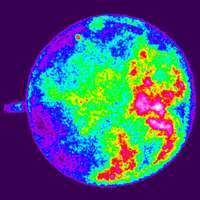
An image of destructive acoustic waves building inside a small, simulated rocket combustor.

There’s a strange wave phenomenon that’s plagued rocket scientists for years, a lurking threat with the power to destroy an engine at almost any time. For decades, scientists have had a limited understanding of how or why it happens because they could not replicate or investigate the problem under controlled laboratory conditions.

Scientists generally believe that these powerful and unstable sound waves, created by energy supplied by the combustion process, were the cause of rocket failures in several U.S. and Russian rockets. Scientists have also observed these mysterious oscillations in other propulsion and power-generating systems such as missiles and gas turbines.

Now, researchers at the Georgia Institute of Technology have developed a liquid rocket engine simulator and imaging techniques that can help demystify the cause of these explosive sound waves and bring scientists a little closer to being able to understand and prevent them. The Georgia Tech research team was able to clearly demonstrate that the phenomenon manifests itself in the form of spinning acoustic waves that gain destructive power as they rotate around the rocket’s combustion chamber.

“This is a very troublesome phenomenon in rockets,” said Ben Zinn, the David S. Lewis Jr. Chair and Regents’ Professor in the Guggenheim School of Aerospace Engineering at Georgia Tech. “These spinning acoustic oscillations destroy engines without anyone fully understanding how these waves are formed. Visualizing this phenomenon brings us a step closer to understanding it.”

The research was presented at the 2008 American Institute of Aeronautics and Astronautics (AIAA) Aerospace Sciences Meeting in Reno, Nevada, and funded by the Air Force Office of Scientific Research.

During past investigations into this damaging instability, scientists were able to observe initial stages of the problem but were forced to shut down engines before the waves could fully develop and cause serious damage to the engine. Researchers were also hindered by their inability to clearly observe the complex processes inside the investigated rocket engines.

But with a great deal of help from Dr. Oleksandr Bibik, a visiting physicist and research scientist from Ukraine, the Georgia Tech research team developed an experimental setup and imaging technique that provides detailed information on how these waves form and behave — without blowing up an engine or endangering lives.

First, the researchers developed a low-pressure combustor that serves as a true simulator of larger rocket engines. Bibik then used a very-high-speed camera in combination with series of fiber optic probes that together allowed researchers to clearly observe the formation and behavior of excited spinning sound waves within the engine. Additionally, Bibik’s new imaging method enabled researchers to determine the conditions under which these waves are excited and how they can be controlled.

Bibik’s method uses a high-speed camera to view the reaction zone via a system of filters that allow only specific light radiation generated in the combustion zone to reach the camera’s lens. This strategy eliminates all background light interference and provides clear images of combustion (and sound) waves spinning around the engine’s periphery. Simultaneously, strategically placed fiber optic probes collect information on the reaction process oscillations in various locations in the combustor.

Using these new techniques, the research team discovered that the destructive waves gained energy as they spun around the engine’s periphery at a rate of 5,000 revolutions per second.

The capability to simulate and observe these destructive oscillations in a controlled laboratory environment could help researchers develop techniques to prevent their occurrence in real engines.

“Better understanding this phenomenon could very likely lead to safer tactical and space missions and save billions of dollars for technologies that use combustors,” Zinn said.

Source: Georgia Institute of Technology


print this article email this article download pdf blog this article bookmark this article     Digg this Stumble it share on Facebook share on Reddit add to delicious save to Yahoo! bookmarks
4.3/5 after 46 votes


April 9th, 2008 all stories
Physics / General Physics

Comments: 0
Rank: 4.3/5 after 46 votes

  • Stumble this up

  • Digg this

  • Share it:
  • share on Facebook
  • share on MySpace
  • share on Slashdot
  • rss-newsfeed
  • share on Google
  • share on Reddit
  • add to delicious
  • save to Yahoo! bookmarks
  • share on Windows Live
  • Add to Mixx!
Rating: 4.3/5 after 46 votes

  • Related Stories

  • Researchers set alarm for incoming space storms
    created May 27, 2009 | popularity not rated yet | comments 0
  • Scientists develop new approach to mine disasters
    created Mar 26, 2009 | popularity not rated yet | comments 0
  • Researchers See the 'Dark Side' of the Sun
    created Jan 26, 2009 | popularity not rated yet | comments 0
  • Researchers cooking up new gelled rocket fuels
    created Jan 21, 2009 | popularity not rated yet | comments 0
  • Astronomers hit a telescopic jackpot
    created Jan 12, 2009 | popularity not rated yet | comments 0

Tags


  • Physicists Demonstrate Quantum Memory with Matter Qubits
    Physicists Demonstrate Quantum Memory with Matter Qubits
    Physics / General Physics
    created Jul 03, 2009 | popularity 4.4 / 5 (17) | comments 1
  • 'Holey' Nanosheets for Wastewater Dye Removal
    Nanotechnology / Nanomaterials
    created Jul 01, 2009 | popularity 5 / 5 (5) | comments 1
  • Jellyfish Robot Swims Like its Biological Counterpart
    Jellyfish Robot Swims Like its Biological Counterpart
    Electronics / Robotics
    created Jun 26, 2009 | popularity 4.4 / 5 (8) | comments 1
  • Could Maxwell's Demon Exist in Nanoscale Systems?
    Could Maxwell's Demon Exist in Nanoscale Systems?
    Physics / General Physics
    created Jun 24, 2009 | popularity 4.4 / 5 (18) | comments 29
  • Living Safely with Robots, Beyond Asimov's Laws
    Living Safely with Robots, Beyond Asimov's Laws
    Electronics / Robotics
    created Jun 22, 2009 | popularity 4.6 / 5 (53) | comments 40
  • Other News

    Physical reality of string theory demonstrated

    Physics / General Physics

    created 53 minutes ago | popularity 4.8 / 5 (8) | comments 1

    String theory has come under fire in recent years. Promises have been made that have not been lived up to. Leiden (The Netherlands) theoretical physicists have now for the first time used string theory to describe a physical ...


    UQ researchers break the law -- of physics

    Physics / General Physics

    created 6 hours ago | popularity 4.5 / 5 (10) | comments 4

    (PhysOrg.com) -- Two UQ Science researchers have proved two famous physical laws that have been widely used for the past 25 years do not always work.


    Scientists create first electronic quantum processor

    Scientists create first electronic quantum processor

    Physics / General Physics

    created Jun 28, 2009 | popularity 4.8 / 5 (54) | comments 44

    A team led by Yale University researchers has created the first rudimentary solid-state quantum processor, taking another step toward the ultimate dream of building a quantum computer.


    Science journals

    How to Spot an Influential Paper Based on its Citations

    Physics / General Physics

    created Jul 04, 2009 | popularity 3.9 / 5 (10) | comments 6

    (PhysOrg.com) -- At first it may seem that the number of citations received by a published scientific paper is directly related to that paper's quality of content. The higher the quality, the more people read ...


    Fermilab's CDF observes Omega-sub-b baryon

    Fermilab's CDF observes Omega-sub-b baryon

    Physics / General Physics

    created Jun 29, 2009 | popularity 4.7 / 5 (18) | comments 7

    (PhysOrg.com) -- At a recent physics seminar at the Department of Energy’s Fermi National Accelerator Laboratory, Fermilab physicist Pat Lukens of the CDF experiment announced the observation of a new particle, ...