Wireless EEG system self-powered by body heat and light
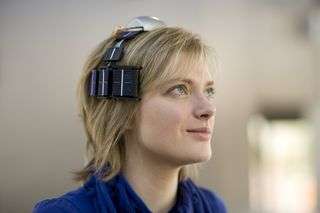
In the framework of Holst Centre, IMEC has developed a battery-free wireless 2-channel EEG (electroencephalography or monitoring of brain waves) system powered by a hybrid power supply using body heat and ambient light. The hybrid power supply combines a thermoelectric generator that uses the heat dissipated from a person’s temples and silicon photovoltaic cells. The entire system is wearable and integrated into a device resembling headphones. The system can provide more than 1mW on average indoor, which is more than enough for the targeted application.
Thermoelectric generators using body heat typically show a drop in generated power when the ambient temperature is in range of the body temperature. Especially outside, the photovoltaic cells in the hybrid system counter this energy drop and ensure a continuous power generation. Moreover, they serve as part of the radiators for the thermoelectric generator, which are required to obtain high efficiency.
Compared to a previous EEG demonstrator developed within Holst Centre, which was solely powered by thermoelectric generators positioned on the forehead, the hybrid system has a reduced size and weight. Combined with full autonomous operation, no maintenance and an acceptable low heat flow from the head, it further increases the patient’s autonomy and quality of life. Potential applications are detection of imbalance between the two halves of the brain, detection of certain kinds of brain trauma and monitoring of brain activity.
The system is a tangible demonstrator of Holst Centre’s Human++ program researching healthcare, lifestyle and sport applications of body area networks. Future research targets further reduction of the power consumption of the different system components of the body area network as well as a significant reduction of the production cost by using micromachining. Interested parties can get more insight in this research or license the underlying technologies through membership of the program.
The thermoelectric generator is composed of six thermoelectric units made up from miniature commercial thermopiles. Each of the two radiators, on left and right sides of the head, has an external area of 4×8cm² that is made of high-efficiency Si photovoltaic cells. Further, thermally conductive comb-type structures (so-called thermal shunts) have been used to eliminate the thermal barrier between the skin and the thermopiles that is caused by the person’s hair on the thermoelectric generator.
The EEG system uses IMEC’s proprietary ultra-low-power biopotential readout application-specific integrated circuit (ASIC) to extract high-quality EEG signals with micro-power consumption. A low-power digital-signal processing block encodes the extracted EEG data, which are sent to a PC via a 2.4GHz wireless radio link. The whole system consumes only 0.8mW, well below the power produced to provide full autonomy.
Source: IMEC


