How fast you'll age is written in the bones, research finds
April 9th, 2008 Bones and Aging

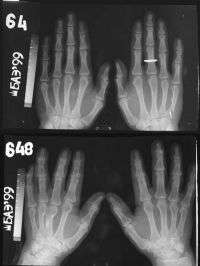
Two x-rays used in Dr. Kalichman's research. The hands of a 22-year-old man at top are compared with the hands of a 74-year-old man at bottom. The two men were not related. Credit: AFTAU

Perhaps the aging process can’t be stopped. But it can be predicted, and new research from Tel Aviv University indicates that people may live longer and lead healthier lives as a result.

Researchers have developed a new biological marker that represents the age of a body’s bones. It reveals that the speed of physical aging is strongly influenced by genetics.

Christened the osseographic score (OSS), this new marker can be used by doctors as a scientific tool for predicting a person’s general functioning and lifespan, says Tel Aviv University scientist Dr. Leonid Kalichman, an instructor at The Stanley Steyer School of Health Professions. He is a co-author of the study published in Biogerontology and the American Journal of Human Biology (2007), which was conducted in partnership with Dr. Ida Malkin and Prof. Eugene Kobyliansky, both from the Sackler Faculty of Medicine at Tel Aviv University.

Add Years to Your Life

If a doctor can determine that a person is aging “biologically faster” than he or she should, measures such as vitamin supplements and exercise can help slow down the process, says Dr. Kalichman.

“While different biomarkers such as grey hair, wrinkles or elasticity of the skin can help us estimate a person’s biological age, these features are hard to quantify,” he says. But with the new OSS biomarker, and treatment at a younger age, “at age 90 people can function as though they are 30,” says Kalichman.

He predicts that biological aging will be an increasingly hot topic of study in the coming years, especially in the western world where people are living longer than ever before.

Male and Female Bones Tell Different Stories

The Tel Aviv University researchers investigated the bones of about 400 Russian families – 787 men 18 to 89 years old and 723 women 18 to 90 years old. The results of the study indicated that men and women inherit different aging patterns. In men, the genes expressed are more likely to influence how quickly they will age. For women, the genes are more likely to represent at what age visible changes in the bone will begin to appear.

The results of this new study will join a battery of other tools used by scientists who research aging and ways to fight it. Presently a research fellow at Boston University, Kalichman says, “At the end of the day, the quest of scientists and doctors is to help people function better than their chronological age — the age written on your passport.”

Source: American Friends of Tel Aviv University


print this article email this article download pdf blog this article bookmark this article     Digg this Stumble it share on Facebook share on Reddit add to delicious save to Yahoo! bookmarks
4.4/5 after 7 votes


April 9th, 2008 all stories
Medicine & Health / Research

Comments: 0
Rank: 4.4/5 after 7 votes

  • Stumble this up

  • Digg this

  • Share it:
  • share on Facebook
  • share on MySpace
  • share on Slashdot
  • rss-newsfeed
  • share on Google
  • share on Reddit
  • add to delicious
  • save to Yahoo! bookmarks
  • share on Windows Live
  • Add to Mixx!
Rating: 4.4/5 after 7 votes

  • Related Stories

  • Link found between history of periodontitis and cerebrovascular disease in men
    created Jun 30, 2009 | popularity not rated yet | comments 0
  • Remembering what to remember and what to forget
    created Jun 25, 2009 | popularity not rated yet | comments 0
  • US seniors 'smarter' than their English peers: study
    created Jun 25, 2009 | popularity not rated yet | comments 0
  • Researchers to reveal aging's origins on global stage
    created Jun 23, 2009 | popularity not rated yet | comments 0
  • Indonesian elephant fossil opens window to past
    created Jun 23, 2009 | popularity not rated yet | comments 0

Tags


  • Physicists Demonstrate Quantum Memory with Matter Qubits
    Physicists Demonstrate Quantum Memory with Matter Qubits
    Physics / General Physics
    created Jul 03, 2009 | popularity 4.4 / 5 (17) | comments 1
  • 'Holey' Nanosheets for Wastewater Dye Removal
    Nanotechnology / Nanomaterials
    created Jul 01, 2009 | popularity 5 / 5 (5) | comments 1
  • Jellyfish Robot Swims Like its Biological Counterpart
    Jellyfish Robot Swims Like its Biological Counterpart
    Electronics / Robotics
    created Jun 26, 2009 | popularity 4.4 / 5 (8) | comments 1
  • Could Maxwell's Demon Exist in Nanoscale Systems?
    Could Maxwell's Demon Exist in Nanoscale Systems?
    Physics / General Physics
    created Jun 24, 2009 | popularity 4.4 / 5 (18) | comments 29
  • Living Safely with Robots, Beyond Asimov's Laws
    Living Safely with Robots, Beyond Asimov's Laws
    Electronics / Robotics
    created Jun 22, 2009 | popularity 4.6 / 5 (52) | comments 40
  • Other News

    Variations in 5 genes raise risk for most common brain tumors

    Medicine & Health / Genetics

    created 15 hours ago | popularity not rated yet | comments 1

    Common genetic variations spread across five genes raise a person's risk of developing the most frequent type of brain tumor, an international research team reports online in Nature Genetics.


    Researchers highlight new direction for drug discovery

    Medicine & Health / Research

    created 13 hours ago | popularity not rated yet | comments 0

    In a discovery that rebuffs conventional scientific thinking, researchers at Georgetown University Medical Center (GUMC) have discovered a novel way to block the activity of the fusion protein responsible for Ewing's sarcoma, ...


    Wind power may have its own environmental problems

    Medicine & Health / Health

    created 14 hours ago | popularity 3.7 / 5 (6) | comments 3

    Wind power generation is expected to be a clean and environmentally friendly natural energy source, but a new kind of environmental problem has surfaced as infrasonic waves caused by windmills are suspected of causing health ...


    MicroRNAs hold promise for treating diseases in blood vessels

    Medicine & Health / Research

    created 15 hours ago | popularity not rated yet | comments 0

    A newly discovered mechanism controls whether muscle cells in blood vessels hasten the development of both atherosclerosis and Alzheimer's disease, according to an article published online today in the journal Nature.


    Malaysian authorities seize 'Viagra coffee' : report

    Medicine & Health / Health

    created 18 hours ago | popularity not rated yet | comments 1

    Malaysia's health authorities have seized over 20,000 dollars worth of coffee mixed with sildenafil, the main ingredient in erectile dysfunction drug Viagra, a report said Sunday.