Discovery could lead to attack on mosquito-borne disease
April 10, 2008
Discovery could lead to attack on mosquito-borne disease

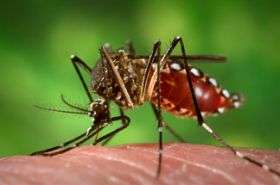
A female Aedes aegypti mosquito obtains a "blood meal." The A. aegypti mosquito is the primary vector for dengue and yellow fevers.

Cornell researchers have identified a mating mechanism that possibly could be adapted to prevent female mosquitoes from spreading the viruses that cause dengue fever, second only to malaria as the most virulent mosquito-borne disease in the tropical world.

Specifically, they have discovered 63 proteins that male mosquitoes transfer to Aedes aegypti females during mating and are thought briefly to change the females' physiology and behavior, in particular suppressing the female's appetite for mammalian blood.

In a study published in the journal Insect Biochemistry and Molecular Biology, the Cornell researchers report that the proteins in the seminal fluid of the males also trigger a loss of sexual appetite in the females, stimulate egg production and influence clotting of the blood she has ingested.

The findings could lead to novel strategies to prevent the spread of dengue as well as mosquito-borne yellow fever viruses. "This is a new angle in our fight against vector-borne disease," said Laura Harrington, Cornell associate professor of entomology and the paper's senior author.

Dengue affects 50 million people annually, and two-thirds of the world's population is at risk. In the past year, it has reached epidemic levels in Asia, South and Central America and Mexico, where the number of dengue cases has increased by more than 300 percent from a year earlier. No dengue vaccine is available, and no treatment exists beyond supportive care.

Laura Sirot, a postdoctoral researcher in molecular biology and genetics, is the paper's lead author, and Mariana Wolfner, Cornell professor of molecular biology and genetics, also is a co-author. The work builds on Wolfner's work on the reproductive biology of fruit flies.

The next step, said Harrington, is to isolate, identify and verify the targets of the mosquito proteins that regulate such key post-mating behaviors as reduced sexual drive or lack of appetite for blood; also, to manipulate such physiological responses as increased egg production. Eventually, the researchers hope that this knowledge will lead to new ways to control mosquitoes that spread disease. This could involve the identification of highly specific chemicals that affect these newly discovered reproductive proteins, or potentially could inform experiments on the use of genetically modified mosquitoes with knocked out (or turned off) genes or modified reproductive behaviors.

Source: Cornell University


Rank 3 /5 (1 vote)
Tags

Relevant PhysicsForums posts

More news stories

Entire genome of extinct human decoded from fossil

(PhysOrg.com) -- In 2010, Svante Pääbo and his colleagues presented a draft version of the genome from a small fragment of a human finger bone discovered in Denisova Cave in southern Siberia. The ...

Biology / Biotechnology

created Feb 07, 2012 | popularity 4.7 / 5 (58) | comments 44 | with audio podcast

Why are there so few fish in the Earth's oceans?

(PhysOrg.com) -- A Stony Brook University researcher has found that, contrary to popular belief, there are not plenty of fish in the sea.

Biology / Plants & Animals

created Feb 08, 2012 | popularity 4.3 / 5 (17) | comments 26 | with audio podcast

Miami battling invasion of giant African snails

No one knows how they got there. But an invasion of African giant snails has southern Florida in a panic over potential crop damage, disease and general yuckiness surrounding the slimy gastropods.

Biology / Ecology

created Feb 10, 2012 | popularity 4.5 / 5 (2) | comments 5

Deciding to go left or right: Researchers use device to determine that lower animals can navigate too

For decades, scientists have associated binary decision making — opting to go left or right — with higher-ranking animals, including humans. A team of Harvard researchers, however, is rewriting that ...

Biology / Plants & Animals

created Feb 09, 2012 | popularity 4 / 5 (1) | comments 4 | with audio podcast

The power of estrogen -- male snakes attract other males

A new study has shown that boosting the estrogen levels of male garter snakes causes them to secrete the same pheromones that females use to attract suitors, and turned the males into just about the sexiest ...

Biology / Plants & Animals

created Feb 10, 2012 | popularity 4.8 / 5 (6) | comments 2 | with audio podcast


Walney offshore wind farm is world's biggest (for now)

(PhysOrg.com) -- The Walney wind farm on the Irish Sea--characterized by high tides, waves and windy weather--officially opened this week. The farm is treated in the press as a very big deal as the Walney ...

GPS court ruling leaves US phone tracking unclear

A US Supreme Court decision requiring a warrant to place a GPS device on the car of a criminal suspect leaves unresolved the bigger issue of police tracking using mobile phones, legal experts say.

Europeans protest controversial Internet pact

Tens of thousands of people marched in protests in more than a dozen European cities Saturday against a controversial anti-online piracy pact that critics say could curtail Internet freedom.

Europe stakes billion-dollar bet on new rocket

A pencil-slim rocket is scheduled to lift into space from South America on Monday, carrying a billion-dollar bet that Europe can grab a juicy slice of the market to place satellites in low orbit.

Study finds that anti-diabetic medication can prevent the long-term effects of maternal obesity

In a study to be presented today at the Society for Maternal-Fetal Medicine's annual meeting, The Pregnancy Meeting, in Dallas, Texas, researchers will report findings that show that short therapy with the anti-diabetic medication ...

Netflix settlement trims 14 pct off 4Q earnings

(AP) -- Netflix pressed the rewind button on its fourth-quarter earnings after settling allegations that the video subscription service violated a consumer-privacy law.