The coldest brown dwarf ever observed
April 10, 2008
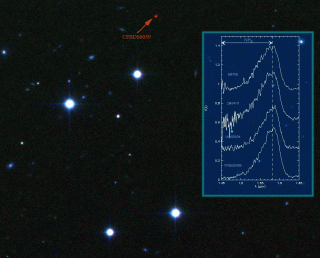
Picture of the brown dwarf CFBDS0059 (small red dot on the top of the picture) and its near-infrared spectrum (lowest curve) illustrating the presence of ammonia. Credit: A&A
An international team led by French and Canadian astronomers has just discovered the coldest brown dwarf ever observed. Their results will soon be published in Astronomy & Astrophysics. This new finding was made possible by the performance of telescopes worldwide: Canada France Hawaii Telescope (CFHT) and Gemini North Telescope, both located in Hawaii, and the ESO/NTT located in Chile.
The brown dwarf is named CFBDS J005910.83-011401.3 (it will be called CFBDS0059 in the following). Its temperature is about 350°C and its mass about 15-30 times the mass of Jupiter, the largest planet of our solar system. Located about 40 light years from our solar system, it is an isolated object, meaning that it doesn't orbit another star.
Brown dwarfs are intermediate bodies between stars and giant planets (like Jupiter). The mass of brown dwarfs is usually less than 70 Jupiter masses. Because of their low mass, their central temperature is not high enough to maintain thermonuclear fusion reactions over a long time. In contrast to a star like our Sun, which spends most of its lifetime burning hydrogen, hence keeping a constant internal temperature, a brown dwarf spends its lifetime getting colder and colder after its formation.
The first brown dwarfs were detected in 1995. Since then, this type of stellar object has been found to share common properties with giant planets, even though differences remain. For example, clouds of dust and aerosols, as well as large amounts of methane, were detected in their atmosphere (for the coldest ones), just as in the atmosphere of Jupiter and Saturn. However, there were still two major differences.
In the brown dwarf atmospheres, water is always in gaseous state, while it condenses into water ice in giant planets; and ammonia has never been detected in the brown dwarf near-infrared spectra, while it is a major component of Jupiter's atmosphere. CFBDS0059, the newly-discovered brown dwarf, looks much more like a giant planet than the known classes of brown dwarfs, both because of its low temperature and because of the presence of ammonia.
To date, two classes of brown dwarfs have been known: the L dwarfs (temperature of 1200-2000°C), which have clouds of dust and aerosols in their high atmosphere; and the T dwarfs (temperature lower than 1200°C), which have a very different spectrum because of methane forming in their atmospheres. Because it contains ammonia and has a much lower temperature than do L and T dwarfs, CFBDS0059 might be the prototype of a new class of brown dwarfs to be called the Y dwarfs. This new class would then become the missing link in the sequence from the hottest stars to giant planets of less than -100°C, by filling the gap now left in the midrange.
This discovery also has important implications in the study of extrasolar planets. The atmosphere of brown dwarfs looks very much like that of giant planets, therefore the same models are used to reproduce their physical conditions.
Such modeling needs to be tested against observations. Observing the atmospheres of extrasolar planets is indeed very hard because the light from the planets is embedded in the much stronger light from their parent stars. Because brown dwarfs are isolated bodies, they are much easier to observe. Thus, looking to brown dwarfs with a temperature close to that of the giant planets will help in testing the models of extrasolar planets' atmospheres.
Source: Astronomy & Astrophysics
-
Tidal forces could squeeze out planetary water
8 hours ago |
5 / 5 (1) |
1
-
Radio stars: Caltech's astronomy professor searches for cosmic radio waves
Feb 03, 2012 |
not rated yet |
0
-
Biography of a star
Nov 03, 2011 |
5 / 5 (4) |
4
-
Record-breaking photo reveals a planet-sized object as cool as the Earth
Oct 19, 2011 |
4.7 / 5 (12) |
9
-
Astronomers find bounty of failed stars
Oct 11, 2011 |
5 / 5 (3) |
5
-
Engineers build first sub-10-nm carbon nanotube transistor
Feb 01, 2012 |
4.9 / 5 (33) |
30
-
Something old, something new: Evolution and the structural divergence of duplicate genes
Jan 31, 2012 |
4.6 / 5 (7) |
1
-
The hidden nanoworld of ice crystals: Revealing the dynamic behavior of quasi-liquid layers
Jan 30, 2012 |
5 / 5 (4) |
1
-
Stock market network reveals investor clustering
Jan 27, 2012 |
3.9 / 5 (23) |
8
-
Of microchemistry and molecules: Electronic microfluidic device synthesizes biocompatible probes
Jan 26, 2012 |
5 / 5 (2) |
0
-
Never ending outer space.....
18 hours ago
-
Neutron Star fragments?
20 hours ago
-
stationary or not?
Feb 11, 2012
-
Scale of the Universe
Feb 10, 2012
-
Titan's lack of impact craters
Feb 09, 2012
-
Real pictures of black hole eating a star?
Feb 08, 2012
- More from Physics Forums - General Astronomy
More news stories
Latin America mining boom clashes with conservation
Latin America is experiencing a mining boom as prices rise fuelled by a hike in global demand, but the region is also being hit by a wave of violent protests, strikes and rallies by environmentalists.
11 hours ago |
5 / 5 (1) |
1
Salvage workers begin pumping fuel from Italian shipwreck
Salvage workers Sunday began pumping fuel from the shipwrecked Italian cruise liner Costa Concordia, a day ahead of schedule, officials said.
3 hours ago |
not rated yet |
0
Political leaders play key role in how worried Americans are by climate change: study
More than extreme weather events and the work of scientists, it is national political leaders who influence how much Americans worry about the threat of climate change, new research finds.
Feb 06, 2012 |
5 / 5 (6) |
73
NASA budget will axe Mars deal with Europe: scientists
US President Barack Obama's budget proposal to be submitted next week for 2013 will cut NASA's budget by 20 percent and eliminate a major partnership with Europe on Mars exploration, scientists said Thursday.
Space & Earth / Space Exploration
Feb 10, 2012 |
5 / 5 (3) |
58
Humans may have helped the decline of African rainforests 3000 years ago
(PhysOrg.com) -- Large areas of rainforests in Central Africa mysteriously disappeared over three thousand years ago, to be replaced by savannas. The prevailing theory has been that the cause was a change ...
Google might launch Drive for cloud storage soon
(PhysOrg.com) -- Google's next big move, according to the Wall Street Journal, is a cloud storage service called Drive. Hardly first to the plate, Google is simply catching up to introducing its cloud reposi ...
Scientists discover molecular secrets of 2,000-year-old Chinese herbal remedy
For roughly two thousand years, Chinese herbalists have treated Malaria using a root extract, commonly known as Chang Shan, from a type of hydrangea that grows in Tibet and Nepal. More recent studies suggest that halofuginone, ...
New method to examine batteries -- MRI from the inside
There is an ever-increasing need for advanced batteries for portable electronics, such as phones, cameras, and music players, but also to power electric vehicles and to facilitate the distribution and storage of energy derived ...
Lab study raises questions over nano-particle impact
Tests involving chickens have raised questions about the impact on health from engineered nano-particles, the ultra-fine grains commonly used in drugs and processed foods, scientists said on Sunday.
Injured boomers beware: Know when to see doctor
(AP) -- It happened to nurse Jane Byron years after an in-line skating fall, business owner Haralee Weintraub while doing "men's" push-ups, and avid cyclist Gene Wilberg while lifting a heavy box.
A mitosis mystery solved: How chromosomes align perfectly in a dividing cell
Although the process of mitotic cell division has been studied intensely for more than 50 years, Whitehead Institute researchers have only now solved the mystery of how cells correctly align their chromosomes during symmetric ...