Popcorn-ball design doubles efficiency of dye-sensitized solar cells
April 10, 2008
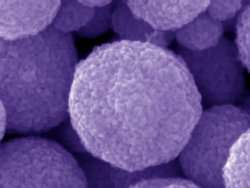
A close-up of a single ball, taken with a scanning electron microscope. The 300-nanometer sphere is large enough to scatter light. But its insides are made of tiny grains just 15 nanometers across. Credit: University of Washington
A new approach creates a dramatic improvement in cheap solar cells now being developed in laboratories.
By using a popcorn-ball design – tiny kernels clumped into much larger porous spheres – researchers at the University of Washington are able to manipulate light and more than double the efficiency of converting solar energy to electricity. The findings will be presented today in New Orleans at the national meeting of the American Chemical Society.
"We think this can lead to a significant breakthrough in dye-sensitized solar cells," said lead author Guozhong Cao, a UW professor of materials science and engineering.
Dye-sensitized solar cells, first popularized in a scientific article in 1991, are more flexible, easier to manufacture and cheaper than existing solar technologies. Researchers have tried various rough surfaces and achieved higher and higher efficiencies. Current lab prototypes can convert just over one tenth of the incoming sun's energy into electricity. This is about half as efficient as the commercial, silicon-based cells used in rooftop panels and calculators.
The UW researchers did not attempt to maximize the overall efficiency of a dye-sensitized solar cell to match or beat these previous records. Instead, they focused on developing new approaches and compared the performance of a homogeneous rough surface with a clumping design. One of the main quandaries in making an efficient solar cell is the size of the grains. Smaller grains have bigger surface area per volume, and thus absorb more rays. But bigger clumps, closer to the wavelength of visible light, cause light to ricochet within the thin light-absorbing surface so it has a higher chance of being absorbed.
"You want to have a larger surface area by making the grains smaller," Cao said. "But if you let the light bounce back and forth several times, then you have more chances of capturing the energy."
Other researchers have tried mixing larger grains in with the small particles to scatter the light, but have little success in boosting efficiency. The UW group instead made only very tiny grains, about 15 nanometers across. (Lining up 3,500 grains end to end would equal the width of a human hair.) Then they clumped these into larger agglomerations, about 300 nanometers across. The larger balls scatter incoming rays and force the light to travel a longer distance within the solar cell. The balls' complex internal structure, meanwhile, creates a surface area of about 1,000 square feet for each gram of material. This internal surface is coated with a dye that captures the light.
The researchers expected some improvement in the performance but what they saw exceeded their hopes.
"We did not expect the doubling," Cao said. "It was a happy surprise."
The overall efficiency was 2.4 percent using only small particles, which is the highest efficiency achieved for this material. With the popcorn-ball design, results presented today at the conference show an efficiency of 6.2 percent, more than double the previous performance.
"The most significant finding is the amount of increase using this unique approach," Cao said.
The experiments were performed using zinc oxide, which is less stable chemically than the more commonly used titanium oxide but easier to work with.
"We first wanted to prove the concept in an easier material. Now we are working on transferring this concept to titanium oxide," Cao said. Titanium oxide based dye-sensitized solar cells are now at 11 percent maximum efficiency. Cao hopes his strategy could push dye-sensitized solar cells' efficiency significantly over that threshold.
Source: University of Washington
-
Temperature differences give rise to electricity
Nov 09, 2011 |
4.7 / 5 (3) |
3
-
An electronic bucket brigade could boost solar cell voltages
Sep 15, 2011 |
4.9 / 5 (8) |
7
-
Researchers improve efficiency of low-cost solar cells
Dec 07, 2010 |
4.5 / 5 (19) |
25
-
New INL invention could aid Mars probes' search for life
May 24, 2010 |
4.8 / 5 (5) |
0
-
Graphite oxide at high pressure opens a road to new amazing nano-materials
Dec 21, 2009 |
5 / 5 (4) |
2
-
Engineers build first sub-10-nm carbon nanotube transistor
Feb 01, 2012 |
4.9 / 5 (30) |
30
-
Something old, something new: Evolution and the structural divergence of duplicate genes
Jan 31, 2012 |
4.6 / 5 (7) |
1
-
The hidden nanoworld of ice crystals: Revealing the dynamic behavior of quasi-liquid layers
Jan 30, 2012 |
5 / 5 (3) |
1
-
Stock market network reveals investor clustering
Jan 27, 2012 |
3.9 / 5 (23) |
8
-
Of microchemistry and molecules: Electronic microfluidic device synthesizes biocompatible probes
Jan 26, 2012 |
5 / 5 (1) |
0
-
polymer nanocomposites
10 hours ago
-
Corrosion Tests on Magnesium
23 hours ago
-
polyethylene copper nanocomposite
Feb 09, 2012
-
Output of xrd analysis
Feb 08, 2012
-
Transport phenomena problem based on problems 18.B11 and 19B.6 from Bird, stewart, lw
Feb 06, 2012
-
Help with material selection - Car Piston
Feb 05, 2012
- More from Physics Forums - Materials & Chemical Engineering
More news stories
What lies beneath: Mapping hidden nanostructures
The ability to diagnose and predict the properties of materials is vital, particularly in the expanding field of nanotechnology. Electron and atom-probe microscopy can categorize atoms in thin sheets of material, ...
2 hours ago |
5 / 5 (1) |
1
'Dark plasmons' transmit energy
Microscopic channels of gold nanoparticles have the ability to transmit electromagnetic energy that starts as light and propagates via "dark plasmons," according to researchers at Rice University.
19 hours ago |
5 / 5 (6) |
1
|
Nanotube therapy takes aim at breast cancer stem cells
Wake Forest Baptist Medical Center researchers have again proven that injecting multiwalled carbon nanotubes (MWCNTs) into tumors and heating them with a quick, 30-second laser treatment can kill them.
Nanotechnology / Bio & Medicine
Feb 09, 2012 |
5 / 5 (1) |
0
|
New kind of solar cell could capture significantly more energy than current cells
New solar cells could increase the maximum efficiency of solar panels by over 25%, according to scientists from the University of Cambridge.
Feb 08, 2012 |
4.5 / 5 (11) |
14
|
Nanoshell whispering galleries improve thin solar panels
Visitors to Statuary Hall in the U.S. Capitol Building may have experienced a curious acoustic feature that allows a person to whisper softly at one side of the cavernous, half-domed room and for another on ...
Nanotechnology / Nanomaterials
Feb 07, 2012 |
4.3 / 5 (6) |
6
|
New understanding of DNA repair could eventually lead to cancer therapy
A research group in the Faculty of Medicine & Dentistry at the University of Alberta is hoping its latest discovery could one day be used to develop new therapies that target certain types of cancers.
Zuckerberg's focus drives Facebook's ascent
When Mark Zuckerberg showed up to rent Judy Fusco's Los Altos, Calif., house in the fall of 2004, soon after he'd arrived in Silicon Valley, the landlord was immediately struck by his confidence.
Both maternal and paternal age linked to autism
Older maternal and paternal age are jointly associated with having a child with autism, according to a recently published study led by researchers at The University of Texas Health Science Center at Houston (UTHealth).
Night, weekend delivery OK for babies with birth defects
Weekday delivery is no better than night or weekend delivery for infants with birth defects, according to a new study presented today at The Pregnancy Meeting, the Society for Maternal-Fetal Medicine's annual conference. ...
Sonic Cradle lands spot in TED exhibition
A Simon Fraser University graduate student project that melds music, meditation and modern technology has landed a rare spot as an exhibit at TEDActive 2012 in Palm Springs, California this month.
Drug halts organ damage in inflammatory genetic disorder
A new study shows that Kineret (anakinra), a medication approved for the treatment of rheumatoid arthritis, is effective in stopping the progression of organ damage in people with neonatal-onset multisystem inflammatory disease ...
Apr 10, 2008
Rank: 4.8 / 5 (4)
Apr 10, 2008
Rank: 4.5 / 5 (2)
http://uwnews.org...ID=40714
Apr 11, 2008
Rank: 3.5 / 5 (2)
I STILL aint holdin my breath.