And the first animal on Earth was a...
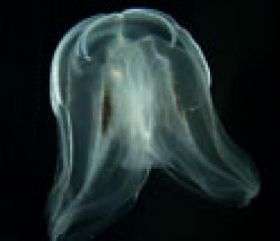
A new study mapping the evolutionary history of animals indicates that Earth's first animal--a mysterious creature whose characteristics can only be inferred from fossils and studies of living animals--was probably significantly more complex than previously believed.
The study, which was funded by the National Science Foundation (NSF), is the cover story of the April 10, 2008 issue of Nature. Using new high-powered technologies for analyzing massive volumes of genetic data, the study defined the earliest splits at the base of the animal tree of life. The tree of life is a hierarchical representation of the evolutionary relationships between species that was introduced by Charles Darwin.
Shaking Up the Tree of Life
Among the study's surprising findings is that the comb jelly split off from other animals and diverged onto its own evolutionary path before the sponge. This finding challenges the traditional view of the base of the tree of life, which honored the lowly sponge as the earliest diverging animal. "This was a complete shocker," says Dunn. "So shocking that we initially thought something had gone very wrong."
But even after Dunn's team checked and rechecked their results and added more data to their study, their results still suggested that the comb jelly, which has tissues and a nervous system, split off from other animals before the tissue-less, nerve-less sponge.
The presence of the relatively complex comb jelly at the base of the tree of life suggests that the first animal was probably more complex than previously believed, says Dunn.
While cautioning that additional studies should be conducted to corroborate his team's findings, Dunn says that the comb jelly could only have achieved its apparent seniority over the simpler sponge via one of two new evolutionary scenarios: 1) the comb jelly evolved its complexity independently of other animals, after it branched off onto its own evolutionary path; or 2) the sponge evolved its simple form from more complex creatures--a possibility that underscores the fact that "evolution is not necessarily just a march towards increased complexity," says Dunn. "This scenario would provide a particularly dramatic example of that principle."
How Old is Old?
How long ago did the earliest comb jelly diverge" "Unfortunately, we don't have fossils of the oldest comb jelly," laments Dunn. "Therefore, there is no way to date the earliest jelly and determine when it diverged."
After diverging from other species, the comb jelly probably continued to evolve, says Herendeen. Therefore, today's comb jelly--a common creature--probably looks very different that did the earliest comb jelly.
Moreover, the tentacled, squishy but bell-less comb jelly developed along a different evolutionary path than did the classically bell-shaped jellyfish, says Patrick Herendeen, an NSF program director. Such divergences mean that "the jellyfish type of body form has independently evolved several times," says Herendeen.
Remaining Gaps in the Tree of Life
While reversing the evolutionary order of the sponge and comb jelly, Dunn's study also resolved some long-standing questions about other species. Among these was whether millipedes and centipedes are more closely related to spiders than to insects. The answer: spiders.
But despite these and other important evolutionary insights provided by Dunn's team, the tree of life remains a work in progress. "Scientists currently estimate that there are a total of about 10 million species of organisms on earth," says Dunn. "But so far, only about 1.8 million species--most of which are animals--have been described by science. Very few of these species have, so far, been positioned in the tree of life."
A Methodological Breakthrough
But at least some of the tree of life's remaining gaps will likely be filled through the use of high-powered analytic approaches pioneered in Dunn's study--which involved using more than 100 computers to analyze more data than incorporated into any previous comparable evolutionary study. "Dunn's high-powered approach is just what we need to continue assembling the tree of life," says Herendeen. "We are going to see a lot of this approach in the future."
Dunn explains one of the advantages of his team's approach: "Even though we looked at fewer than 100 species, they were sampled in such a way that they inform the relationships of major groups of animals relative to each other. Therefore, this study, and others like it, will have implications for the placement of far more species than just those that are sampled."
Remaining Challenges
But no matter how many high-tech analytic tools scientists use to analyze the genetics of organisms, they must still conquer "the exact same challenges that naturalists faced 200 years ago," says Dunn. "We still don't even know enough about many species to have a good idea where to look for them."
"And even as it is getting easier and cheaper to analyze the DNA of organisms with increasingly powerful computers, it is getting more expensive and difficult to find, collect, and identify organisms." For example, Dunn's team had to use remotely operated underwater vehicles to collect one of the comb jellies included in this study.
Dunn concludes: "It may come as a surprise to some that the many that huge advances in technology actually bring us right back to the same challenges that naturalists faced 200 years ago: the day-to-day practical challenges of just figuring out what lives on our planet, where to find it and how to collect it."
Source: National Science Foundation


