Grand Canyon may be as old as dinosaurs, says new study
April 10, 2008
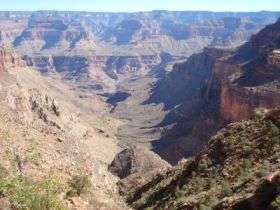
The Grand Canyon may be as old as the dinosaurs, according to a new study by the University of Colorado and the California Institute of Technology Credit: Rebecca Flowers, CU-Boulder
New geological evidence indicates the Grand Canyon may be so old that dinosaurs once lumbered along its rim, according to a study by researchers from the University of Colorado at Boulder and the California Institute of Technology.
The team used a technique known as radiometric dating to show the Grand Canyon may have formed more than 55 million years ago, pushing back its assumed origins by 40 million to 50 million years. The researchers gathered evidence from rocks in the canyon and on surrounding plateaus that were deposited near sea level several hundred million years ago before the region uplifted and eroded to form the canyon.
A paper on the subject will be published in the May issue of the Geological Society of America Bulletin. CU-Boulder geological sciences Assistant Professor Rebecca Flowers, lead author and a former Caltech postdoctoral researcher, collaborated with Caltech geology Professor Brian Wernicke and Caltech geochemistry Professor Kenneth Farley on the study.
"As rocks moved to the surface in the Grand Canyon region, they cooled off," said Flowers. "The cooling history of the rocks allowed us to reconstruct the ancient topography, telling us the Grand Canyon has an older prehistory than many had thought."
The team believes an ancestral Grand Canyon developed in its eastern section about 55 million years ago, later linking with other segments that had evolved separately. "It's a complicated picture because different segments of the canyon appear to have evolved at different times and subsequently were integrated," Flowers said.
The ancient sandstone in the canyon walls contains grains of a phosphate mineral known as apatite -- hosting trace amounts of the radioactive elements uranium and thorium -- which expel helium atoms as they decay, she said. An abundance of the three elements, paired with temperature information from Earth's interior, provided the team a clock of sorts to calculate when the apatite grains were embedded in rock a mile deep -- the approximate depth of the canyon today -- and when they cooled as they neared Earth's surface as a result of erosion.
Apatite samples from the bottom of the Upper Granite Gorge region of the Grand Canyon yield similar dates as samples collected on the nearby plateau, said Caltech's Wernicke. "Because both canyon and plateau samples resided at nearly the same depth beneath the Earth's surface 55 million years ago, a canyon of about the same dimensions of today may have existed at least that far back, and possibly as far back as the time of dinosaurs at the end of the Cretaceous period 65 million years ago."
One of the most surprising results from the study is the evidence showing the adjacent plateaus around the Grand Canyon may have eroded away as swiftly as the Grand Canyon itself, each dropping a mile or more, said Flowers. Small streams on the plateaus appear to have been just as effective at stripping away rock as the ancient Colorado River was at carving the massive canyon.
"If you stand on the rim of the Grand Canyon today, the bottom of the ancestral canyon would have sat over your head, incised into rocks that have since been eroded away," said Flowers. The ancestral Colorado River was likely running in the opposite direction millions of years ago, she said.
When the canyon was formed, it probably looked like a much deeper version of present-day Zion Canyon, which cuts through strata of the Mesozoic era dating from about 250 million to 65 million years ago, Wernicke said. From 28 million to 15 million years ago, a pulse of erosion deepened the already-formed canyon and also scoured surrounding plateaus, stripping off the Mesozoic strata to reveal the Paleozoic rocks visible today, he said.
The prevailing belief is that the canyon was incised by an ancient river about six million years ago as the surrounding plateau began rising from sea level to the current elevation of about 7,000 feet. The new scenario described in the GSA Bulletin by Flowers and her colleagues is consistent with recent evidence by other geologists using radiometric dating techniques indicating the Grand Canyon is significantly older than scientists had long believed.
Source: University of Colorado at Boulder
-
US expected to extend Grand Canyon mining ban
Jan 09, 2012 |
4 / 5 (4) |
3
-
Seven natural wonders of the world set to be unveiled
Nov 11, 2011 |
3.5 / 5 (4) |
8
-
Poisonous oceans delayed animal evolution
Oct 24, 2011 |
not rated yet |
0
-
Irradiation underused to fight E. coli in foods
Jun 06, 2011 |
4.5 / 5 (2) |
3
-
Geologists solve mystery of the Colorado Plateau
Apr 27, 2011 |
4.8 / 5 (10) |
2
-
Engineers build first sub-10-nm carbon nanotube transistor
Feb 01, 2012 |
4.9 / 5 (30) |
30
-
Something old, something new: Evolution and the structural divergence of duplicate genes
Jan 31, 2012 |
4.6 / 5 (7) |
1
-
The hidden nanoworld of ice crystals: Revealing the dynamic behavior of quasi-liquid layers
Jan 30, 2012 |
5 / 5 (3) |
1
-
Stock market network reveals investor clustering
Jan 27, 2012 |
3.9 / 5 (23) |
8
-
Of microchemistry and molecules: Electronic microfluidic device synthesizes biocompatible probes
Jan 26, 2012 |
5 / 5 (1) |
0
-
Discrepancy between oxygen and carbon-dioxide levels
3 hours ago
-
where gems are found in the world
6 hours ago
-
Wind Waves in Reservoir ~ Wind run-up and Wind set-up
Feb 08, 2012
-
Balance of oxygen in the atmosphere
Feb 01, 2012
-
The case for a methanol-based economy
Jan 30, 2012
-
Weather in a rotating cylinder
Jan 25, 2012
- More from Physics Forums - Earth
More news stories
Deconstructing a mystery: What caused Snowmaggedon?
In the quiet after the storms, streets and cars had all but disappeared under piles of snow. The U.S. Postal Service suspended service for the first time in 30 years. Snow plows struggled to push the evidence ...
Space & Earth / Earth Sciences
9 hours ago |
4.7 / 5 (3) |
1
|
New views show old NASA Mars landers
(PhysOrg.com) -- The High Resolution Imaging Science Experiment (HiRISE) camera on NASA's Mars Reconnaissance Orbiter recorded a scene on Jan. 29, 2012, that includes the first color image from orbit showing ...
Space & Earth / Space Exploration
17 hours ago |
4.9 / 5 (7) |
7
|
Researchers create 3-D laser maps that show how earthquake changes landscape
Geologists have a new tool to study how earthquakes change the landscape down to a few inches, and it's giving them insight into how earthquake faults behave. In the Feb. 10 issue of the journal Science, a team ...
Space & Earth / Earth Sciences
11 hours ago |
5 / 5 (4) |
0
|
Ocean microbe communities changing, but long-term environmental impact is unclear
As oceans warm due to climate change, water layers will mix less and affect the microbes and plankton that pump carbon out of the atmosphere but researchers say it's still unclear whether these processes ...
Space & Earth / Earth Sciences
11 hours ago |
5 / 5 (2) |
2
|
Black holes and star formation
(PhysOrg.com) -- It has long been recognized that galaxy mergers or even close interactions can play a vital role in shaping the morphology of galaxies. One way they can do so, it is thought, is by triggering ...
16 hours ago |
4 / 5 (6) |
3
|
'Dark plasmons' transmit energy
Microscopic channels of gold nanoparticles have the ability to transmit electromagnetic energy that starts as light and propagates via "dark plasmons," according to researchers at Rice University.
FDA-approved drug rapidly clears amyloid from the brain, reverses Alzheimer's symptoms in mice
Neuroscientists at Case Western Reserve University School of Medicine have made a dramatic breakthrough in their efforts to find a cure for Alzheimer's disease. The researchers' findings, published in the journal Science, show t ...
Hydrogen from acidic water: Researchers develop potential low cost alternative to platinum for splitting water
A technique for creating a new molecule that structurally and chemically replicates the active part of the widely used industrial catalyst molybdenite has been developed by researchers with the Lawrence Berkeley ...
Ultraviolet protection molecule in plants yields its secrets
Lying around in the sun all day is hazardous not just for humans but also for plants, which have no means of escape. Ultraviolet (UV) radiation from the sun can damage proteins and DNA inside cells, leading ...
Anyone can learn to be more inventive, cognitive researcher says
There will always be a wild and unpredictable quality to creativity and invention, says Anthony McCaffrey, a cognitive psychology researcher at the University of Massachusetts Amherst, because an "Aha moment" is rare and ...
New method makes culture of complex tissue possible in any lab
Scientists at the University of California, San Diego have developed a new method for making scaffolds for culturing tissue in three-dimensional arrangements that mimic those in the body. This advance, published online in ...
Apr 10, 2008
Rank: 3.7 / 5 (3)
Apr 10, 2008
Rank: 1.7 / 5 (3)
I'm not going to give you a good grade for being confused, you actually need to know the stuff! By the way, the radiometric dating method they used wasn't carbon14-carbon12 dating, you know, just in case any of you creationists want to make that lie again. They probably used potassium-argon dating.
Apr 10, 2008
Rank: 4.5 / 5 (2)