Spitzer Sees Shining Stellar Sphere
April 10, 2008 Spitzer Sees Shining Stellar Sphere

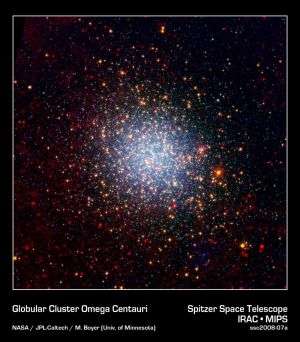
A cluster brimming with millions of stars glistens like an irridescent opal in this image from NASA's Spitzer Space Telescope. Image Credit: NASA/JPL-Caltech/ NOAO/AURA/NSF

Millions of clustered stars glisten like an iridescent opal in a new image from NASA's Spitzer Space Telescope.

Called Omega Centauri, this sparkling orb of stars is like a miniature galaxy. It is the biggest and brightest of the more than 150 similar objects, called globular clusters, that orbit around the outside of our Milky Way galaxy. Stargazers at southern latitudes can spot the stellar gem with the naked eye in the constellation Centaurus.

While the visible-light observations highlight the cluster's millions of jam-packed stars, Spitzer's infrared eyes reveal the dustier, more evolved stars tossed throughout the region.

"Now we can see which stars form dust and can begin to understand how the dust forms and where it goes once it is expelled from a star," said Martha Boyer of the University of Minnesota, Twin Cities. Boyer is lead author of a paper about Omega Centauri appearing in the April issue of the Astronomical Journal. "Surprisingly, Spitzer revealed fewer of these dusty stars than expected."

Globular clusters are some of the oldest objects in our universe. Their stars are more than 12 billion years old, and, in most cases, formed all at once when the universe was just a toddler. Omega Centauri is unusual in that its stars are of different ages and possess varying levels of metals, or elements heavier than boron. Astronomers say this points to a different origin for Omega Centauri than other globular clusters: they think it might be the core of a dwarf galaxy that was ripped apart and absorbed by our Milky Way long ago.

In the new picture of Omega Centauri, the red- and yellow-colored dots represent the stars revealed by Spitzer. These are the more evolved, larger, dustier stars, called red giants. The stars colored blue are less evolved, like our own sun, and were captured by both Spitzer's infrared eyes and in visible light by the National Science Foundation's Blanco 4-meter telescope at Cerro Tololo Inter-American Observatory in Chile. Some of the red spots in the picture are distant galaxies beyond our own.

"As stars age and mature into red giants, they form dust grains, which play a vital role in the evolution of the universe and the formation of rocky planets," said Jacco van Loon, the study's principal investigator at Keele University in England. "Spitzer can see this dust, and it was able to resolve individual red giants even in the densest central parts of the cluster."

NASA's Hubble Space Telescope and Gemini Observatory on Cerro Pachon in Chile recently found evidence that Omega Centauri is home to a medium-sized black hole (http://www.physorg.com/news126355560.html).

Other authors of the paper include Iain McDonald and Nye Evans of Keele University; Robert Gehrz and Charles Woodward of the University of Minnesota; and Andrea Dupree of the Harvard-Smithsonian Center for Astrophysics, Cambridge, Mass.

Source: NASA


print this article email this article download pdf blog this article bookmark this article     Stumble it Digg this share on Facebook retweet share on Reddit add to delicious
Rate this story - 4.2 /5 (17 votes)

Rank Filter

Move the slider to adjust rank threshold, so that you can hide some of the comments.


Display comments: newest first

  • TimESimmons - Apr 11, 2008
    • Rank: 3 / 5 (2)
    How do globular clusters form? Why are they mostly composed of old stars? Guess what...

    http://www.presto...ndex.htm
  • lengould100 - Jun 06, 2008
    • Rank: 1 / 5 (1)
    Tim: Very interesting theory and good presentation. I can see no clear reason to object to your proposal of an anti-gravity particle and it would explain a lot about spiral galaxies which has long puzzled me.

April 10, 2008 all stories

Comments: 2

4.2 /5 (17 votes)
  • Stumble this up

  • Digg this

  • share this

  • hide
  • Related Stories

  • Omega Centauri -- The Glittering Giant of the Southern Skies
    created Dec 02, 2008 | popularity not rated yet | comments 0
  • Black hole found in enigmatic Omega Centauri
    created Apr 02, 2008 | popularity not rated yet | comments 0
  • Hubble finds multiple stellar 'baby booms' in a globular cluster
    created May 02, 2007 | popularity not rated yet | comments 0
  • New Adaptive Optics technique demonstrated
    created Mar 30, 2007 | popularity not rated yet | comments 0
  • Mars Reconnaissance Orbiter Mission Status
    created Sep 15, 2005 | popularity not rated yet | comments 0


  • hide
  • Relevant PhysicsForums posts

  • Question about 2-body gravity
    created 1hour ago
  • life on Mars
    created 4 hours ago
  • Semi-major axis from cartesian co-ordinates
    created 16 hours ago
  • Primary Mirror grinding
    created 19 hours ago
  • More from Physics Forums - General Astronomy

Other News

Researchers Establish Common Seasonal Patterns Among Bacterial Communities in Arctic Rivers

Researchers Establish Common Seasonal Patterns Among Bacterial Communities in Arctic Rivers

Space & Earth / Earth Sciences

created 4 minutes ago | popularity not rated yet | comments 0

(PhysOrg.com) -- New research on bacterial communities throughout six large Arctic river ecosystems reveals predictable temporal patterns, suggesting that scientists could use these communities as markers ...


From Greenhouse to Icehouse

From Greenhouse to Icehouse

Space & Earth / Earth Sciences

created 3 hours ago | popularity 4 / 5 (2) | comments 5

A new study that reconstructed ocean temperatures from millions of years ago could provide new insight into how the Earth responds to climate change.


'Cosmic fruit machine' matches collisions

'Cosmic fruit machine' matches collisions

Space & Earth / Astronomy

created 5 hours ago | popularity 5 / 5 (1) | comments 1

(PhysOrg.com) -- A new website will give everyone the chance to contribute to science by playing a 'cosmic fruit machine' and compare images of colliding galaxies with millions of simulated images of galactic ...


Humanity would need five Earths to create the resources needed if everyone lived as like Americans, a report has stated

Mankind using Earth's resources at alarming rate

Space & Earth / Environment

created 3 hours ago | popularity 2.6 / 5 (5) | comments 6

Humanity would need five Earths to produce the resources needed if everyone lived as profligately as Americans, according to a report issued Tuesday.


Supervolcano eruption -- in Sumatra -- deforested India 73,000 years ago

Supervolcano eruption -- in Sumatra -- deforested India 73,000 years ago

Space & Earth / Earth Sciences

created 20 hours ago | popularity 4.4 / 5 (12) | comments 2

A new study provides "incontrovertible evidence" that the volcanic super-eruption of Toba on the island of Sumatra about 73,000 years ago deforested much of central India, some 3,000 miles from the epicenter, ...