Picture this: Explaining science through drawings
April 10, 2008
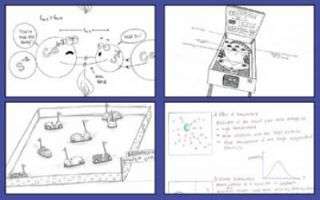
The act of creating pencil drawings helps students clarify the underlying science. Credit: Kara Culligan and Eunji Chung, Harvard University; Lina Garcia, Massachusetts Institute of Technology
If a picture is worth a thousand words, creating one can have as much value to the illustrator as to the intended audience. This is the case with "Picturing to Learn," a project in which college students create pencil drawings to explain scientific concepts to a typical high school student. The National Science Foundation (NSF), Division of Undergraduate Education, provides support for this effort.
What sets this project apart is its emphasis on inviting students to draw in order to explain scientific concepts to others. The act of creating pencil drawings calls into play a different kind of thought process that forces students to break down larger concepts into their constitutive pieces. This helps clarify the underlying science--from Brownian motion (the movement of particles suspended in a liquid or gas and the impact of raising the temperature of the liquid), to chemical bonding, to the quantum behavior of a particle in a box. In the same assignment, students are asked to evaluate their own drawings, which helps them identify and appreciate critical components.
"Visually explaining concepts can be a powerful learning tool," says Felice Frankel, principal investigator at Harvard University. "The other important part of this is that the teacher immediately identifies student misconceptions."
The project brings together five institutions: Harvard, the Massachusetts Institute of Technology (MIT), Duke University, Roxbury Community College and the School of Visual Arts in New York City. The students involved are undergraduates studying physics, chemistry and biology.
Each drawing assignment asks students to explain a science concept or process. For example, in addressing the question of how to identify which of two compounds has the higher boiling point, students are encouraged to be creative and to consider a variety of formats, including cartoons and stick figures. Students are also told, "In your drawing, strive for clarity in visually representing the concepts of bond type and strength."
Many of the drawings bring scientific concepts to life in interesting and unexpected ways. They also bring any misconceptions immediately to light so that professors can address them with students.
"I've been surprised and very pleased about the enthusiasm and excitement we've seen in some very renowned science professors," says Rebecca Rosenberg, the project manager and a former secondary school science teacher. "They could have pooh-poohed this idea, but instead, they're seeing how it helps inform their teaching."
Four Harvard physics majors will take their work to the next level on April 12, when they travel to New York City for a workshop with design students at the School of Visual Arts (SVA). The idea is to engage design students in conversation with science students so that each can learn from the other. In a previous workshop which involved students from SVA and MIT, the participants created an anthropomorphic metaphor, where "little guys" representing particles interacted with each other. As the students drew out the metaphor, they ultimately realized that this model wouldn't work. They scrapped it and started over, in the process developing a better understanding of both the concept and how to communicate it to others.
An eventual goal of the project is to expand it to students in middle school, high school and graduate school. In parallel, this approach is of growing interest to educators.
"This project promotes widespread adoption of these methods through workshops and publications," says Hal Richtol, NSF program manager. "Clearly it offers a useful teaching tool to anyone teaching science at any level."
Source: National Science Foundation
-
Engineers build first sub-10-nm carbon nanotube transistor
Feb 01, 2012 |
4.9 / 5 (31) |
30
-
Something old, something new: Evolution and the structural divergence of duplicate genes
Jan 31, 2012 |
4.6 / 5 (7) |
1
-
The hidden nanoworld of ice crystals: Revealing the dynamic behavior of quasi-liquid layers
Jan 30, 2012 |
5 / 5 (3) |
1
-
Stock market network reveals investor clustering
Jan 27, 2012 |
3.9 / 5 (23) |
8
-
Of microchemistry and molecules: Electronic microfluidic device synthesizes biocompatible probes
Jan 26, 2012 |
5 / 5 (1) |
0
-
Bohr-Einstein debate: why did Bohr not simply say...
Feb 06, 2012
-
Best/Worst U.S. Presidents
Jan 31, 2012
- More from Physics Forums - History & Humanities
More news stories
A frank discussion of the power law and linking correlation to causation
(PhysOrg.com) -- Michael Stumpf a mathematics professor at Imperial College in London, and Mason Porter a lecturer at Oxford have teamed together to write and publish a perspective piece in Science regarding the in ...
Employers feel no love for unscrupulous practice of 'service sweethearting'
A new study led by two Florida State University marketing professors finds that some frontline service employees who are rewarded for hikes in customer loyalty and satisfaction also may engage in "service ...
Other Sciences / Economics & Business
Feb 10, 2012 |
3.3 / 5 (3) |
11
US workers are 'giving away the store,' costing firms billions
Nearly 70 percent of the nation's service employees give away free goods and services from hamburgers to cable TV costing companies billions of dollars a year, according to a groundbreaking study.
Other Sciences / Economics & Business
Feb 09, 2012 |
3.5 / 5 (4) |
10
New insights into how to correct false knowledge
The abundance of false information available on the Internet, in movies and on TV has created a big challenge for educators.
Other Sciences / Social Sciences
Feb 07, 2012 |
4.9 / 5 (7) |
9
|
Neanderthal demise due to many influences, including cultural changes: study
As an ice age crept upon them thousands of years ago, Neanderthals and modern human ancestors expanded their territory ranges across Asia and Europe to adapt to the changing environment.
Other Sciences / Archaeology & Fossils
Feb 07, 2012 |
4.4 / 5 (5) |
8
|
Google might launch Drive for cloud storage soon
(PhysOrg.com) -- Google's next big move, according to the Wall Street Journal, is a cloud storage service called Drive. Hardly first to the plate, Google is simply catching up to introducing its cloud reposi ...
Latin America mining boom clashes with conservation
Latin America is experiencing a mining boom as prices rise fuelled by a hike in global demand, but the region is also being hit by a wave of violent protests, strikes and rallies by environmentalists.
Love a click away in Indonesia's Twitter Republic
He was a geeky kid from Yogyakarta, she a glamorous city girl in Jakarta. In a country with one of the world's most vibrant social networking scenes they fell in love on Twitter.
Europeans protest controversial Internet pact
Tens of thousands of people marched in protests in more than a dozen European cities Saturday against a controversial anti-online piracy pact that critics say could curtail Internet freedom.
Walney offshore wind farm is world's biggest (for now)
(PhysOrg.com) -- The Walney wind farm on the Irish Sea--characterized by high tides, waves and windy weather--officially opened this week. The farm is treated in the press as a very big deal as the Walney ...
Navy to begin tests on electromagnetic railgun prototype launcher
The Office of Naval Research (ONR)'s Electromagnetic (EM) Railgun program will take an important step forward in the coming weeks when the first industry railgun prototype launcher is tested at a facility ...