Journey to the center of the earth: Discovery sheds light on mantle formation
April 11th, 2008 Journey to the center of the earth: Discovery sheds light on mantle formation

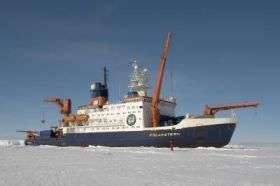
The mantle rock was collected during an expedition to the North Pole aboard a 400-foot-long icebreaker, a research vessel designed to break through the ice. Credit: Heinz Feldmann, Max-Planck Insitut fuer Chemie, Mainz, German

Uncovering a rare, two-billion-year-old window into the Earth’s mantle, a University of Houston professor and his team have found our planet’s geological history is more complex than previously thought.

Jonathan Snow, assistant professor of geosciences at UH, led a team of researchers in a North Pole expedition, resulting in a discovery that could shed new light on the mantle, the vast layer that lies beneath the planet’s outer crust. These findings are described in a paper titled “Ancient, highly heterogeneous mantle beneath Gakkel Ridge, Arctic Ocean,” appearing recently in Nature.

These two-billion-year-old rocks that time forgot were found along the bottom of the Arctic Ocean floor, unearthed during research voyages in 2001 and 2004 to the Gakkel Ridge, an approximately 1,000-mile-long underwater mountain range between Greenland and Siberia. This massive underwater mountain range forms the border between the North American and Eurasian plates beneath the Arctic Ocean, where the two plates diverge.

These were the first major expeditions ever undertaken to the Gakkel Ridge, and these latest published findings are the fruit of several years of research and millions of dollars spent to retrieve and analyze these rocks.

The mantle, the rock layer that comprises about 70 percent of the Earth’s mass, sits several miles below the planet’s surface. Mid-ocean ridges like Gakkel, where mantle rock is slowly pushing upward to form new volcanic crust as the tectonic plates slowly move apart, is one place geologists look for clues about the mantle. Gakkel Ridge is unique because it features – at some locations – the least volcanic activity and most mantle exposure ever discovered on a mid-ocean ridge, allowing Snow and his colleagues to recover many mantle samples.

“I just about fell off my chair,” Snow said. “We can’t exaggerate how important these rocks are – they’re a window into that deep part of the Earth.”

Venturing out aboard a 400-foot-long research icebreaker, Snow and his team sifted through thousands of pounds of rocks scooped up from the ocean floor by the ship’s dredging device. The samples were labeled and cataloged and then cut into slices thinner than a human hair to be examined under a microscope. That is when Snow realized he found something that, for many geologists, is as rare and fascinating as moon rocks – mantle rocks devoid of sea floor alteration. Analysis of the isotopes of osmium, a noble metal rarer than platinum within the mantle rocks, indicated they were two billion years old. The use of osmium isotopes underscores the significance of the results, because using them for this type of analysis is still a new, innovative and difficult technique.

Since the mantle is slowly moving and churning within the Earth, geologists believe the mantle is a layer of well-mixed rock. Fresh mantle rock wells up at mid-ocean ridges to create new crust. As the tectonic plates move, this crust slowly makes its way to a subduction zone, a plate boundary where one plate slides underneath another and the crust is pushed back into the mantle from which it came.

Because this process takes about 200 million years, it was surprising to find rocks that had not been remixed inside the mantle for two billion years. The discovery of the rocks suggests the mantle is not as well-mixed or homogenous as geologists previously believed, revealing that the Earth’s mantle preserves an older and more complex geologic history than previously thought. This opens the possibility of exploring early events on Earth through the study of ancient rocks preserved within the Earth’s mantle.

The rocks were found during two expeditions Snow and his team made to the Arctic, each lasting about two months. The voyages were undertaken while Snow was a research scientist at the Max Planck Institute in Germany, and the laboratory study was done by his research team that now stretches from Hawaii to Houston to Beijing.

Since coming to UH in 2005, Snow’s work stemming from the Gakkel Ridge samples has continued, with more research needed to determine exactly why these rocks remained unmixed for so long. Further study using a laser microprobe technique for osmium analysis available only in Australia is planned for next year.

Source: University of Houston


print this article email this article download pdf blog this article bookmark this article     Digg this Stumble it share on Facebook share on Reddit add to delicious save to Yahoo! bookmarks
4.3/5 after 50 votes

Rank Filter

Move the slider to adjust rank threshold, so that you can hide some of the comments.


Display comments: newest first

  • Bradyn - Apr 11, 2008
    • Rank: 3 / 5 (2)
    This seems to be a redundant theme in science. Everything is more complex then previously thought. Wouldn't logic dictate that the more we know, the more we'll discover about what we previously didn't know. www.madnessletters.com
  • out7x - Apr 12, 2008
    • Rank: 2.5 / 5 (2)
    Gakkel Ridge needs drill cuttings. Sea floor sampling seems less reliable for age dating. Please show the Os isotope graph vs. time.
  • maxberan - Apr 12, 2008
    • Rank: 4 / 5 (1)
    Bradyn's comment is arguable. The other way of looking at it is that as data accumulate, study reveals theories that explain those observations. As Penrose (I think) put it - "theories eat data". That's why science isn't just a ramifying jumble of observations and data.

April 11th, 2008 all stories
Space & Earth / Earth Sciences

Comments: 3
Rank: 4.3/5 after 50 votes

  • Stumble this up

  • Digg this

  • Share it:
  • share on Facebook
  • share on MySpace
  • share on Slashdot
  • rss-newsfeed
  • share on Google
  • share on Reddit
  • add to delicious
  • save to Yahoo! bookmarks
  • share on Windows Live
  • Add to Mixx!
Rating: 4.3/5 after 50 votes


Tags


  • Physicists Demonstrate Quantum Memory with Matter Qubits
    Physicists Demonstrate Quantum Memory with Matter Qubits
    Physics / General Physics
    created Jul 03, 2009 | popularity 4.4 / 5 (16) | comments 1
  • 'Holey' Nanosheets for Wastewater Dye Removal
    Nanotechnology / Nanomaterials
    created Jul 01, 2009 | popularity 5 / 5 (5) | comments 1
  • Jellyfish Robot Swims Like its Biological Counterpart
    Jellyfish Robot Swims Like its Biological Counterpart
    Electronics / Robotics
    created Jun 26, 2009 | popularity 4.4 / 5 (8) | comments 1
  • Could Maxwell's Demon Exist in Nanoscale Systems?
    Could Maxwell's Demon Exist in Nanoscale Systems?
    Physics / General Physics
    created Jun 24, 2009 | popularity 4.4 / 5 (18) | comments 29
  • Living Safely with Robots, Beyond Asimov's Laws
    Living Safely with Robots, Beyond Asimov's Laws
    Electronics / Robotics
    created Jun 22, 2009 | popularity 4.6 / 5 (52) | comments 40
  • Other News

    Forty years ago man first walked on the moon

    Space & Earth / Space Exploration

    created 4 hours ago | popularity 5 / 5 (2) | comments 0

    Forty years ago on July 20, 1969, American astronaut Neil Armstrong realized the oldest dream of human civilizations when he became the first man to walk on the moon.


    The least sea ice in 800 years

    The least sea ice in 800 years

    Space & Earth / Earth Sciences

    created Jul 01, 2009 | popularity 4.3 / 5 (59) | comments 52

    New research, which reconstructs the extent of ice in the sea between Greenland and Svalbard from the 13th century to the present indicates that there has never been so little sea ice as there is now. The ...


    Gas around young galaxy

    Intense heat killed the Universe's would-be galaxies, researchers say

    Space & Earth / Astronomy

    created Jul 01, 2009 | popularity 3.2 / 5 (19) | comments 25

    (PhysOrg.com) -- Our Milky Way galaxy only survived because it was already immersed in a large clump of dark matter which trapped gases inside it, scientists led by Durham University's Institute for Computational ...


    Scientists' Drill Hits Magma: Only Third Time on Record

    Scientists' Drill Hits Magma: Only Third Time on Record

    Space & Earth / Earth Sciences

    created Jun 29, 2009 | popularity 4.7 / 5 (20) | comments 19

    (PhysOrg.com) -- Scientists drilling a borehole deep into Iceland’s rocky crust to explore new methods of using geothermal energy hit a major roadblock on Thursday: Their drill ran into molten rock at a depth ...


    NASA manager pitches a cheaper return-to-moon plan

    Space & Earth / Space Exploration

    created Jun 30, 2009 | popularity 4 / 5 (7) | comments 18

    (AP) -- Like a car salesman pushing a luxury vehicle that the customer no longer can afford, NASA has pulled out of its back pocket a deal for a cheaper ride to the moon.