Cycling More Intelligently
April 11, 2008
Cycling More Intelligently

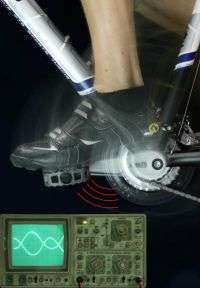
Adaptronic elements cast in the pedal crank report inappropriate biomechanical stress during cycling. Credit: Fraunhofer IFAM

Modern bicycles leave nothing to be desired. 21, 24, 27 gears! For many amateur cyclists, such luxury is too much of a good thing. They change gear too infrequently and too late, get out of breath and don’t enjoy the ride. At the Hannover Messe (April 21 through 25), Fraunhofer researchers are presenting a bicycle with an intelligent pedal crank that helps the biker to direct his strength into the pedals.

There are two piezo-sensors integrated in one of the pedal cranks of this bicycle. One function of the sensors is to measure the forces that propel the rider forwards and show him how ‘evenly’ he is pedaling. In the exhibited prototype, the registered data are transmitted wirelessly in real time to a PC – in practical use this would be a device such as a PDA or a cell phone.

The integrated-function pedal crank is a result of the InGuss project, whose goal is to manufacture ‘intelligent’ cast parts, by directly integrating sensors, actuators and electronic components in the parts while they are being cast. In this project, researchers at the Fraunhofer Institutes for Manufacturing Technology and Applied Materials Research IFAM, for Structural Durability and System Reliability LBF and for Integrated Circuits IIS are developing the manufacturing technology and the components to be integrated.

The special feature of the bicycle pedal crank is that the piezoceramic actuators, sensors and electronic components are integrated in the light metal components during casting. This is no easy task, for the high temperatures of over 700°C that prevail during casting can destroy the sensitive electronic and electromechanical components.

“We protect the components with special insulating materials, and adapt the process accordingly to prevent them from being damaged,” says Christoph Pille of the IFAM in Bremen. This would make it possible for the first time ever to integrate components such as RFID transponders during casting in such a way that they could not be lost, enabling components to be tracked, identified and protected against product piracy.

Heiko Atzrodt of the LBF is certain that this pedal crank demonstrator is just one example out of many potential applications for the technology: “Integrated sensor and adaptronic functions are likely to make their way into numerous products before long – for instance, sensors in aircraft parts could report material fatigue before it is too late. Integrated actuators make it possible to actively influence vibrations, too.”

Source: Fraunhofer-Gesellschaft

3.8 /5 (4 votes)  

Rank 3.8 /5 (4 votes)
Tags

Related Stories
Relevant PhysicsForums posts
  • How to tilt a object
    created4 hours ago
  • How to calculate total compressibility in liquid porous solid system
    created10 hours ago
  • Need help reading 3-D
    createdFeb 11, 2012
  • A way to send and receive wireless data
    createdFeb 11, 2012
  • Calling function with no input argument
    createdFeb 10, 2012
  • Force free body diagram problem on gym equipment
    createdFeb 10, 2012
  • More from Physics Forums - General Engineering

More news stories

Google might launch Drive for cloud storage soon

(PhysOrg.com) -- Google's next big move, according to the Wall Street Journal, is a cloud storage service called Drive. Hardly first to the plate, Google is simply catching up to introducing its cloud reposi ...

Technology / Internet

created 18 hours ago | popularity 4.8 / 5 (5) | comments 5 | with audio podcast report

Iran blocks email, restricts net access: reports

Iran has further restricted access to the Internet and blocked popular email services for the past few days, in a move a top lawmaker said could "cost the regime dearly," media reports said on Sunday.

Technology / Internet

created 11 hours ago | popularity 5 / 5 (2) | comments 5

Walney offshore wind farm is world's biggest (for now)

(PhysOrg.com) -- The Walney wind farm on the Irish Sea--characterized by high tides, waves and windy weather--officially opened this week. The farm is treated in the press as a very big deal as the Walney ...

Technology / Energy & Green Tech

created Feb 11, 2012 | popularity 4.1 / 5 (14) | comments 57 | with audio podcast weblog

Navy to begin tests on electromagnetic railgun prototype launcher

The Office of Naval Research (ONR)'s Electromagnetic (EM) Railgun program will take an important step forward in the coming weeks when the first industry railgun prototype launcher is tested at a facility ...

Technology / Engineering

created Feb 06, 2012 | popularity 4.6 / 5 (20) | comments 95 | with audio podcast

New power source discovered

(PhysOrg.com) -- Researchers at the Massachusetts Institute of Technology (MIT) and RMIT University have made a breakthrough in energy storage and power generation.

Technology / Energy & Green Tech

created Feb 10, 2012 | popularity 4.6 / 5 (51) | comments 51 | with audio podcast


Scientists discover molecular secrets of 2,000-year-old Chinese herbal remedy

For roughly two thousand years, Chinese herbalists have treated Malaria using a root extract, commonly known as Chang Shan, from a type of hydrangea that grows in Tibet and Nepal. More recent studies suggest that halofuginone, ...

New method to examine batteries -- MRI from the inside

There is an ever-increasing need for advanced batteries for portable electronics, such as phones, cameras, and music players, but also to power electric vehicles and to facilitate the distribution and storage of energy derived ...

A mitosis mystery solved: How chromosomes align perfectly in a dividing cell

Although the process of mitotic cell division has been studied intensely for more than 50 years, Whitehead Institute researchers have only now solved the mystery of how cells correctly align their chromosomes during symmetric ...

Lab study raises questions over nano-particle impact

Tests involving chickens have raised questions about the impact on health from engineered nano-particles, the ultra-fine grains commonly used in drugs and processed foods, scientists said on Sunday.

Starve a virus, feed a cure? Findings show how some cells protect themselves against HIV

A protein that protects some of our immune cells from the most common and virulent form of HIV works by starving the virus of the molecular building blocks that it needs to replicate, according to research published online ...

Researchers find extensive RNA editing in human transcriptome

In a new study published online in Nature Biotechnology, researchers from BGI, the world's largest genomics organization, reported the evidence of extensive RNA editing in a human cell line by analysis of RNA-seq data, demons ...