One virtual step for man, one real leap for mankind
Imagine being able to take a step back in time and walk through the streets of ancient Pompeii hours before the eruption of Vesuvius. In April 2008, European researchers will demonstrate that walking through virtual environments is set to be a reality.
“In the virtual environment you have flight simulators, car simulators, but the most natural way of locomotion for humans is walking and this was practically impossible,” says Marc Ernst, the coordinator of the CyberWalk project at the Max Planck Institute for Biological Cybernetics.
To make virtual walking a reality, the CyberWalk researchers had to address five key issues: providing a surface to walk on, controlling the surface in a way that minimised forces on the user, developing a non-intrusive tracking system, displaying a high-quality visualisation, and ensuring a natural human perception of the virtual environment.
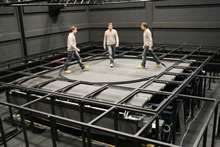
This month, at a special workshop in Tuebingen, Germany, the EU-funded researchers will demonstrate their treadmill allowing unconstrained walking in all directions (omni-directional) through large-scale virtual environments.
“Walking through a virtual city was impossible before,” Ernst says. “We are the first to demonstrate that you can walk through a virtual city or any type of extended environment.”
Be natural
Several attempts have been made to develop omni-directional treadmills, with Japanese researchers producing prototypes, and a group in the USA developing a smaller treadmill for military use. Neither allow for truly natural walking and immersion in a virtual environment.
“A key feature is that you need a relatively large treadmill to simulate natural walking,” explains Ernst. “The one that will be demonstrated is 6m by 6m, with an active walking area of 4.5m by 4.5m.”
According to Ernst, this is the minimum size necessary for 'natural walking'.
The treadmill, or CyberCarpet, incorporates several new mechanical solutions, which ensure smooth and safe operation. The key to the CyberCarpet is a platform with a big chain drive. The chain elements are made of conventional treadmills.
The chain moves in one direction whereas the movement direction of the belts is orthogonal to that. Summing the two directions of the chain and the belts provides the omni-directional actuation principle and so the treadmill motion opposing the motion of the walker can be in any direction.
“Theoretically there is no limit to the size of treadmill. In fact, the bigger the better,” says Ernst. “But practicalities dictate that the size of the CyberCarpet is limited to the size of the room, the mechanical constraints of the construction and the money you have to spend.”
To track the walker, CyberCarpet wanted to dispense with the Hollywood-style suits covered in reflective marker balls. Its unique system uses cameras to track the position and posture of the individual. This helps control the velocity of the treadmill and interactions with the virtual environment.
Visualising the virtual environment is achieved courtesy of a commercial head-mounted display, which does have markers on it, says Ernst, because you “simply need a fast and accurate system”.
Real-life applications for virtual reality
The possibility of walking through large virtual environments has already received a lot of attention and captured the public’s attention. One project partner, the Swiss Federal Institute of Technology (ETHZ) developed the CityEngine, developed a software package for quickly creating large-scale virtual environments in particular cities, in various degrees of detail.
Combining the CityEngine with CyberWalk will allow people to go beyond strolling through the streets of ancient Pompeii and Rome. Architects, for example, could transport customers into the future, and allow them to walk through buildings even before they have been built.
ETHZ is considering exploiting CityEngine as a tool for the gaming industry. Talks with some game production houses are already underway.
Beyond the obvious use in entertainment, the achievements of the CyberWalk project could extend to training for firemen in dangerous scenarios, while keeping them well out of harm’s way. It could also help with medical rehabilitation for people after a stroke, people with Parkinson’s disease, or to help them overcome phobias.
The developments have also created exciting new academic possibilities for research into behavioural science and the biomechanics of human locomotion.
But the showcase demonstration is pure escapism, bringing Pompeii to life again after nearly two millennia.
Source: ICT Results


