Moondust in the Wind
April 11, 2008
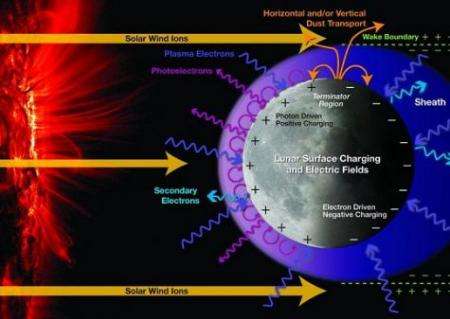
Lunar surface charging and electric fields caused by sunlight and solar wind. Credit: Jasper Halekas and Greg Delory of U.C. Berkeley, and Bill Farrell and Tim Stubbs of the Goddard Space Flight Center.
Moondust is dry, desiccated stuff, and may seem like a dull topic to write about. Indeed, you could search a ton of moondust without finding a single molecule of water, so it could make for a pretty "dry" story. But like the dust in your mother's attic, moondust covers something interesting – the moon – and even the dust itself has curious tales to tell.
A group of NASA and University of Alabama researchers are what you might call "active listeners": Mian Abbas, James Spann, Richard Hoover and Dragana Tankosic have been shooting moondust with electrons, levitating moondust using electric fields, and scrutinizing moondust under an electron microscope. All this is happening at the National Space Science and Technology Center's "Dusty Plasma Lab" in Huntsville, Alabama.
Why such attention? Spann explains: "Humans will return to the moon in a few years and have to know what to expect. How do you live and work in a place filled with moondust? We're trying to find out."
"Moondust was a real nuisance for Apollo astronauts," adds Abbas. "It stuck to everything – spacesuits, equipment, instruments." The sharp-edged grains scratched faceplates, clogged joints, blackened surfaces and made dials all but unreadable. "The troublesome clinginess had a lot to do with moondust's electrostatic charge."
Dust on the moon is electrified, at least in part, by exposure to the solar wind. Earth is protected from the solar wind by our planet's magnetic field, but the moon has no global magnetic field to ward off charged particles from the sun. Free electrons in the solar wind interact with grains of moondust and, in effect, "charge them up."
At the Dusty Plasma Lab, the scientists simulate solar wind-like conditions to study the moon's dust in a realistic environment. In previous studies, Abbas and colleagues examined the effects of ultraviolet sunlight on grains of moondust to help construct theories about how moondust will behave during daylight hours on the moon. (UV photons can also charge up moondust.) Now they are investigating how the grains behave in the dark of night, when the swirling solar wind dominates "lunar weather."
"Fortunately, we know what the solar wind is like, so we can simulate it," says Spann.
In a typical experiment, Abbas peppers the dust grains with a beam of electrons from an electron gun. He suspends a single grain of moondust inside the vacuum test chamber and bombards the grain with different numbers of electrons.
"We've had some surprising results," says Abbas "We're finding that individual dust grains do not act the same as larger amounts of moon dust put together. Existing theories based on calculations of the charge of a large amount of moondust don't apply to the moondust at the single particle level."
When it comes to electrostatic charging, grains of moondust are individualists capable of eccentric and surprising behavior. For instance, in one experiment conducted by Abbas, pelting a positively charged grain of moondust with electrons (which carry a negative charge) caused the grain to exhibit a more positive charge. Consider that grain a contrarian! Abbas thinks that each electron hitting the grain dislodged two or more electrons already there, resulting in a net increase of positive charge.
Not all moondust behaves this way. How each grain reacts depends on a variety of factors including the grain's size, the charge it already carries, and the number of free electrons incoming.
Spann adds, "We believe the single grains will behave differently on the moon, too – not just in our lab. Our results are closer to what's really happening on the moon. We're saying, 'Hey wait a second guys. We're finding something odd. When you go to the moon, it's going to be a little different than you thought.'"
You can bet mission planners will be listening as the moondust tells its tale.
Source: Science@NASA, by Dauna Coulter
-
Engineers build first sub-10-nm carbon nanotube transistor
Feb 01, 2012 |
4.9 / 5 (31) |
30
-
Something old, something new: Evolution and the structural divergence of duplicate genes
Jan 31, 2012 |
4.6 / 5 (7) |
1
-
The hidden nanoworld of ice crystals: Revealing the dynamic behavior of quasi-liquid layers
Jan 30, 2012 |
5 / 5 (3) |
1
-
Stock market network reveals investor clustering
Jan 27, 2012 |
3.9 / 5 (23) |
8
-
Of microchemistry and molecules: Electronic microfluidic device synthesizes biocompatible probes
Jan 26, 2012 |
5 / 5 (1) |
0
-
Never ending outer space.....
12 hours ago
-
Neutron Star fragments?
14 hours ago
-
stationary or not?
18 hours ago
-
Scale of the Universe
Feb 10, 2012
-
Titan's lack of impact craters
Feb 09, 2012
-
Real pictures of black hole eating a star?
Feb 08, 2012
- More from Physics Forums - General Astronomy
More news stories
Latin America mining boom clashes with conservation
Latin America is experiencing a mining boom as prices rise fuelled by a hike in global demand, but the region is also being hit by a wave of violent protests, strikes and rallies by environmentalists.
5 hours ago |
not rated yet |
0
Political leaders play key role in how worried Americans are by climate change: study
More than extreme weather events and the work of scientists, it is national political leaders who influence how much Americans worry about the threat of climate change, new research finds.
Feb 06, 2012 |
5 / 5 (6) |
72
NASA budget will axe Mars deal with Europe: scientists
US President Barack Obama's budget proposal to be submitted next week for 2013 will cut NASA's budget by 20 percent and eliminate a major partnership with Europe on Mars exploration, scientists said Thursday.
Space & Earth / Space Exploration
Feb 10, 2012 |
5 / 5 (3) |
55
Humans may have helped the decline of African rainforests 3000 years ago
(PhysOrg.com) -- Large areas of rainforests in Central Africa mysteriously disappeared over three thousand years ago, to be replaced by savannas. The prevailing theory has been that the cause was a change ...
High planetary tilt lowers odds for life?
Highly-tilted worlds would have extreme seasons, subjecting life to alternating periods of scorching and subzero temperatures. This could make the development of all but hardiest, simplest creatures a long ...
Space & Earth / Space Exploration
Feb 06, 2012 |
4.8 / 5 (12) |
14
|
Google might launch Drive for cloud storage soon
(PhysOrg.com) -- Google's next big move, according to the Wall Street Journal, is a cloud storage service called Drive. Hardly first to the plate, Google is simply catching up to introducing its cloud reposi ...
Love a click away in Indonesia's Twitter Republic
He was a geeky kid from Yogyakarta, she a glamorous city girl in Jakarta. In a country with one of the world's most vibrant social networking scenes they fell in love on Twitter.
Europeans protest controversial Internet pact
Tens of thousands of people marched in protests in more than a dozen European cities Saturday against a controversial anti-online piracy pact that critics say could curtail Internet freedom.
Walney offshore wind farm is world's biggest (for now)
(PhysOrg.com) -- The Walney wind farm on the Irish Sea--characterized by high tides, waves and windy weather--officially opened this week. The farm is treated in the press as a very big deal as the Walney ...
Navy to begin tests on electromagnetic railgun prototype launcher
The Office of Naval Research (ONR)'s Electromagnetic (EM) Railgun program will take an important step forward in the coming weeks when the first industry railgun prototype launcher is tested at a facility ...
Explained: Sigma
It's a question that arises with virtually every major new finding in science or medicine: What makes a result reliable enough to be taken seriously? The answer has to do with statistical significance -- but ...
Apr 11, 2008
Rank: not rated yet
Obviously, these Alabama researchers will be very interested in the "Mapping Lunar Surface Electric Fields and Characterizing the Exospheric Dust Environment" experiement that may be included on the upcoming LRO mission to launch in October (see more at www.moonposter.ie/news.htm ).
John
Moon Missions %u2014 http://www.moonposter.ie/missions.htm (Kaguya, Chang'e-1, Chandrayaan-1, LRO, GRAIL & LADEE, LunaGlob, LEO, MoonLITE)