April 14, 2008 feature
Physicists model how we form opinions
In large part, a society’s image stems from its overall opinions – its political, religious, and ethical beliefs – and how much diversity it tolerates. For example, how do some areas develop images of being either liberal or conservative, and, in others, liberals and conservatives live side by side?
As a team of researchers explains, our individual opinions both influence and are influenced by our surroundings. By following a set of rules, the researchers have modeled the opinion formation process in societies where individuals’ opinions are strongly influenced by others they interact with. The scientists found that, depending on two criteria – how strongly individuals are influenced by each other and how many connections individuals have – a society’s overall state can exhibit either large segregated patches of consensus, or areas with closely intermingled opinions.
Peter Klimek from the Medical University of Vienna, Renaud Lambiotte from the University of Liege and the Catholic University of Louvain in Belgium, and Stefan Thurner of the Medical University of Vienna and the Santa Fe Institute in the US have published their study in a recent issue of Europhysics Letters.
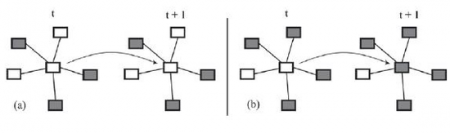
In their model, individuals are represented as nodes in a network. The nodes are binary, and they display an individual’s opinion on some subject, such as yes/no, liberal/conservative, Clinton/Obama, or any other choice.
Then, the society’s overall stance on a subject can be determined for the future by evolving the system. First, an algorithm checks the state of all nodes connected to the node in question. If the fraction of the state of neighboring nodes exceeds a certain threshold (which the researchers call the “laggard parameter” and must be above 50%), then the central node adopts that state. If not, the node remains in its original state. This process is iterated several times, until it can no longer be updated, and the society freezes.
“The original opinions of the individuals are 'a priori' inclinations toward some subject,” Thurner told PhysOrg.com. “To stay within the Clinton/Obama example, although most of my peers may be democrats, some of them may consider political experience to be more important, while others think that a fresh start is needed. Given such individual initial dispositions, our work shows under which circumstances individuals will stick to them or change their mind.”
Depending on the laggard parameter and the system’s average connectivity, the model produces societies with different features. For example, as the laggard parameter increases (when individuals require a greater fraction of neighbors holding the opposite opinion in order to change their opinions), the regions of consensus shrink, and the society’s diverse views intermingle. In other words, individuals stubbornly hold on to their opinions, even if many of their neighbors have the opposite view. But the more that people are influenced by others, the less likely it is that the society will ever reach such an intermixed state.
Secondly, changing the connectivity parameter affects how quickly the system transitions from the segregated state to the intermixed state. For the same laggard parameter, a system with higher connectivity (10 or more connections in the model) creates a sharper transition from a segregated society to a mixed society. Systems with lower connectivity take longer to intermingle, and may never completely mix, as the system could stop evolving after fewer iterations.
Because social ties fluctuate, the researchers also modified their model by randomly rewiring the connections after the system reached its final update. This rewiring represents how individuals lose and make new friends and acquaintances, resulting in a more realistic model.
Overall, the researchers explain that a society’s public opinion can form one of two scenarios: segregated or coexistence of differences. But, as the team explains, even segregated societies can be versatile, with clusters of different groups – just as long as they aren’t forced to interact too much.
“Our model predicts that the formation of consensus depends on how actively an issue is under debate, especially if the original sets of opinions are balanced, i.e. there is roughly the same amount of people sharing each of the two opinions,” Thurner explained. “This is, of course, the most interesting case. In societies where debate is encouraged, a group of people is more likely to find consensus on a topic than, say, in a society where active discussions are not appreciated, suppressed or even forbidden.”
As the researchers explain, the model could be used as a tool to make statistical predictions in real-life scenarios.
“In principle, all our model parameters can be determined in real life,” Thurner said. “Presently, large efforts are made by dozens of groups to map social networks. The outcome of these efforts can be straight forwardly taken as an input to our model. The nature of social influence that individuals exert on each other (in the model this is the laggard parameter), can be assessed through polls, behavioral surveys, etc.
“However, predictions of our model are of statistical nature, and results predict most likely outcomes,” he added. “Predicting the outcome of a specific election can be compared to playing poker. Just from knowing that I hold an above average hand there is no guarantee that I will actually win this round.”
More information: Klimek, P., Lambiotte, R., and Thurner, S. “Opinion formation in laggard societies.“ Europhysics Letters 82 (2008) 28008.
Copyright 2008 PhysOrg.com.
All rights reserved. This material may not be published, broadcast, rewritten or redistributed in whole or part without the express written permission of PhysOrg.com.


