Human vascular system in mice
April 14, 2008
Human Vascular System in Mice

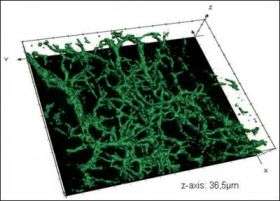
Three-dimensional reconstruction of a vascular system made of human endothelial cells in mice 20 days after injection of the spheroids. Image taken with a confocal microscope, stained green. Credit: Professor Hellmut Augustin, Joint Research Division "Vascular Biology" of the Mannheim Medical Faculty of the University of Heidelberg and the German Cancer Research Center

Tumors use the body's blood system for their own purposes: They stimulate the growth of blood vessels that supply the tumor. Medical treatment blocks this process in order to restrain tumors. Scientists of the Joint Research Division "Vascular Biology" of the Mannheim Medical Faculty of the University of Heidelberg and the German Cancer Research Center, collaborating with colleagues in Freiburg, have developed a method for producing a complex human vascular system in mice.

The formation of new blood vessels, or angiogenesis, is an Achilles’ heel of tumor growth, because tumors depend on the supply of oxygen and nutrients for survival. Therefore, for some years now substances called angiogenesis inhibitors have been used in cancer treatment to suppress this process.

In order to advance this new research field, a team of researchers headed by Professor Hellmut Augustin has developed a method to create a complex human vascular system in mice, which stays functional even after several months.

The method is based on the observation that isolated cells of the vessel walls, called endothelial cells, congregate spontaneously in cell cultures to form aggregates known as spheroids. “Individual endothelial cells floating in suspension are doomed to die – the association in spheroids stabilizes them,” says Hellmut Augustin.

The scientists Abdullah Alajati and Anna Laib have been able to inject such spheroids, embedded in a gel matrix, under the skin of mice and to stimulate the formation of a network of human blood vessels by means of growth factors. The mice were genetically modified in such a way that their immune system was unable to reject the foreign cells. “The newly formed blood vessels are made exclusively of human endothelial cells,” explains Anna Laib, a young researcher at the DKFZ. “At the matrix borders the human endothelial cells establish contact with those of the mouse. In this way, the transplanted human vasculature gets connected to the blood circulation of the mouse.”

The method provides experimental freedom and may deliver answers to various questions of vascular biology research. Scientists can genetically manipulate the endothelial cells before transplantation in order to investigate the formation of vascular networks.

In addition, it is possible to test the effect of pharmacological substances; the Freiburg-based company ProQinase GmbH, which is involved in the study, is already conducting such experiments. “The method is even interesting for the production of artificial tissues,” Hellmut Augustin says. “So far, one difficulty with the use of artificial replacement tissues has been to create a functioning vascular system that sufficiently supplies the tissue constructs.”

Source: Helmholtz Association of German Research Centres

4.5 /5 (2 votes)  

Rank 4.5 /5 (2 votes)
Tags

Relevant PhysicsForums posts
  • Is Everyday Technology Killing Us?
    createdFeb 08, 2012
  • Exercise and weight loss
    createdFeb 08, 2012
  • Why do we have head aches? Our brains can't feel anything.
    createdFeb 07, 2012
  • "The end of diseases" by David Agus, interview from Daily Show with Jon Stewart
    createdFeb 04, 2012
  • Oncolytic adenovirus
    createdFeb 04, 2012
  • Nutrition label stuffs and diets
    createdFeb 02, 2012
  • More from Physics Forums - Medical Sciences

More news stories

Botox developer rues missing out on billions

Botox developer Alan Scott says he rues the day he handed over rights to the best-selling wrinkle-smoothing drug to a US company for just $4.5 million, saying he might have become a billionaire.

Medicine & Health / Medications

created 2 minutes ago | popularity not rated yet | comments 0

Starve a virus, feed a cure? Findings show how some cells protect themselves against HIV

A protein that protects some of our immune cells from the most common and virulent form of HIV works by starving the virus of the molecular building blocks that it needs to replicate, according to research published online ...

Medicine & Health / Research

created 14 hours ago | popularity 5 / 5 (3) | comments 0 | with audio podcast

Overeating may double risk of memory loss

New research suggests that consuming between 2,100 and 6,000 calories per day may double the risk of memory loss, or mild cognitive impairment (MCI), among people age 70 and older. The study was released today and will be ...

Medicine & Health / Neuroscience

created 10 hours ago | popularity 5 / 5 (2) | comments 0 | with audio podcast

Declining health-care productivity in England: Who says so?

Reports that the National Health Service in England has been declining in productivity in the last decade appear to have been accepted as fact. However, a Viewpoint published Online First by The Lancet disputes this. The Vi ...

Medicine & Health / Health

created 8 hours ago | popularity 1 / 5 (1) | comments 1

Injured boomers beware: Know when to see doctor

(AP) -- It happened to nurse Jane Byron years after an in-line skating fall, business owner Haralee Weintraub while doing "men's" push-ups, and avid cyclist Gene Wilberg while lifting a heavy box.

Medicine & Health / Health

created 15 hours ago | popularity 5 / 5 (1) | comments 0


Japan's Fukushima reactor may be reheating: operator

Temperature readings at one of the crippled Fukushima nuclear reactors have risen above Japan's stringent new safety standard but there was no immediate danger, its operator said Sunday.

Australian women reject 'I love u' texts

Australian women may have embraced the digital era, but they prefer a face-to-face declaration of affection to an "I love u" text and find men addicted to their mobile phones a major turnoff.

Scientists discover molecular secrets of 2,000-year-old Chinese herbal remedy

For roughly two thousand years, Chinese herbalists have treated Malaria using a root extract, commonly known as Chang Shan, from a type of hydrangea that grows in Tibet and Nepal. More recent studies suggest that halofuginone, ...

New method to examine batteries -- MRI from the inside

There is an ever-increasing need for advanced batteries for portable electronics, such as phones, cameras, and music players, but also to power electric vehicles and to facilitate the distribution and storage of energy derived ...

Google might launch Drive for cloud storage soon

(PhysOrg.com) -- Google's next big move, according to the Wall Street Journal, is a cloud storage service called Drive. Hardly first to the plate, Google is simply catching up to introducing its cloud reposi ...

A mitosis mystery solved: How chromosomes align perfectly in a dividing cell

Although the process of mitotic cell division has been studied intensely for more than 50 years, Whitehead Institute researchers have only now solved the mystery of how cells correctly align their chromosomes during symmetric ...