Researchers mimic bacteria to produce magnetic nanoparticles
When it comes to designing something, it’s hard to find a better source of inspiration than Mother Nature. Using that principle, a diverse, interdisciplinary group of researchers at the U.S. Department of Energy’s Ames Laboratory is mimicking bacteria to synthesize magnetic nanoparticles that could be used for drug targeting and delivery, in magnetic inks and high-density memory devices, or as magnetic seals in motors.
Commercial room-temperature synthesis of ferromagnetic nanoparticles is difficult because the particles form rapidly, resulting in agglomerated clusters of particles with less than ideal crystalline and magnetic properties. Size also matters. As particles get smaller, their magnetic properties, particularly with regard to temperature, also diminish.
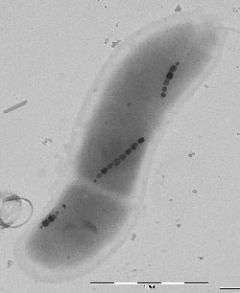
However, several strains of bacteria produce magnetite (Fe3O4) – fine, uniform nanoparticles that have desirable magnetic properties. These magnetotactic bacteria use a protein to form crystalline particles about 50 nanometers in size. These crystals are bound by membranes to form chains of particles which the bacteria use like a compass needle to orient themselves with the Earth’s magnetic field.
To see if researchers could learn from the bacteria, Surya Mallapragada, Ames Laboratory Materials Chemistry and Biomolecular Materials program director pulled together a team that included microbiologists, biochemists, material chemists, chemical engineers, materials scientists and physicists from Ames Laboratory and Iowa State University.
As a starting point, former ISU microbiologist Dennis Bazylinski, now at the University of Nevada-Las Vegas, isolated several strains of magnetotactic bacteria for use in the study.
Based on earlier work by a Japanese research team, Ames Laboratory biochemist Marit Nilsen-Hamilton looked at several proteins known to bind iron, including Mms6 found in magnetotactic bacteria, which she cloned from the bacteria. “This protein is associated with the membranes that surround the magnetite crystals,” Nilsen-Hamilton said, “and each bacterium appears to make particles with their own unique crystal structure.”
Ames Lab chemist Tanya Prozorov tried synthesizing crystals, using the proteins with various concentrations of reagents in an aqueous solution, but the particles formed quickly, were small and lacked specific crystal morphology. At the suggestion of Ames Lab senior physicist and crystal growth expert Paul Canfield, the team used polymer gels developed by Mallapragada and Balaji Narasimhan, who are both Ames Lab scientists as well as ISU chemical engineers, to slow down the reaction and help control formation of the nanocrystals and minimize aggregation.
“It’s simple chemistry,” Prozorov said, “and you can judge the reaction by the color, watching it go from yellow to green to black as the crystals form. Once the crystals precipitate out, we use a magnet to concentrate the particles at the bottom of the flask, then separate them out to study them further.”
Prozorov also conducted electron microscopy analysis of the synthetic nanoparticles which showed that Mms6 produced well-formed, faceted crystals resembling those produced naturally by the bacteria. Powder X-ray diffraction studies verified the crystal structure of the particles.
Ames Lab physicist Ruslan Prozorov, tested the magnetic properties of the synthetic crystals which also showed striking similarities to the bacteria-produced crystals and bulk magnetite. The magnetic studies also showed that the “chains” of particles formed by the bacteria had a much sharper magnetic transition definition at a higher temperature than single crystals.
“Nature found a way to beat the thermodynamics (of crystalline magnetite) by arranging the nanoparticles in such a way that they aren’t affected by temperature the way individual crystals are,” Ruslan Prozorov said.
With this basic understanding of magnetotatic bacteria and the ability to synthesize magnetite nanoparticles, the team proceeded to find out if the bioinspired approach could be used to produce cobalt-ferrite nanoparticles. Cobalt-ferrite, which doesn’t occur in living organisms, has more desirable magnetic properties than magnetite, yet presents the same problems for commercially producing nano-scale particles.
In addition to their previous method, the team took the added step of covalently attaching the Mms6 to a strand of functionalized polymer known to self-assemble and form thermoreversible gels. Because the polymer strands come together in a particular way, the attached proteins had a specific alignment that the researchers hoped would serve as a template for the formation of cobalt-ferrite crystals. And the way in which the gel formed would help control the speed of the reaction.
“It worked rather well,” Tanya Prozorov said, “and we ended up with very nice hexagonal cobalt ferrite crystals” and added that she is studying whether the protein will also work for the other neodymium, gadolinium, and holmium ferrites.
The project is funded by the Department of Energy’s Office of Basic Energy Sciences, the National Science Foundation, and the Alfred P. Sloan Foundation. The research has generated fodder for a number of journal articles, including published works in ACSNano, Physical Review B, and Advanced Functional Materials.
“This is an exciting interdisciplinary project addressing some of Basic Energy Sciences’ ‘Grand Challenges’ by bringing together materials scientists, chemists, physicists and biologists to develop new bioinspired materials of relevance to DOE's mission,” said Mallapragada. “Ames Laboratory is a wonderful environment in which to foster and grow these sorts of interdisciplinary initiatives because teamwork is really built into the culture here."
Source: Ames Laboratory


