Folks below the 'digital divide' would use the Internet more if they had it, research suggests
April 14th, 2008 Folks below the 'digital divide' would use the Internet more if they had it, research suggests

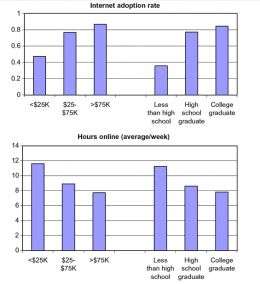
Although higher-income and better-educated people are more likely to be connected to the Internet, Internet usage increases as income and education go down, according to Cornell and University of Toronto research. Helping more low-income people get online could have social and economic benefits, the researchers say.

There is still a "digital divide." Rich people are connected to the Internet more than poor people, and some worry that this creates an "electronic underclass" unable to access important services. Subsidies to help low-income households get online have been suggested.

If connected, these families would use the Internet more than the affluent, according to research by Jeff Prince, assistant professor of applied economics and management at Cornell, and Avi Goldfarb of the University of Toronto. And Prince said that much of that use could benefit society and the national economy.

The study, reported in the March 2008 issue of the journal Information Economics and Policy, shows that low-income households spend more time on the Internet than others, using it for e-mail, researching purchases, finding health information and reading news, just as other users do, although spending more time on chat and gaming than the affluent.

"From the perspective of an economist, some of these activities benefit not only those partaking in them, but other members of society as well, making it possibly in the government's interest to encourage them," Prince said. "For sure they may use it for things we don't care about like chat and games, but we also predict that a decent proportion would use it for things we might think socially beneficial. We find some argument for a subsidy."

The researchers analyzed data on 18,439 Americans from a 2002 study of technology choices by Forrester Research and found that families with incomes below $25,000 a year who had access to the Internet used it a bit over 11.6 hours a week on average. Families with income between $25,000 and $75,000 averaged a little more than 8.9 hours a week and those with incomes over $75,000 used it a little more than 7.7 hours. Similar numbers appeared when comparing education levels, with college-educated people using the Internet less than high school graduates, and users with no high school diplomas spending the most time online.

The numbers were statistically corrected for such factors as race, age, number of children in the family and urban vs. rural environment.

The researchers conclude that the main reason for the difference in Internet use was the "opportunity cost of leisure time" -- that low-income users have fewer other uses for the time that they find more valuable. People in all income groups reported having about the same amount of leisure time.

Other possible explanations are that low-income people find the Internet more useful, giving them access to services they can't find elsewhere, and that low-income people who are willing to pay the cost of Internet access probably value it more highly and therefore use it more often. Analyzing how people use the Internet and statistically correcting for self-selection, respectively, show these explanations to be far less likely, the researchers said.

Prince cautioned that the analysis is based on data from several years ago, and that the benefits they find must be weighed against the costs before deeming subsidies a good policy decision. Also, he said, the rise of widespread broadband access may have changed the social landscape, and he hopes to study that in the future.

Source: Cornell University


print this article email this article download pdf blog this article bookmark this article     Digg this Stumble it share on Facebook share on Reddit add to delicious save to Yahoo! bookmarks
4.5/5 after 2 votes


April 14th, 2008 all stories
Technology / Other

Comments: 0
Rank: 4.5/5 after 2 votes

  • Stumble this up

  • Digg this

  • Share it:
  • share on Facebook
  • share on MySpace
  • share on Slashdot
  • rss-newsfeed
  • share on Google
  • share on Reddit
  • add to delicious
  • save to Yahoo! bookmarks
  • share on Windows Live
  • Add to Mixx!
Rating: 4.5/5 after 2 votes

  • Related Stories

  • Omg! Positive tone boosts Yahoo celeb site to top
    created Jul 04, 2009 | popularity not rated yet | comments 0
  • PC makers voluntarily supply Web filter in China
    created Jul 02, 2009 | popularity not rated yet | comments 0
  • Web browser enters a golden age
    created Jul 01, 2009 | popularity not rated yet | comments 0
  • New e-science service could accelerate cancer research
    created Jul 01, 2009 | popularity not rated yet | comments 0
  • China Web controversy highlights public role
    created Jul 01, 2009 | popularity not rated yet | comments 0

Tags


  • Physicists Demonstrate Quantum Memory with Matter Qubits
    Physicists Demonstrate Quantum Memory with Matter Qubits
    Physics / General Physics
    created Jul 03, 2009 | popularity 4.4 / 5 (17) | comments 1
  • 'Holey' Nanosheets for Wastewater Dye Removal
    Nanotechnology / Nanomaterials
    created Jul 01, 2009 | popularity 5 / 5 (5) | comments 1
  • Jellyfish Robot Swims Like its Biological Counterpart
    Jellyfish Robot Swims Like its Biological Counterpart
    Electronics / Robotics
    created Jun 26, 2009 | popularity 4.4 / 5 (8) | comments 1
  • Could Maxwell's Demon Exist in Nanoscale Systems?
    Could Maxwell's Demon Exist in Nanoscale Systems?
    Physics / General Physics
    created Jun 24, 2009 | popularity 4.4 / 5 (18) | comments 29
  • Living Safely with Robots, Beyond Asimov's Laws
    Living Safely with Robots, Beyond Asimov's Laws
    Electronics / Robotics
    created Jun 22, 2009 | popularity 4.6 / 5 (52) | comments 40
  • Other News

    Japan demands 119 million dlrs in tax from Amazon: report

    Technology / Business

    created 18 hours ago | popularity 3.6 / 5 (5) | comments 1

    Japanese authorities told a sales affiliate of US retail giant Amazon.com to pay about 119 million dollars in tax for unreported income over a three-year period, a newspaper said Sunday.


    Iconic skyscrapers find new luster by going green (AP)

    Iconic skyscrapers find new luster by going green

    Technology / Energy

    created 19 hours ago | popularity 1 / 5 (1) | comments 0

    (AP) -- When owners of the Empire State Building decided to blanket its towering facade this year with thousands of insulating windows, they were only partly interested in saving energy. They also needed ...


    Geeks double as scourges and sages at media summit

    Technology / Business

    created 14 hours ago | popularity not rated yet | comments 0

    (AP) -- The media moguls attending an annual powwow staged by investment bank Allen & Co. used to be able to rest comfortably in the Idaho mountains as they mulled their next moves.


    Downturn dating: Hearts flutter as markets stutter (AP)

    Downturn dating: Hearts flutter as markets stutter

    Technology / Internet

    created 19 hours ago | popularity not rated yet | comments 0

    (AP) -- Credit the recession for "staycations" and bringing us more game-night parties at home. But also give it a shout for spurring more first dates.


    UK spy chief's family details posted on Facebook

    Technology / Internet

    created 19 hours ago | popularity not rated yet | comments 0

    (AP) -- He's the spy who came in from the beach.