Stilgoe predicts the return of railroad
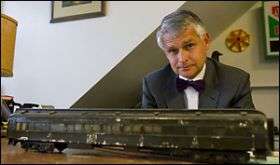
The golden age of the railroad ended in the mid-20th century, when Americans switched from Pullman cars to Chevys and eventually 747 jetliners. Yet, to John R. Stilgoe, Robert and Lois Orchard Professor in the Faculty of Arts and Sciences and Harvard Graduate School of Design, trains are anything but passé. Based on analyses of real estate investment patterns along railroad corridors, Stilgoe predicts that trains will once again play a key role in shaping American life.
“Train travel will supplant highway and air travel in the next few decades,” Stilgoe says. “Furthermore, electric railroads will increasingly be used to distribute freight items — such as coal and grain — as well as mail and express packages.” He explores this scenario in a recently published book, “Train Time: Railroads and the Imminent Reshaping of the United States Landscape” (University of Virginia Press, 2007).
Stilgoe cites investment and real estate activity as the best indicators of the impending railroad renaissance. He notes that in April 2007, for example, investor Warren Buffett purchased 39 million shares of Burlington Northern Santa Fe, which operates railroad services in the Midwestern and western United States.
“It’s very clear what is happening,” Stilgoe says. “The share price of railroad stocks is going up and up. One would never imagine that railroads could be good investment … but then why is Warren Buffett so interested?”
Stilgoe also says that real estate transfers in Midwestern towns that lie along old rail routes have been more frequent, with most properties significantly increasing in value.
“There is a lot of money moving this way,” he says, “because these satellite towns will be worth a great deal when the trains come back. Investors are purchasing everything from derelict buildings to gravel plots, which can be easily transformed into parking lots when the time is right.”
Stilgoe adds that politicians are increasingly interested in exploring railroad development. In “auto-centric” cities like St. Louis and Atlanta, he says, politicians are initiating feasibility studies to determine how an increased railroad presence would enhance commercial activity.
“Rail-equipment manufacturers are already soliciting orders,” says Stilgoe. “This is well under way.”
According to Stilgoe, the three prime factors driving railroad development are population growth, rising gas prices, and advanced technology.
“Experts anticipate that there will be 150 million more Americans by 2050,” says Stilgoe. “Anyone who drives knows that the highways are already jammed and can hardly accommodate additional traffic.” Stilgoe argues that extension of high-speed rail service would alleviate crowded urban highways by enabling commuters to live farther from the city center.
“If more passenger trains were permitted to go 90 miles per hour — which they are capable of doing — that would dramatically impact the shape of urban and exurban settlement,” he says.
Development in Albuquerque, N.M., provides a compelling example of Stilgoe’s theory. In 2004, city officials ordered 10 new bi-level commuter railroad cars, at a price of $2.2 million each. The cars serve a newly expanded network that connects small communities throughout greater Albuquerque.
“Wealthy people can live north or south of the city, come in to do their work, and leave again,” says Stilgoe.
In addition to population growth, Stilgoe argues that increasing gas prices will lead more passengers to the railroad.
“As gasoline rises it becomes cheaper to travel by train,” Stilgoe says. “Railroads are part of a sustainable future.”
Fuel efficiency will not only alter passenger travel, says Stilgoe, it will also impact the distribution of freight. Electrified railways will provide a convenient and low-cost method of delivering goods and packages throughout the country.
“In the 1930s it was possible to order a fridge in the morning and have it delivered by train later the same day,” says Stilgoe. “Americans forgot about this, but we’re starting to put it back together.”
Finally, Stilgoe suggests that advanced technology will play a key role in encouraging railroad development.
“This is a high-tech industry,” he says. “We have the technology to revitalize outdated tracks, to turn them into electrified rails that can support high-speed, on-time trains.” Eco-friendly locomotives have already been developed, as well as onboard computer systems designed to calculate the most fuel-efficient speeds.
“Few people have taken notice of the developments in the railroad industry,” Stilgoe says. “But they should — because it is going to have an undeniable impact on the future of our nation.”
Source: Harvard University


