Bikini corals recover from atomic blast
April 15, 2008 Bikini corals recover from atomic blast

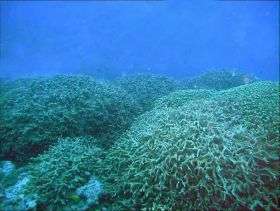
Porites matrices growing in the Bravo Crater. Credit: ARC Centre of Excellence in Coral Reef Studies

Half a century after the last earth-shattering atomic blast shook the Pacific atoll of Bikini, the corals are flourishing again. Some coral species, however, appear to be locally extinct.

These are the findings of a remarkable investigation by an international team of scientists from Australia, Germany, Italy, Hawaii and the Marshall Islands. The expedition examined the diversity and abundance of marine life in the atoll.

One of the most interesting aspects is that the team dived into the vast Bravo Crater left in 1954 by the most powerful American atom bomb ever exploded (15 megatonnes - a thousand times more powerful than the Hiroshima bomb). The Bravo bomb vapourised three islands, raised water temperatures to 55,000 degrees, shook islands 200 kilometers away and left a crater 2km wide and 73m deep.

After diving into the crater, Zoe Richards of the ARC Centre of Excellence for Coral Reef Studies and James Cook University says, “I didn’t know what to expect – some kind of moonscape perhaps. But it was incredible, huge matrices of branching Porites coral (up to 8 meters high) had established, creating thriving coral reef habitat. Throughout other parts of the lagoon it was awesome to see coral cover as high as 80 per cent and large tree-like branching coral formations with trunks 30cm thick. It was fascinating – I’ve never seen corals growing like trees outside of the Marshall Islands.

“The healthy condition of the coral at Bikini atoll today is proof of their resilience and ability to bounce back from massive disturbances, that is, if the reef is left undisturbed and there are healthy nearby reefs to source the recovery.”

However the research has also revealed a disturbingly high level of loss of coral species from the atoll. Compared with a famous study made before the atomic tests were carried out, the team established that 42 species were missing compared to the early 1950s. At least 28 of these species losses appear to be genuine local extinctions probably due to the 23 bombs that were exploded there from 1946-58, or the resulting radioactivity, increased nutrient levels and smothering from fine sediments.

“The missing corals are fragile lagoonal specialists – slender branching or leafy forms that you only find in the sheltered waters of a lagoon,” Zoe explains. While corals in general have shown resilience, Zoe adds that the coral biodiversity at Bikini Atoll has proven only partially resilient to the disturbances that have occurred there.

Maria Beger from the Commonwealth Research Facility for Applied Environmental Decision Analysis at The University of Queensland took a Geiger counter with her on the expedition.

“The ambient gamma radiation the residential island of Bikini atoll was fairly low – pretty much like the background radiation in an Australian city. However when I put the Geiger counter near a coconut, which accumulates radioactive material from the soil, it went berserk,” Maria remembers.

Extensive decontamination works have been carried out at Bikini atoll making it safe to visit, however local produce is unsafe to eat, and it is unlikely the Bikinian people will return to live on Bikini Atoll in the near future.

The coral survey was carried out at the request of the atoll’s local government.
For comparison the team also dived on neighbouring Rongelap Atoll, where no atomic tests were carried out directly although the atoll was contaminated by radioactive ash from the Bravo Bomb and local inhabitants were also evacuated and for the most part, have not returned. The marine environment at this Atoll was found to be in a pristine condition.

The team thinks that Rongelap Atoll is potentially seeding Bikini’s recovery, because it is the second largest atoll in the world with a huge amount of coral reef diversity and biomass and lies upstream from Bikini.

Zoe says that ironically, thanks to the bombs, Bikini Atoll represents a priceless laboratory showing how in the absence of ongoing stress, some corals have the capacity to recover from vast upheavals, which may contain valuable lessons for the management of reefs in other parts of the world including Australia.

“Apart from occasional forays of illegal shark, tuna and Napoleon Wrasse fishing, the reef is almost completely undisturbed to this day. There are very few local inhabitants and the divers who visit dive on shipwrecks, like the USS Saratoga, and not on the reef” says Maria.”

Because of its incredible history and current undisturbed character Bikini Atoll is now part of a larger project to have northern Marshall Island Atolls World Heritage listed. The expedition served to illustrate the tragic history of the Bikinian people is not entirely reflected below the surface because the reefs of Bikini are recovering to present themselves as havens of abundance to the marine life of the Northern Pacific Ocean.

Source: ARC Centre of Excellence in Coral Reef Studies


print this article email this article download pdf blog this article bookmark this article     Stumble it Digg this share on Facebook retweet share on Reddit add to delicious
Rate this story - 4.6 /5 (14 votes)

Rank Filter

Move the slider to adjust rank threshold, so that you can hide some of the comments.


Display comments: newest first

  • CWFlink - Apr 15, 2008
    • Rank: 4 / 5 (2)
    How do these results (some species extinct after 50 years) compare to results in nature?

    How long must we continue to see even the scientific media fail to "normalize" their observations by comparison with a "placebo". For example, I suspect there has been some island in the world where a volcano exploded. Some 50 years after that, were not some lagoon based species still absent?

    And on the scale of species extinction and recovery, is 50 years enough time? I don't know. I just want to see at least scientific journalists not slip into the sensationalism that dominates much of the rest of the news media.

    I realize we no longer teach the scientific method in high school, but certainly we still teach percentages, don't we?
  • DeeSmith - Apr 26, 2008
    • Rank: not rated yet
    To compare the devastation of an atomic bomb to a very large area versus the confined flow lava inundation is to compare apples and oranges - processes, time-scale of effect, and geochemical factors affecting upset to local flora and fauna.

    Fifty years was apparently enough time for certain species to recover. What is obvious from the article is that species diversity was significantly reduced. The sad bit is that the area has been left 'unmolested' by humans in recent decades. There can be no sensible comparison of this unique disturbance to natural processes (severe storms, earthquakes, volcanic eruptions). It might be interesting to assess human disturbance types(pollution induced bleaching and algal overgrowth, dynamite collection, etc) of single event (bomb) versus continuous damage effects to reef systems.

    I would like to see studies of local sediment microbial communities of the Bikini Atoll; it might be instructive to determine if important coral symbiotic assemblages have shifted due to longterm radiation exposure.

April 15, 2008 all stories

Comments: 2

4.6 /5 (14 votes)
  • Stumble this up

  • Digg this

  • share this

  • hide
  • Related Stories

  • Wasteland and wilderness
    created Oct 09, 2009 | popularity not rated yet | comments 0
  • Hawaii researchers explore previously unseen coral
    created Sep 09, 2009 | popularity not rated yet | comments 0
  • Ocean health plays vital role in coral reef recovery, study shows
    created Jul 22, 2009 | popularity not rated yet | comments 0
  • Shipwrecks on coral reefs harbor unwanted species
    created Aug 20, 2008 | popularity not rated yet | comments 0
  • Global warming threatens more than just coral
    created Mar 03, 2008 | popularity not rated yet | comments 0


  • hide
  • Relevant PhysicsForums posts

  • The IPCC and the term "most"
    created 17 hours ago
  • Is global warming a fact?
    created 19 hours ago
  • Random variability of wind patterns
    created Nov 23, 2009
  • Record precipitation in the UK
    created Nov 22, 2009
  • How to move cloud from one time to another..
    created Nov 22, 2009
  • Which countries around the world cause the most destruction to the rain forest
    created Nov 21, 2009
  • More from Physics Forums - Earth

Other News

From Greenhouse to Icehouse

From Greenhouse to Icehouse

Space & Earth / Earth Sciences

created 2 hours ago | popularity 4 / 5 (2) | comments 4

A new study that reconstructed ocean temperatures from millions of years ago could provide new insight into how the Earth responds to climate change.


'Cosmic fruit machine' matches collisions

'Cosmic fruit machine' matches collisions

Space & Earth / Astronomy

created 4 hours ago | popularity 5 / 5 (1) | comments 1

(PhysOrg.com) -- A new website will give everyone the chance to contribute to science by playing a 'cosmic fruit machine' and compare images of colliding galaxies with millions of simulated images of galactic ...


Humanity would need five Earths to create the resources needed if everyone lived as like Americans, a report has stated

Mankind using Earth's resources at alarming rate

Space & Earth / Environment

created 2 hours ago | popularity 3 / 5 (4) | comments 5

Humanity would need five Earths to produce the resources needed if everyone lived as profligately as Americans, according to a report issued Tuesday.


Supervolcano eruption -- in Sumatra -- deforested India 73,000 years ago

Supervolcano eruption -- in Sumatra -- deforested India 73,000 years ago

Space & Earth / Earth Sciences

created 19 hours ago | popularity 4.4 / 5 (12) | comments 2

A new study provides "incontrovertible evidence" that the volcanic super-eruption of Toba on the island of Sumatra about 73,000 years ago deforested much of central India, some 3,000 miles from the epicenter, ...


New computer-developed map shows more extensive valley network on Mars

New computer-developed map shows more extensive valley network on Mars

Space & Earth / Space Exploration

created 18 hours ago | popularity 4.5 / 5 (8) | comments 0

New research adds to the growing body of evidence suggesting the Red Planet once had an ocean.