Milky Way’s Giant Black Hole Awoke from Slumber 300 Years Ago
April 15, 2008
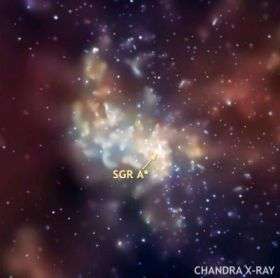
This Chandra image shows our Galaxy's center. The location of the black hole, known as Sagittarius A*, or Sgr A* for short, is arrowed. Credit: NASA/CXC/MIT/Frederick K. Baganoff et al.
Using NASA, Japanese, and European X-ray satellites, a team of Japanese astronomers has discovered that our galaxy’s central black hole let loose a powerful flare three centuries ago.
The finding helps resolve a long-standing mystery: why is the Milky Way’s black hole so quiescent? The black hole, known as Sagittarius A* (pronounced "A-star"), is a certified monster, containing about 4 million times the mass of our Sun. Yet the energy radiated from its surroundings is billions of times weaker than the radiation emitted from central black holes in other galaxies.
"We have wondered why the Milky Way’s black hole appears to be a slumbering giant," says team leader Tatsuya Inui of Kyoto University in Japan. "But now we realize that the black hole was far more active in the past. Perhaps it’s just resting after a major outburst."
The new study, which will appear in the Publications of the Astronomical Society of Japan, combines results from Japan’s Suzaku and ASCA X-ray satellites, NASA’s Chandra X-ray Observatory, and the European Space Agency’s XMM-Newton X-ray Observatory.
The observations, collected between 1994 and 2005, revealed that clouds of gas near the central black hole brightened and faded quickly in X-ray light as they responded to X-ray pulses emanating from just outside the black hole. When gas spirals inward toward the black hole, it heats up to millions of degrees and emits X-rays. As more and more matter piles up near the black hole, the greater the X-ray output.
These X-ray pulses take 300 years to traverse the distance between the central black hole and a large cloud known as Sagittarius B2, so the cloud responds to events that occurred 300 years earlier. When the X-rays reach the cloud, they collide with iron atoms, kicking out electrons that are close to the atomic nucleus. When electrons from farther out fill in these gaps, the iron atoms emit X-rays. But after the X-ray pulse passes through, the cloud fades to its normal brightness.
Amazingly, a region in Sagittarius B2 only 10 light-years across varied considerably in brightness in just 5 years. These brightenings are known as light echoes. By resolving the X-ray spectral line from iron, Suzaku’s observations were crucial for eliminating the possibility that subatomic particles caused the light echoes.
"By observing how this cloud lit up and faded over 10 years, we could trace back the black hole’s activity 300 years ago," says team member Katsuji Koyama of Kyoto University. "The black hole was a million times brighter three centuries ago. It must have unleashed an incredibly powerful flare."
This new study builds upon research by several groups who pioneered the light-echo technique. Last year, a team led by Michael Muno, who now works at the California Institute of Technology in Pasadena, Calif., used Chandra observations of X-ray light echoes to show that Sagittarius A* generated a powerful burst of X-rays about 50 years ago — about a dozen years before astronomers had satellites that could detect X-rays from outer space. "The outburst three centuries ago was 10 times brighter than the one we detected," says Muno.
The galactic center is about 26,000 light-years from Earth, meaning we see events as they occurred 26,000 years ago. Astronomers still lack a detailed understanding of why Sagittarius A* varies so much in its activity. One possibility, says Koyama, is that a supernova a few centuries ago plowed up gas and swept it into the black hole, leading to a temporary feeding frenzy that awoke the black hole from its slumber and produced the giant flare.
Launched in 2005, Suzaku is the fifth in a series of Japanese satellites devoted to studying celestial X-ray sources and is managed by the Japan Aerospace Exploration Agency (JAXA). This mission is a collaborative effort between Japanese universities and institutions and NASA Goddard.
Source: Goddard Space Flight Center
-
Japan electronic giants eye chip merger: reports
Feb 08, 2012 |
5 / 5 (1) |
0
-
NASA's Galaxy Evolution explorer in standby mode
Feb 08, 2012 |
3.5 / 5 (2) |
1
-
Chandra finds Milky Way's black hole grazing on asteroids
17 hours ago |
5 / 5 (5) |
6
-
Astronomy team discovers nearby dwarf galaxy
16 hours ago |
4.3 / 5 (4) |
5
-
Classic portrait of a barred spiral galaxy
Feb 03, 2012 |
4.7 / 5 (7) |
3
-
Engineers build first sub-10-nm carbon nanotube transistor
Feb 01, 2012 |
4.9 / 5 (31) |
30
-
Something old, something new: Evolution and the structural divergence of duplicate genes
Jan 31, 2012 |
4.6 / 5 (7) |
1
-
The hidden nanoworld of ice crystals: Revealing the dynamic behavior of quasi-liquid layers
Jan 30, 2012 |
5 / 5 (3) |
1
-
Stock market network reveals investor clustering
Jan 27, 2012 |
3.9 / 5 (23) |
8
-
Of microchemistry and molecules: Electronic microfluidic device synthesizes biocompatible probes
Jan 26, 2012 |
5 / 5 (1) |
0
-
Never ending outer space.....
15 hours ago
-
Neutron Star fragments?
17 hours ago
-
stationary or not?
21 hours ago
-
Scale of the Universe
Feb 10, 2012
-
Titan's lack of impact craters
Feb 09, 2012
-
Real pictures of black hole eating a star?
Feb 08, 2012
- More from Physics Forums - General Astronomy
More news stories
Salvage workers begin pumping fuel from Italian shipwreck
Salvage workers Sunday began pumping fuel from the shipwrecked Italian cruise liner Costa Concordia, a day ahead of schedule, officials said.
2 minutes ago |
not rated yet |
0
Latin America mining boom clashes with conservation
Latin America is experiencing a mining boom as prices rise fuelled by a hike in global demand, but the region is also being hit by a wave of violent protests, strikes and rallies by environmentalists.
8 hours ago |
not rated yet |
0
Political leaders play key role in how worried Americans are by climate change: study
More than extreme weather events and the work of scientists, it is national political leaders who influence how much Americans worry about the threat of climate change, new research finds.
Feb 06, 2012 |
5 / 5 (6) |
73
NASA budget will axe Mars deal with Europe: scientists
US President Barack Obama's budget proposal to be submitted next week for 2013 will cut NASA's budget by 20 percent and eliminate a major partnership with Europe on Mars exploration, scientists said Thursday.
Space & Earth / Space Exploration
Feb 10, 2012 |
5 / 5 (3) |
55
Humans may have helped the decline of African rainforests 3000 years ago
(PhysOrg.com) -- Large areas of rainforests in Central Africa mysteriously disappeared over three thousand years ago, to be replaced by savannas. The prevailing theory has been that the cause was a change ...
Scientists discover molecular secrets of 2,000-year-old Chinese herbal remedy
For roughly two thousand years, Chinese herbalists have treated Malaria using a root extract, commonly known as Chang Shan, from a type of hydrangea that grows in Tibet and Nepal. More recent studies suggest that halofuginone, ...
New method to examine batteries -- MRI from the inside
There is an ever-increasing need for advanced batteries for portable electronics, such as phones, cameras, and music players, but also to power electric vehicles and to facilitate the distribution and storage of energy derived ...
A mitosis mystery solved: How chromosomes align perfectly in a dividing cell
Although the process of mitotic cell division has been studied intensely for more than 50 years, Whitehead Institute researchers have only now solved the mystery of how cells correctly align their chromosomes during symmetric ...
Starve a virus, feed a cure? Findings show how some cells protect themselves against HIV
A protein that protects some of our immune cells from the most common and virulent form of HIV works by starving the virus of the molecular building blocks that it needs to replicate, according to research published online ...
Researchers find extensive RNA editing in human transcriptome
In a new study published online in Nature Biotechnology, researchers from BGI, the world's largest genomics organization, reported the evidence of extensive RNA editing in a human cell line by analysis of RNA-seq data, demons ...
The proteins ensuring genome protection
Researchers from the University of Geneva (UNIGE), Switzerland, have discovered the crucial role of two proteins in developing a cell 'anti-enzyme shield'. This protection system, which operates at the level of molecular ...
Apr 15, 2008
Rank: 1 / 5 (4)
http://www.scifor...=1820589&postcount=3
Apr 15, 2008
Rank: 4 / 5 (3)
........= A Wacky Theory
........= Assine Wishful Thinking
I could go on...