Early elephant 'was amphibious'
April 15, 2008 Early elephant 'was amphibious'

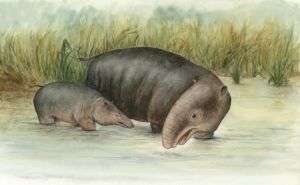
Moeritherium - an early elephant which we now know had an amphibious hippo-like lifestyle. Image: Luci Betti-Nash/Stony Brook University.

An ancient relative of today’s elephants lived in water, a team led by an Oxford University scientist has found.

The scientists were investigating the lifestyle of two early elephants (proboscideans) Moeritherium and Barytherium that lived in the Eocene period, over 37 million years ago. By analysing isotopes in tooth enamel from Moeritherium they were able to deduce that it was very likely a semi-aquatic mammal, spending its days in water eating freshwater plants.‘

We know from molecular data that modern elephants share a common ancestry with the sirenians - aquatic sea cows and dugongs,’ said Alexander Liu of Oxford’s Department of Earth Sciences, lead author of a report of the research published online in PNAS this week. ‘It suggests that elephants may have an ancestor which was amphibious in its mode of life and we wanted to know if Moeritherium or Barytherium was this semi-aquatic ancient relative. Unfortunately only fragments of the skeletons of these early elephants survive, so instead of looking at their bones we looked at the chemical composition of their teeth to determine what they ate and how they lived.’

Alex Liu, with colleagues Erik Seiffert from Stony Brook University (USA) and Elwyn Simons from the Duke Lemur Center (USA), analysed the oxygen and carbon isotope ratios contained within tooth enamel from both extinct proboscideans.

While carbon isotopes can give clues as to an animal’s diet, oxygen isotopes found in teeth come from local water sources - and variations in the ratios of these isotopes can indicate the type of environment the animal lived in. They compared the ratios of these isotopes to definitely terrestrial animals from the same period and these results – when combined with results from studies of embryology, molecular data, and sedimentology – lead them to believe that Moeritherium was semi-aquatic.

Alex Liu commented: ‘We now have substantial evidence to suggest that modern elephants do have ancient relatives which lived primarily in water. The next steps are to conduct similar analyses on other elephant ancestors to determine when the switch from water to land occurred, and to determine exactly when the now fully-aquatic sirenians split from their semi-aquatic proboscidean relatives.’

Source: Oxford University


print this article email this article download pdf blog this article bookmark this article     Stumble it Digg this share on Facebook retweet share on Reddit add to delicious
Rate this story - 4.2 /5 (14 votes)

Rank Filter

Move the slider to adjust rank threshold, so that you can hide some of the comments.


Display comments: newest first

  • earls - Apr 15, 2008
    • Rank: 5 / 5 (2)
    Interesting, makes sense I guess.

    No mention of the use of trunks or tusks?
  • zevkirsh - Apr 15, 2008
    • Rank: 1 / 5 (1)
    elephants are actually what happened when whales came back on land. i know this because i speak to elephants in their native elephantise.

April 15, 2008 all stories

Comments: 2

4.2 /5 (14 votes)
  • Stumble this up

  • Digg this

  • share this

  • hide
  • Related Stories

  • Diet secrets of 'the Royals' -- Elephant tail hair isotopes show cattle out-munch pachyderms
    created Apr 13, 2009 | popularity not rated yet | comments 0
  • A Buffet for Early Human Relatives 1.8 Million Years Ago
    created Nov 09, 2006 | popularity not rated yet | comments 0
  • Fish vision discovery makes waves in natural selection
    created Oct 16, 2009 | popularity not rated yet | comments 0
  • Kenya's hippos hard hit by drought
    created Aug 30, 2009 | popularity not rated yet | comments 0
  • Did dinosaurs hold their heads up?
    created May 27, 2009 | popularity not rated yet | comments 0


Other News

Wasp

Well-traveled wasps provide hope for vanishing species

Biology / Plants & Animals

created 1hour ago | popularity not rated yet | comments 0

They may only be 1.5mm in size, but the tiny wasps that pollinate fig trees can travel over 160km in less than 48 hours, according to research from scientists at the University of Leeds. The fig wasps are transporting ...


New discovery allows scientists for the first time to experimentally annotate genomes

New discovery allows scientists for the first time to experimentally annotate genomes

Biology / Biotechnology

created 21 minutes ago | popularity not rated yet | comments 0

Over the last 20 years, the sequencing of the human genome, along with related organisms, has represented one of the largest scientific endeavors in the history of mankind. The information collected from genome ...


Scientists successfully reprogram blood cells

Biology / Cell & Microbiology

created 1hour ago | popularity 5 / 5 (1) | comments 0

Researchers have transplanted genetically modified hematopoietic stem cells into mice so that their developing red blood cells produce a critical lysosomal enzyme -preventing or reducing organ and central nervous system damage ...


What is the meaning of 'one'? Evolutionary biologists argue for new meaning of 'organismality'

Biology / Evolution

created 5 hours ago | popularity 5 / 5 (1) | comments 1

Rice University evolutionary biologists David Queller and Joan Strassmann argue in a new paper that high cooperation and low conflict between components, from the genetic level on up, give a living thing its "organismality," ...


Study shows that some malignant tumors can be shut down after all

Biology / Cell & Microbiology

created 5 hours ago | popularity 5 / 5 (1) | comments 1

Oncologists have had their hands tied because more than half of all human cancers have mutations that disable a protein called p53. As a critical anti-cancer watchdog, p53 masterminds several cancer-fighting operations within ...