Biogas production is all in the mixing
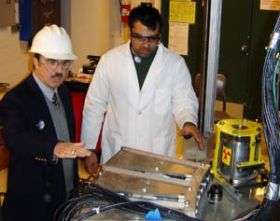
Engineers at Washington University in St. Louis, using an impressive array of imaging and tracking technologies, have determined the importance of mixing in anaerobic digesters for bioenergy production and animal and farm waste treatment. Anaerobic digesters employ reactors that use bacteria to break down organic matter in the absence of oxygen.
They are studying ways to take "the smell of money," as farmers long have termed manure's odor, and produce biogas from it. The major end product of anaerobic digestion is methane, which can be used directly for energy, converted to methanol, or, when partially oxidized, to synthesized gas, a mix of hydrogen and carbon monoxide. Synthesized gas then can be converted to clean alternative fuels and chemicals.
The goal is two-fold; one is to have farms that grow their own energy by using readily available farm waste to power the farm, the other is to eliminate the environmental threat of methane, a greenhouse gas considered 22 times worse than carbon dioxide.
Muthanna Al-Dahhan, Ph.D., Washington University professor of energy, environmental and chemical engineering; his postdoctoral fellow Khursheed Karim, Ph.D.; and his graduate students Rajneesh Varma, Mehuld Vesvikar and Rebecca Hoffman have determined that mixing is the most crucial step in the success of large, commercial anaerobic digesters that can react 15,000 gallons of manure. In addition to graduate students, numerous undergraduates have contributed to the research.
Al-Dahhan received a roughly $2.1 million grant from the U.S. Department of Energy in 2001 to research anaerobic digestion. Since 2004, he and various collaborators have published no fewer than 16 papers on their anaerobic digester studies, and many will follow. The most recent paper is published in Biotechnology and Bioengineering 100 (1): 38-48, 2008.
"Each year livestock operations produce 1.8 billion tons of cattle manure," Al-Dahhan said. "If it sits in fields, the methane from the manure is released into the atmosphere, or it can cause ground water contamination, dust or ammonia leaching, not to mention bad odors. Treating manure by anaerobic digestion gets rid of the environmental threats and produces bioenergy at the same time. That has been our vision."
A good mix
There are about 100 anaerobic digesters in operation in the United States, but a remarkably high percentage — 76 percent — regularly fail. Al-Dahhan and his colleagues at WUSTL, Oak Ridge National Laboratory and ultimately the Iowa Energy Center based in Ames, Iowa, studied the configuration, design, hydrodynamics and mixing parameters of reactors and their effects on the treatment performance and bioenergy production.
"A systematic study had never been done before, so we wanted to get a notion of what was behind the high failure rates reported," Al-Dahhan said. "We tested by gas injection, mechanical agitation, slurry circulation and liquid circulation and at different intensities. We found that, at laboratory scale (four liters), all of the different mixing modes performed adequately."
They then went to Oak Ridge Laboratory to a pilot plant and tested a reactor that held 100 liters.
"As size increased, we found mixing plays a very important role in successful operations," Al-Dahhan said. "Intensity of mixing also is important. We found that if intensity of mixing is reduced, failure often is a consequence."
Anaerobic digestion of manure is opaque, which means to understand the hydrodynamics of anaerobic digestion Al-Dahhan and colleagues developed a unique computer-automated, multi-particle radioactive tracking (MPRT) system, a novel dual source gamma ray computed tomography (DSCT), and computational fluid dynamic simulation. These tools allowed the researchers to see where and under what conditions biochemical stagnant — or dead — zones occurred. They also analyzed mixing systems, hydrodynamics, shear effect and reactor configuration.
"We then used all of our knowledge to redesign the commercial digester at the Iowa Energy Center to make an efficient and long-lasting operation," Al-Dahhan said. At WUSTL, Al-Dahhan and his student Rajneesh Varma collaborated with Joseph O'Sullivan, Ph.D., professor of electrical and systems engineering, on developing a new imaging reconstruction algorithm and program for the developed DSCT. With his student Rebecca Hoffman, Al-Dahhan collaborated with assistant professor of energy, environmental and chemical engineering Lars Angenent, Ph.D., on microbiology techniques and measurement of organisms' distribution.
"The research we've done provides the basis to scale up in the future, " he said. "The process is complex, but we're seeking to simplify it for use as a quick assessment and evaluation of the digester. The final goal is a simple system ready for use by farmers on site for bioenergy production and for animal and farm waste management."
Source: By Tony Fitzpatrick, Washington University in St. Louis


