NIST Micro Sensor and Micro Fridge Make Cool Pair
April 15, 2008 NIST Micro Sensor and Micro Fridge Make Cool Pair

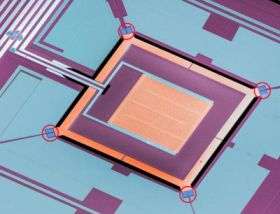
Colorized micrograph of a NIST chip combining four microrefrigerators (circled in red) with a superconducting sensor (large orange square in the middle). The self-cooling chip could be used for applications ranging from detailed X-ray analysis of semiconductors to detection of microwave signals in deep space. Credit: Credit: N. Miller, K. Talbott NIST

Researchers at the National Institute of Standards and Technology have combined two tiny but powerful NIST inventions on a single microchip, a cryogenic sensor and a microrefrigerator. The combination offers the possibility of cheaper, simpler and faster precision analysis of materials such as semiconductors and stardust.

As described in an upcoming issue of Applied Physics Letters, the NIST team combined a transition-edge sensor (TES), a superconducting thin film that identifies X-ray signatures far more precisely than any other device, with a solid-state refrigerator based on a sandwich of a normal metal, an insulator and a superconductor.

The combo chip, a square about a quarter inch on a side, achieved the first cooling of a fully functional detector (or any useful device) with a microrefrigerator. The paper also reports the greatest temperature reduction in a separate object by microrefrigerators: a temperature drop of 110 millikelvins (mK), or about a tenth of a degree Celsius.

TES sensors are most sensitive at about 100 mK (a tenth of a degree Celsius above absolute zero). However, these ultralow temperatures are usually reached only by bulky, complex refrigerators. Because the NIST chip can provide some of its own cooling, it can be combined easily with a much simpler refrigerator that starts at room temperature and cools down to about 300 mK, says lead scientist Joel Ullom. In this setup, the chip would provide the second stage of cooling from 300mK down to the operating temperature (100 mK).

One promising application is cheaper, simpler semiconductor defect analysis using X-rays. A small company is already commercializing an earlier version of TES technology for this purpose. In another application, astronomical telescopes are increasingly using TES arrays to take pictures of the early universe at millimeter wavelengths. Use of the NIST chips would lower the temperature and increase the speed at which these images could be made, Ullom says.

Source: National Institute of Standards and Technology


print this article email this article download pdf blog this article bookmark this article     Stumble it Digg this share on Facebook retweet share on Reddit add to delicious
Rate this story - 4.4 /5 (19 votes)

Rank Filter

Move the slider to adjust rank threshold, so that you can hide some of the comments.


Display comments: newest first

  • DGBEACH - Apr 16, 2008
    • Rank: not rated yet
    Is a 1/10th of a degree Celsius drop in temperature THIS big of a deal??? Am I missing something?
  • Bigfoot - Apr 16, 2008
    • Rank: not rated yet
    It doesn't seem to be that big of a deal, but it means that the technology is progressing.

April 15, 2008 all stories

Comments: 2

4.4 /5 (19 votes)
  • Stumble this up

  • Digg this

  • share this

  • hide
  • Related Stories

  • Novel 'noise thermometry' may help redefine international unit of temperature
    created Jun 03, 2008 | popularity not rated yet | comments 0
  • 'Radio Wave Cooling' Offers New Twist on Laser Cooling
    created Sep 14, 2007 | popularity not rated yet | comments 0
  • Small, low-noise oscillator may help in surveillance
    created Sep 16, 2006 | popularity not rated yet | comments 0
  • A Simpler Design for X-Ray Detectors
    created Sep 28, 2004 | popularity not rated yet | comments 0
  • Novel connector uses magnets for leak-free microfluidic devices
    created Nov 18, 2009 | popularity not rated yet | comments 0


  • hide
  • Relevant PhysicsForums posts

  • Rearranging the kinematic equations
    created 1hour ago
  • Calculating volume of earth
    created 1hour ago
  • magnetic repulsion force between two cylindrical magnets
    created 2 hours ago
  • Setting a circular polarization at an FBG
    created 2 hours ago
  • More from Physics Forums - General Physics

Other News

Spin polarization achieved in room temperature silicon

Spin polarization achieved in room temperature silicon

Physics / General Physics

created 8 hours ago | popularity 4.8 / 5 (9) | comments 0

(PhysOrg.com) -- A group in The Netherlands has achieved a first: injection of spin-polarized electrons in silicon at room temperature. This has previously been observed only at extremely low temperatures, ...


Multiferroic compounds used to produce smaller and cheaper digital memories

Multiferroic compounds used to produce smaller and cheaper digital memories

Physics / Condensed Matter

created 3 hours ago | popularity 5 / 5 (1) | comments 0

(PhysOrg.com) -- Is it possible to make even more compact digital memories for portable electronic devices and which consume even less energy? A team of French researchers has recently demonstrated that it ...


Superconductor magnet heat shield being developed

Superconductor magnet spacecraft heat shield being developed

Physics / General Physics

created Nov 26, 2009 | popularity 5 / 5 (20) | comments 21

(PhysOrg.com) -- European space agencies and an aerospace giant are developing a new re-entry heat shield that will use superconductor magnets to generate a magnetic field strong enough to deflect the superhot ...


Restored machine to explore mysteries of Big Bang (AP)

Restored machine to explore mysteries of Big Bang

Physics / General Physics

created Nov 21, 2009 | popularity 4.6 / 5 (18) | comments 26

(AP) -- Scientists are preparing the world's largest atom smasher to explore the depths of matter after successfully restarting the $10 billion machine following more than a year of repairs.


Scientists react as they stand in front of a screen at CERN

First atoms reported smashed in Large Hadron Collider (Update)

Physics / General Physics

created Nov 23, 2009 | popularity 4.5 / 5 (31) | comments 22

Two circulating beams on Monday produced the first particle collisions in the world's biggest atom smasher, the Large Hadron Collider (LHC), three days after its restart, scientists announced.