Fast AFM probes measure multiple properties of biomolecules or materials simultaneously
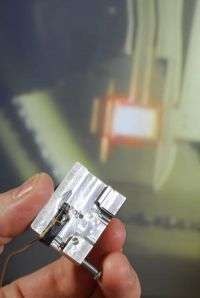
New research demonstrates that novel probe technology based on flexible membranes can replace conventional atomic force microscopy (AFM) cantilevers for applications such as fast topographic imaging, quantitative material characterization and single molecule mechanics measurements.
In addition to the standard AFM topography scan, these novel probes simultaneously measure material properties including adhesion, stiffness, elasticity and viscosity.
“Our probes attach directly to AFM systems currently on the market and can collect topography measurements at least 50 times faster than traditional cantilevers because they use electrostatic forces between the membrane and an electrode to move the tip,” said Levent Degertekin, a professor in the George W. Woodruff School of Mechanical Engineering at Georgia Tech. The research team also includes Guclu Onaran and Hamdi Torun, graduate students in the Georgia Tech School of Electrical and Computer Engineering.
Details of the novel force sensing integrated readout and active tip (FIRAT) probe and its biological applications were presented at the American Physical Society meeting in March. This research was funded by the National Institutes of Health and the National Science Foundation.
In current AFM systems, the sample surface is scanned by a cantilever with a sharp tip just a few nanometers in diameter at the end. An optical beam is bounced off the cantilever tip to measure the deflection of the cantilever as the sharp tip moves over the surface and interacts with the material being analyzed to determine the topography of the surface.
The new probe replaces the cantilever with a drum-like membrane from which a tip extends to scan the material sample. In one scanning mode, as the tip moves above a surface, it lightly taps the material. With each tap, the instrument gathers precise information about both the tip’s position and the forces acting on it, sensing the shape of the material and how stiff and sticky it is.
An output signal is generated only when there is an interaction force on the probe. In other words, transient interaction forces can be measured during each ‘tap’ of the tip with high resolution and without any background signal.
In the February 27 issue of the journal Nanotechnology, the researchers described using the FIRAT probe to characterize the elasticity, surface energy and adhesion hysteresis of three polymers and a silicon sample. The quantitative results were mapped in addition to topography.
FIRAT probes made of dielectric materials with embedded actuation electrodes have also been designed for operation in liquids. The design of these membrane-based probes also makes them relatively easy to arrange in arrays in which each probe can move independently. One application of such an array is fast parallel measurements of forces between biological molecules.
In collaboration with Cheng Zhu, Regents’ Professor in the Wallace H. Coulter Department of Biomedical Engineering, Degertekin is using the probe to measure the force between two interacting biological molecules and unbinding forces between two molecules.
By testing different molecules and buffer solutions, researchers can determine the probability of molecule adhesion, a process that requires many repetitive measurements. This has implications in drug discovery, where determining how frequently certain soft biological molecules adhere to each other is important.
“Rather than moving a single cantilever up and down a thousand times, we have developed a membrane that would allow parallel measurements of molecules to get thousands of measurements at one time,” said Degertekin.
This new technique was described in the February 2007 issue of the journal Nanotechnology.
For different applications, Degertekin can adjust the stiffness of the membranes.
“The best mechanical measurements of surfaces or biomolecules are obtained when the probe stiffness matches the sample stiffness,” explained Degertekin. “If you use a piezoelectric or any other linear actuator, you don’t have that phenomenon – you cannot soften things.”
By electrically changing the spring constant of the FIRAT probe, Degertekin can adjust the stiffness of the membranes, providing the ability to use the same probe to identify the mechanical properties of different samples – some soft and some stiff. This research was published in the December 2007 issue of the journal Applied Physics Letters.
“We know these probes improve the speed of AFM scans and provide increased information about a sample,” said Degertekin. “The next step is to batch fabricate them so that all researchers using AFM systems can benefit from these probes.”
Source: Georgia Institute of Technology


