Researchers stumped by drug addiction paradox
April 16th, 2008 By Lisa Zyga
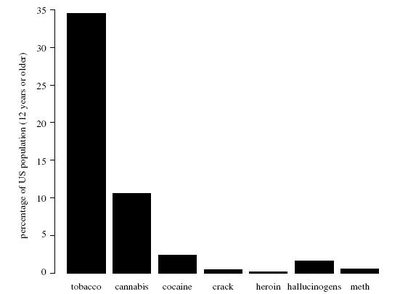
Data from the US National Survey on Drug Use and Health 2004: drug use in the last year. Credit: Sullivan, et al. ©2008 The Royal Society.
From chocolate and caffeine to nicotine and cocaine, many of our most addictive foods and drugs come from plant toxins. Considering that plants originally developed these toxins to deter herbivorous predators, it’s ironic that humans and other mammals don’t merely tolerate the toxins, but can crave them and even develop dependencies on them.
This paradox, presented by researchers in a new paper in Proceedings of the Royal Society B, works both ways: supposedly, the plants should never have developed toxins that reward animals for eating them, and humans should never have developed a reward mechanism for toxic plants.
In their study, Roger Sullivan from California State University and the UC Davis School of Medicine, Edward Hagen from Washington State University, and Peter Hammerstein from Humboldt University in Berlin suggest that the most widely accepted evolutionary explanation of human drug reward might not be on the right track, and that the origins of drug addiction may be even more complicated than previously thought.
“The greatest significance of the paper is in defining the paradox, and laying out the arguments in a manner that shows that it is a real conundrum and not a straw man argument,” Sullivan told PhysOrg.com. “The paradox has deep implications for current drug reward theory because it implicitly suggests that many of the key assumptions in current drug reward theory are flawed.”
Throughout history, plants have created their toxins by mimicking their own molecules that regulate metabolism, growth and reproduction. When ingested by herbivores, some of these molecules can interfere with nearly every step in the animal’s neural signaling process.
In current evolutionary interpretations of drug addiction, these toxic substances trigger the brain’s reward center by rewiring the brain’s natural reward circuits, and falsely indicating a fitness benefit and blocking painful feelings. But, as Sullivan, Hagen, and Hammerstein show, this explanation makes several assumptions that contradict evidence from previous studies. Most significantly, it assumes that humans evolved in environments without exposure to drugs, and that the brain never evolved to protect itself from plant toxins.
However, the researchers point to several other studies which show that the detoxification enzymes developed by animals (and which originally evolved in bacteria about 3.5 billion years ago) expanded in animals about 400 million years ago – about the same time that plants were evolving their own toxins. In other words, animals and plants seemed to have coevolved competitive genes in response to each other, which contradicts the evolutionary interpretation.
As the researchers investigated further, they compiled other studies showing evidence that humans inherited these detox genes from their mammalian ancestors. Interestingly, although many modern animal species can tolerate plant toxins, different species possess different detox function levels. Even among humans from different geographic locations, these functions differ. Often, human populations with greater numbers of toxin-metabolizing genes originate from parts of the world that contain an abundance of those plants. For example, human populations in and near Turkey have a very high frequency of enzymes that can metabolize opiates, and the opiate poppy is native to the Turkish region.
To conclude their argument against the evolutionary interpretation, the researchers explain that (pre-human) animals and plants did appear to have evolved the relevant genes simultaneously. If that’s the case, then the brain shouldn’t treat drugs as if they contained a fitness benefit, giving strong support to the paradox.
“We have been surprised by how robust the paradox is – that is, in presenting the arguments at scientific meetings for several years now, no one has been able to refute the basic argument that plant ecological models and neurobiological models of drug use are in direct conflict,” Sullivan said.
Many more questions also remain unanswered, but they may contain clues to an explanation. For example, there is contradictory evidence for whether commonly used drugs have become more or less potent as they’ve been domesticated. Also, as the researchers point out, current models explaining drug reward mechanisms don’t differentiate between different drugs – even though the pathways taken by opiates, cannabis, or any other drug are vastly different. Models of multiple-drug pathways might better explain drug appeal, the scientists suggest.
Based on evidence from previous studies, Sullivan, Hagen, and Hammerstein note that plant toxins may actually have some kind of benefit for animals. For instance, because plant toxins are more harmful to some species than to others, the less affected species might actually consume levels of toxin that are tolerable to themselves but much worse for the parasites or pathogens that feed on them in order to protect themselves. For example, earlier humans that consumed nicotine (in much smaller amounts than today) could have received the benefit of fewer parasitic infections. Of course, the benefits also come with trade-offs.
“The main implications for future research are that neurobiological theorists must consider facts emerging from plant ecology,” Sullivan said. “We are also planning field studies looking for relationships between human drug use and protection from helminth parasites.”
More information: Sullivan, Roger J.; Hagen, Edward H.; and Hammerstein, Peter. “Revealing the paradox of drug reward in human evolution.” Proc. R. Soc. B. doi:10.1098/rspb.2007.1673. (http://journals.royalsociety.org/content/ql240r18116x5870/)
Copyright 2008 PhysOrg.com.
All rights reserved. This material may not be published, broadcast, rewritten or redistributed in whole or part without the express written permission of PhysOrg.com.


Why describe these "drugs" as toxins. Our main-stream are remaking our vocabulary. Please be weary of semantics and the ploys of the manipulators. There exists many substances that are nutritional and essential in small amounts but are toxic in large amounts. However, we do not necessarily describe vitamin C as a toxin. Are all of the psychological prescription medicines toxins also?
As well I like the idea put forth on the nicotine - parasite relationship. Sort of a pseudosymbiotic relationship. Makes a person wonder how psychoactive compounds have shaped our evolution. Pretty much every ancient culture has used them in religious and spiritual contexts. Prohibition is a relatively new concept regarding wild plants.
Technically, the enjoyable "toxins" hardly work against the plant, as they are mass cultivated for their "toxin" thereby ensuring reproduction. Counter-intuitive, but effective.
I think high and holy jesus said it best however, that it's simply a bastardization of semantics. No "paradox" here.
Generally, yes.
The key thing to remember is that when your brain starts to die your perceive funky things. We just happen to have selected all the plants that produce good psychedelic effects on us. So studies like this one suffer from a simple selection bias. They purposefully ignored all plant toxins that DON'T interact with humans in a positive manner. If they hadn't done so, they'd have found a beautiful little bell curve of toxin interaction effects on humans ranging from horrible to good.
Good luck.
Have a nice day.
The parasite explanation might explain why organisms which were rewarded increased in frequency instead of decreasing, especially where these things grow. But as for the origin, it could have just been that amounts needed to kill insects only mildly inhibited larger animal's neural activity and, as with many such inhibitions, some just happened to inhibit brain areas which told our reward system to stay quiet.
Psalms 104:14 "He causeth the grass to grow for the cattle, and herb for the service of man."
Did not our feline companion pets evolve in similar fashion, for example?
What do you guys think?
humans appeared on the scene. Our ego
centric thoughts are also a toxin.
Create a paradox today, solve it tomorrow,
and get research funds both days.
I see very little, if any, paradox, and quite a few reasonable explanations. Symbiosis, differences in the abilities of prime predator (insects, dumb animals) and man, etc.
1. Does THC help the plant reproduce more?
2. Does THC thwart the plant from being eaten (bacteria, bugs, animals) before it can reproduce?
3. Does THC increase the plants longevity?
I prise the plants for their gifts!
It's an 'out there' theory, but hey I'm anonymous so what the hell, right?
http://www.physfo...ic=14988&st=195entry334377
A. From http://www.physor...887.html
"...it%u2019s ironic that humans and other mammals don%u2019t merely tolerate the toxins, but can crave them and even develop dependencies on them."
B. From http://www.physfo...top...95entry331389
"Don't apply anthropomorphic thinking-expectations. Apply genomorphic behaviour expectation.
From genomorphic considerations Survival At ALL circumstances, both with and without insectiside, is best and should be selected. And in the genome cooperative community survival is best when there is cooperation-synergism between individual genes. There is little native genes-cooperation with a single stranger in the community and more cooperation when two different strangers are implanted in the community."
C. Remeber, two interdependent organisms are involved in drug addiction
Where is the irony?
Likewise in this case, from the genomorphic considerations of the plant producing the toxin the more toxin seekers-cravers the more enhanced its own survivability.
Whereas in regards to the seekers-cravers, obviously since they do not feed back a rejection-damage to their genome, their base prime organism, why should their genome select an uncalled-for "defense modification-mutation"?.
(If/when our genome eventually selects a specific toxin defense gene it will take, as nature goes, many more years...)
Dov Henis
Plants and spices have been traded for millennia, and are the basis of most (all?) modern medicines. The original article just hopes to associate a few popular plants with the words toxin and addiction, whilst admitting it is totally stumped as to the meaning of it all. - a null hypothesis surely ...??
snwboardn has it right. I have never read, in one location, comments from a more confused band of quasi-intellectuals. If you are to follow the theory of evolution, it is not that the plants decide what makes them more or less fit to survive, but that the qualities of those that do survive are passed on to other generations.
In other words, the plants don't choose, the choice is made for them by nature.
Addictive behaviors in modern humans don't occur naturally; they are an acquired behavior of self medication to offset abnormally low stress tolerance (insufficient cellular redox maintenance and altered neurotransmitter activity). The authors assertion of a supposed paradox is strange. Substance abuse is a relatively modern issue. Nicotine, cocaine and cannabis use was limited not widespread, and often restricted by cost and supply. Before widespread cultivation and trade (within the last 500 years out of tens of thousands of years of human history), their use was localized (example: cannabinoid use pre-1500 was confined to India) and often ritualized. Primary example: historic use of hallucinogenic plants by shamans in many regions of the world.
That these behavior-altering compounds are widely abused speaks to the problems of mental health and wellness of modern society.
many plants likely "take advantage" (through selective processes, not via intention) of this; the ones we like, we propagate. the ones we propagate survive to reproduce, and often even spread as the human animal spreads. it's worked for corn, wheat, soy, cannabis, and so on.