Methane sources over the last 30,000 years
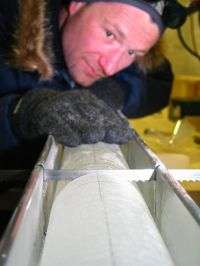
Ice cores are essential for climate research, because they represent the only archive which allows direct measurements of atmospheric composition and greenhouse gas concentrations in the past. Using novel isotopic studies, scientists from the European Project for Ice Coring In Antarctica (EPICA) were now able to identify the most important processes responsible for changes in natural methane concentrations over the transition from the last ice age into our warm period.
The study now published in the scientific magazine nature shows that wetland regions emitted significantly less methane during glacial times. In contrast methane emissions by forest fire activity remained surprisingly constant from glacial to interglacial times.
In the current issue of Nature, members of the EPICA team publish new insights into natural changes in the atmospheric concentrations of the second most important greenhouse gas methane (CH4). The scientist present the first glacial/interglacial record of the carbon isotopic composition of methane (δ13CH4) providing essential information on the sources being responsible for the observed CH4 concentration changes.
The well known glacial/interglacial changes in atmospheric methane concentrations are quite drastic. Glacial concentration were on average 350 ppbv (part per billion by volume) and increased to approximately 700 ppbv during the last glacial/interglacial transition superimposed by rapid shifts of about 200 ppbv connected to rapid climate changes. During the last centuries human methane emissions artificially increased CH4 concentrations to approximately 1750 ppbv.
But what caused these substantial changes in natural atmospheric CH4 concentrations prior to the human impact? To answer this question, the scientists developed a new analytical method that now allows to quantify changes in the isotopic ratio of 12CH4 and 13CH4 in ice core samples. This ratio provides insight into the responsible methane sources.
“These studies bring us much closer to a quantitative understanding of what happened with wetlands and methane in the past”, says Dr. Hubertus Fischer from the Alfred-Wegener-Institute for Polar and Marine Research, who is the lead author of the publication and coordinator of the gas studies on the EPICA ice cores. “This is essential to also improve our predictions of how the methane cycle will respond to an increased warming in the future”, he adds.
The study shows, that tropical wetlands emitted substantially less CH4 during glacials; most likely caused by changes in monsoonal precipitation patterns. Together with a reduced atmospheric lifetime, this explains major parts of the glacial CH4 reduction. In addition, boreal methane sources located in wetlands in higher northern latitudes were essentially switched off during the glacial due to the expansion of the northern ice sheets and the very cold temperatures in high northern latitude. However, these high latitude wetlands were quickly reactivated when rapid climate warming events occurred. Also forest fires emit a considerable amount of CH4, which, however, remained surprisingly constant over time. The isotopic measurements show no signs of CH4 emissions by a destabilization of marine gas hydrate reservoirs when climate was warming.
The current results were published by a team of scientist from Germany, France and Switzerland. As the German partner within EPICA, the Alfred-Wegener-Institute was responsible for the drilling operation of the ice core used for this study. In addition, it specialized on the development of new analytical techniques to measure isotopes in greenhouse gases and the interpretation of changes in biogeochemical cycles in the past. Coordinated by the European Science Foundation (ESF), EPICA is funded by the participating countries and the European Union. EPICA is one of the core projects of the AWI Research Program “Maritime, Coastal and Polar Systems” in the “Earth and Environment” research section of the Helmholtz-Gemeinschaft. For its outstanding effort and large impact on climate research, EPICA has recently received the Descartes Prize for Transnational, Collaborative Research awarded by the European Commission.
Source: Helmholtz Association of German Research Centres


