Bloodless Worm Sheds Light on Human Blood, Iron Deficiency
April 16, 2008
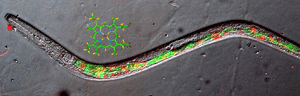
A C. elegans worm expressing the Green Fluorescent Protein and a fluorescent heme molecule (red) in the intestine. Credit: Jason Sinclair and Iqbal Hamza
Using a lowly bloodless worm, University of Maryland researchers have discovered an important clue to how iron carried in human blood is absorbed and transported into the body. The finding could lead to developing new ways to reduce iron deficiency, the world's number one nutritional disorder.
With C. elegans , a common microscopic worm that lives in dirt, Iqbal Hamza, assistant professor of animal and avian sciences, and his team identified previously unknown proteins that are key to transporting heme, the molecule that creates hemoglobin in blood and carries iron. It is a critical step in understanding how our bodies process iron. Their findings are published in the April 16 issue of Nature online.
"The structure of hemoglobin has been crystallized over and over," says Hamza, "but no one knows how the heme gets into the globin, or how humans absorb iron, which is mostly in the form of heme.
"To understand the underlying issues of nutritional and genetic causes of iron deficiency, we are looking at the molecules and mechanisms involved in heme absorption. Once you understand transport of heme, you can more effectively deliver it to better absorb iron in the human intestine."
Heme and Blood
Heme is a critical molecule for health in all eukaryotes, organisms whose cells are organized into complex structures enclosed in membranes. Species of eukaryotes range from humans to baker's yeast. Heme makes blood red and binds to oxygen and other gases we need to survive.
Heme is created in the mitochondria, then moves through pathways that connect other cells, where it is synthesized to form blood. Heme on its own, however, is toxic. "We wanted to find out how heme gets carried between and within cells," said Hamza.
A Bloodless Worm
Eight steps are required to generate heme, making it a difficult process to control in the study of heme transport pathways, as Hamza learned when he first studied the question in bacteria and mice.
So Hamza did the non-intuitive thing. He chose a test subject that doesn't make heme, but needs it to survive, that doesn't even have blood, but shares a number of genes with humans - the C. elegans roundworm, a simple nematode.
"We tried to understand how blood is formed in an animal that doesn't have blood, that doesn't turn red, but has globin," Hamza said.
C. elegans gets heme by eating bacteria in the soil where it lives. "C. elegans consumes heme and transports it into the intestine. So now you have a master valve to control how much heme the animal sees and digests via its food," Hamza explains.
C. elegans has several other benefits for studying heme transport. Hamza's team could control the amount of heme the worms were eating. With only one valve controlling the heme transport, the scientists knew exactly where heme was entering the worm's intestine, where, as in humans, it is absorbed.
And C. elegans is transparent, so that under the microscope researchers could see the movement of the heme ingested by the worm.
Genes and Iron Deficiency
The study revealed several findings that could lead to new treatment for iron deficiency. One was the discovery that genes are involved in heme transport. Hamza's group found that HRG-1 genes, which are common to humans and C. elegans , were important regulators of heme transport in the worm.
To test their findings in an animal that makes blood, Hamza's team removed the HRG-1 gene in zebrafish. The fish developed bone and brain defects, much like birth defects. The gene removal also resulted in a severe form of anemia usually caused by iron deficiencies.
When they substituted the zebrafish gene with the worm HRG-1 gene, the mutant fish returned to normal, indicating that the fish and worm genes are interchangeable, irrespective of the animal's ability to make blood.
They also found that too little or too much heme can kill C. elegans , a result that could help researchers find ways to treat people who suffer from iron deficiency caused by parasitic worms.
"More than two billion people are infected with parasites," says Hamza. "Hookworms eat a huge amount of hemoglobin and heme in their hosts. If we can simultaneously understand heme transport pathways in humans and worms, we can exploit heme transport genes to deliver drugs disguised as heme to selectively kill parasites but not harm the host."
Link: Nature paper http://www.nature. … re06934.html
Source: University of Maryland
-
Researchers show how iron activates oxygen in living things
Nov 18, 2011 |
4.3 / 5 (3) |
0
-
Worm study yields insights on humans, parasites and iron deficiency
May 26, 2011 |
5 / 5 (1) |
0
-
Another iron in the fire
Apr 19, 2011 |
not rated yet |
0
-
Iowa State, Ames Lab researcher hunts for green catalysts
Mar 07, 2011 |
not rated yet |
0
-
Lightning rod for head and neck cancer
Jan 31, 2011 |
5 / 5 (1) |
0
-
Engineers build first sub-10-nm carbon nanotube transistor
Feb 01, 2012 |
4.9 / 5 (33) |
30
-
Something old, something new: Evolution and the structural divergence of duplicate genes
Jan 31, 2012 |
4.6 / 5 (7) |
1
-
The hidden nanoworld of ice crystals: Revealing the dynamic behavior of quasi-liquid layers
Jan 30, 2012 |
5 / 5 (4) |
1
-
Stock market network reveals investor clustering
Jan 27, 2012 |
3.9 / 5 (23) |
8
-
Of microchemistry and molecules: Electronic microfluidic device synthesizes biocompatible probes
Jan 26, 2012 |
5 / 5 (2) |
0
-
Is Everyday Technology Killing Us?
Feb 08, 2012
-
Exercise and weight loss
Feb 08, 2012
-
Why do we have head aches? Our brains can't feel anything.
Feb 07, 2012
-
"The end of diseases" by David Agus, interview from Daily Show with Jon Stewart
Feb 04, 2012
-
Oncolytic adenovirus
Feb 04, 2012
-
Nutrition label stuffs and diets
Feb 02, 2012
- More from Physics Forums - Medical Sciences
More news stories
Starve a virus, feed a cure? Findings show how some cells protect themselves against HIV
A protein that protects some of our immune cells from the most common and virulent form of HIV works by starving the virus of the molecular building blocks that it needs to replicate, according to research published online ...
11 hours ago |
5 / 5 (2) |
0
|
Overeating may double risk of memory loss
New research suggests that consuming between 2,100 and 6,000 calories per day may double the risk of memory loss, or mild cognitive impairment (MCI), among people age 70 and older. The study was released today and will be ...
Medicine & Health / Neuroscience
7 hours ago |
5 / 5 (2) |
0
|
Injured boomers beware: Know when to see doctor
(AP) -- It happened to nurse Jane Byron years after an in-line skating fall, business owner Haralee Weintraub while doing "men's" push-ups, and avid cyclist Gene Wilberg while lifting a heavy box.
12 hours ago |
5 / 5 (1) |
0
Declining health-care productivity in England: Who says so?
Reports that the National Health Service in England has been declining in productivity in the last decade appear to have been accepted as fact. However, a Viewpoint published Online First by The Lancet disputes this. The Vi ...
5 hours ago |
1 / 5 (1) |
0
FDA-approved drug rapidly clears amyloid from the brain, reverses Alzheimer's symptoms in mice
Neuroscientists at Case Western Reserve University School of Medicine have made a dramatic breakthrough in their efforts to find a cure for Alzheimer's disease. The researchers' findings, published in the journal Science, show t ...
Medicine & Health / Neuroscience
Feb 09, 2012 |
4.9 / 5 (58) |
17
|
Scientists discover molecular secrets of 2,000-year-old Chinese herbal remedy
For roughly two thousand years, Chinese herbalists have treated Malaria using a root extract, commonly known as Chang Shan, from a type of hydrangea that grows in Tibet and Nepal. More recent studies suggest that halofuginone, ...
New method to examine batteries -- MRI from the inside
There is an ever-increasing need for advanced batteries for portable electronics, such as phones, cameras, and music players, but also to power electric vehicles and to facilitate the distribution and storage of energy derived ...
Google might launch Drive for cloud storage soon
(PhysOrg.com) -- Google's next big move, according to the Wall Street Journal, is a cloud storage service called Drive. Hardly first to the plate, Google is simply catching up to introducing its cloud reposi ...
A mitosis mystery solved: How chromosomes align perfectly in a dividing cell
Although the process of mitotic cell division has been studied intensely for more than 50 years, Whitehead Institute researchers have only now solved the mystery of how cells correctly align their chromosomes during symmetric ...
Lab study raises questions over nano-particle impact
Tests involving chickens have raised questions about the impact on health from engineered nano-particles, the ultra-fine grains commonly used in drugs and processed foods, scientists said on Sunday.
Researchers find extensive RNA editing in human transcriptome
In a new study published online in Nature Biotechnology, researchers from BGI, the world's largest genomics organization, reported the evidence of extensive RNA editing in a human cell line by analysis of RNA-seq data, demons ...