From cartilage to fruit-fly wings, physicist studies 'squishiness' in everyday things
Cartilage is essential to movement in the human body, cushioning bones and joints, while retaining its shape despite a lot of pressure, poking and prodding. Unfortunately, it also often starts breaking down after 60 or so years, leading to such conditions as osteoarthritis and painful inflammations.
Figuring out the physics of how cartilage moves, is compressed, twisted and otherwise deformed to eventually be replaced by better, longer-lasting artificial cartilage are some goals of Itai Cohen as he directs his lab at Cornell.
Though Cohen works with biological materials, he is a physicist, not a doctor or biologist. His broad interests lie in the properties of complex fluids and soft condensed matter. More simply put, Cohen is fascinated by things that have a little squish to them (think cornstarch, silly putty, toothpaste, paint, cells and blood).
Cohen, who can use the words "gorgeous" and "fluid dynamics" in the same breath, speaks with infectious enthusiasm about the materials that fill our lives and that display such unique characteristics.
"These are everyday materials you see in your kitchen or at your breakfast table," said Cohen, who joined the Cornell faculty in 2005 as an assistant professor of physics. "The idea behind them is that you have both liquid-like and solid-like properties combined in the same material."
Having such a vast interest area as soft condensed matter gives Cohen a reason to be involved in a wide berth of projects. Besides his lab's tissue-deformation work, he also collaborates with Chekesha Liddell in materials science and engineering and Fernando Escobedo in chemical and biomolecular engineering on colloidal suspensions.
He is also deeply involved in a three-way collaboration with faculty in theoretical and applied mechanics, biology and computational biology, studying the evolution of flight by observing and calculating the flight patterns of fruit flies.
The common theme in all these projects, he says, is seeing how the time dependence and structure of fluids and other complex matter, at different length scales, change the behavior of the materials.
Take human cartilage -- it is a classic biological example of soft condensed matter. It's enormously complicated and intricately layered, consisting of collagen fibers, proteoglycans, which are charged, brush-like molecules; and chondrocytes, which are types of cells.
He is trying to discover how all these materials are layered together to achieve cartilage's unique mechanical properties, such as its ability to retain its shape and strength despite external forces: pressure, twisting or shear (parallel strain).
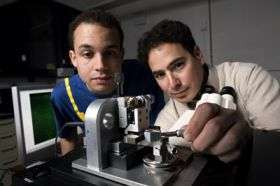
Cohen's graduate student Mark Buckley has developed a machine called a tissue deformation device, which Cohen's group is working to commercialize in partnership with Pleasantville, N.Y.-based Harrick Scientific. The machine helps the group recreate the strains placed on a real piece of cartilage. Using specimens from cows, they load the 3-millimeter cube of cartilage into the machine, which pokes, shears, squeezes and tugs the cartilage as it sits in a saline bath.
Using an attached confocal microscope, they can then observe and record the 3-D structure of the cartilage at varying depth and length scales, as well as the way it responds to stimuli.
The machine isn't just for shearing cartilage. It also works for such biological tissues as sclera (the white part of the eye), the cornea and other hard tissues.
These efforts toward understanding cartilage might lead to building better artificial joints and to further the scientific knowledge of how cartilage withstands stress in the human body.
Osteoarthritis is a mystery to many scientists, but it's clear that the deformation of cartilage is a key component to studying the disease.
"Whether the disease starts at the surface of the cartilage and works its way down to the bone, or it starts at the bone-cartilage interface and works up to the surface -- nobody knows," Cohen said. "Nobody has really been able to compare healthy and damaged tissue on the scale that we're doing it."
Source: Cornell University


