Mars radar opens up a planet’s third dimension
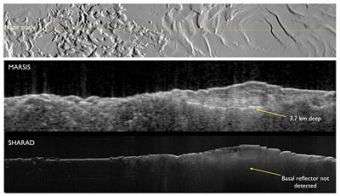
April 17, 2008 South polar layered deposit on Mars

South polar layered deposit (SPLD) on Mars. The Mars Express radar experiment, MARSIS, was designed to penetrate deep and it has delivered on its promise. The above figure shows the base of the SPLD at the deepest recorded point of 3.7 km. In contrast, The Shallow Subsurface Radar (SHARAD) on NASA’s Mars Reconnaissance Orbiter designed as a high-resolution radar for a maximum penetration of 1 km has difficulty detecting the SPLD base. The two complementary instruments work together to discover hidden martian secrets. Credits: MARSIS: ESA/NASA/ASI/JPL-Caltech/University of Rome; SHARAD: NASA/JPL-Caltech/ASI/University of Rome/Washington Universtiy in St. Louis

ESA’s Mars Express radar sounder, MARSIS, has looked beneath the martian surface and opened up the third dimension for planetary exploration. The technique’s success is prompting scientists to think of all the other places in the Solar System where they would like to use radar sounders.

No matter how accurate a camera is, it can only map a planet’s surface. To retrieve information about the underground realm, planetary scientists in the past would have thought it necessary to land on the surface and start digging. But that would only be good for a single spot on a large planet and the first few decimetres of the surface.

To get the global picture of the subsurface they need a radar sounder, such as the Mars Advanced Radar for Subsurface and Ionosphere Sounding (MARSIS), to find the best spots for the future landers to go and dig.

MARSIS was an experiment in every sense of the word. “It was a leap into the unknown,” says Ali Safaeinili, MARSIS co-investigator at the Jet Propulsion Laboratory (JPL), California, USA.

No one had ever used a radar sounder from orbit on another planet before. So the team could not even be sure whether it would work as planned. The subsurface of the planet might have been too opaque to the radar waves or the upper levels of martian atmosphere (ionosphere) might have distorted the signal too much to be useful. Thankfully, none of this happened.

“We have demonstrated that the polar caps at Mars are mostly water ice, and produced an inventory so now we know exactly how much water there is,” says Roberto Orosei, MARSIS Deputy Principal Investigator, IASF-INAF, Italy.

Armed with a better understanding of how planetary radar sounders work, the MARSIS team is beginning to look further afield in the Solar System, to other bodies that might benefit from radar investigation. One obvious target is Jupiter’s icy moon, Europa.

A MARSIS-type experiment in orbit around Europa could probe its icy crust to help understand the puzzling features we see on the surface. It may even see the interface at the bottom of the ice where an ocean is expected to begin.

At Saturn’s moon, Titan, penetrating radar could be used to measure the depths of the hydrocarbon lakes that the Cassini spacecraft has detected. It could also probe the structure beneath the enigmatic geysers that Cassini has observed on another one of Saturn’s satellites, Enceladus. “Radar sounders are very well suited to exploring icy worlds,” says Orosei.

But not just for icy moons. Asteroids and comets could be thoroughly scanned by a radar sounder, producing three-dimensional maps of their interior – perhaps exactly the data we will need if, one day, we have to nudge one out of Earth’s way.

MARSIS has served as an excellent example of international collaboration between Europe and America. Increasingly, such collaborations are set to become a positive feature of our joint exploration of space.

Source: ESA


print this article email this article download pdf blog this article bookmark this article     Stumble it Digg this share on Facebook retweet share on Reddit add to delicious
Rate this story - 4 /5 (20 votes)

Rank Filter

Move the slider to adjust rank threshold, so that you can hide some of the comments.


Display comments: newest first

  • out7x - Apr 18, 2008
    • Rank: 3 / 5 (1)
    Mars polar ice? There is alot of doubt about this. Ice mixed with soil, or frozen CO2?

April 17, 2008 all stories

Comments: 1

4 /5 (20 votes)
  • Stumble this up

  • Digg this

  • share this

  • hide
  • Related Stories

  • Mars Express observes aurorae on the red planet
    created Nov 21, 2008 | popularity not rated yet | comments 0
  • Scientists close in on the origin of Mars' larger moon
    created Oct 16, 2008 | popularity not rated yet | comments 0
  • Mars Express to rendezvous with Martian moon
    created Jul 16, 2008 | popularity not rated yet | comments 0
  • Icy Promethei Planum
    created Mar 12, 2008 | popularity not rated yet | comments 0
  • ESA presents Mars in 3D
    created Feb 05, 2008 | popularity not rated yet | comments 0


  • hide
  • Relevant PhysicsForums posts

  • Question about 2-body gravity
    created Nov 24, 2009
  • life on Mars
    created Nov 24, 2009
  • Semi-major axis from cartesian co-ordinates
    created Nov 23, 2009
  • Primary Mirror grinding
    created Nov 23, 2009
  • More from Physics Forums - General Astronomy

Other News

Cosmic 'dig' reveals vestiges of the Milky Way's building blocks

Cosmic 'Dig' Reveals Vestiges of the Milky Way's Building Blocks

Space & Earth / Astronomy

created 10 hours ago | popularity 4.9 / 5 (13) | comments 1

(PhysOrg.com) -- Peering through the thick dust clouds of our galaxy's "bulge" (the myriads of stars surrounding its center), a team of astronomers has unveiled an unusual mix of stars in the stellar grouping ...


No Wheel Stall in Diagnostic Drive

Spirit Mars Rover: No Wheel Stall in Diagnostic Drive

Space & Earth / Space Exploration

created 6 hours ago | popularity 5 / 5 (1) | comments 0

(PhysOrg.com) -- On Sol 2095 (Tuesday, Nov. 24), Spirit performed a set of diagnostic actions related to a stall of the right-rear wheel on the previous drive, three days earlier.


Monster Waves on the Sun are Real

Monster Waves on the Sun are Real (w/ Video)

Space & Earth / Astronomy

created 5 hours ago | popularity 5 / 5 (8) | comments 0

Sometimes you really can believe your eyes. That's what NASA's STEREO (Solar Terrestrial Relations Observatory) spacecraft are telling researchers about a controversial phenomenon on the sun known as the "solar ...


Oceanic crust formation is dynamic after all

Oceanic crust formation is dynamic after all

Space & Earth / Earth Sciences

created 9 hours ago | popularity 4.5 / 5 (4) | comments 0

Imagine the Earth's crust as the planet's skin: Some areas are old and wrinkled while others have a fresher, more youthful sheen, as if they had been regularly lathered with lotion.


Climate experts debate strategies for reducing atmospheric carbon and future warming

Climate experts debate strategies for reducing atmospheric carbon and future warming

Space & Earth / Environment

created 6 hours ago | popularity 2.6 / 5 (5) | comments 5

(PhysOrg.com) -- Reducing carbon dioxide to safe levels may require extracting carbon from the air, says Cornell climate researcher.