Graphene used to create world's smallest transistor
April 17, 2008 Graphene used to create world's smallest transistor

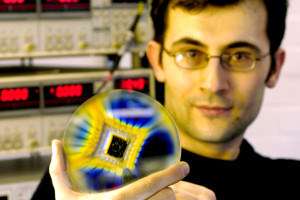
A Manchester researcher shows graphene quantum dots on a chip.

Researchers have used the world's thinnest material to create the world's smallest transistor, one atom thick and ten atoms wide.

Reporting their peer-reviewed findings in the latest issue of the journal Science, Dr Kostya Novoselov and Professor Andre Geim from The School of Physics and Astronomy at The University of Manchester show that graphene can be carved into tiny electronic circuits with individual transistors having a size not much larger than that of a molecule.

The smaller the size of their transistors the better they perform, say the Manchester researchers.

In recent decades, manufacturers have crammed more and more components onto integrated circuits. As a result, the number of transistors and the power of these circuits have roughly doubled every two years. This has become known as Moore's Law.

But the speed of cramming is now noticeably decreasing, and further miniaturisation of electronics is to experience its most fundamental challenge in the next 10 to 20 years, according to the semiconductor industry roadmap.

At the heart of the problem is the poor stability of materials if shaped in elements smaller than 10 nanometres in size. At this spatial scale, all semiconductors -- including silicon -- oxidise, decompose and uncontrollably migrate along surfaces like water droplets on a hot plate.

Four years ago, Geim and his colleagues discovered graphene, the first known one-atom-thick material which can be viewed as a plane of atoms pulled out from graphite. Graphene has rapidly become the hottest topic in physics and materials science.

Now the Manchester team has shown that it is possible to carve out nanometre-scale transistors from a single graphene crystal. Unlike all other known materials, graphene remains highly stable and conductive even when it is cut into devices one nanometre wide.

Graphene transistors start showing advantages and good performance at sizes below 10 nanometres - the miniaturization limit at which the Silicon technology is predicted to fail.

"Previously, researchers tried to use large molecules as individual transistors to create a new kind of electronic circuits. It is like a bit of chemistry added to computer engineering", says Novoselov. "Now one can think of designer molecules acting as transistors connected into designer computer architecture on the basis of the same material (graphene), and use the same fabrication approach that is currently used by semiconductor industry".

"It is too early to promise graphene supercomputers," adds Geim. "In our work, we relied on chance when making such small transistors. Unfortunately, no existing technology allows the cutting materials with true nanometre precision. But this is exactly the same challenge that all post-silicon electronics has to face. At least we now have a material that can meet such a challenge."

"Graphene is an exciting new material with unusual properties that are promising for nanoelectronics", comments Bob Westervelt, professor at Harvard University. "The future should be very interesting".

A paper entitled "Chaotic Dirac Billiard in Graphene Quantum Dots" is published in April 17 issue of Science. It is accompanied by a Perspective article entitled "Graphene Nanoelectronics" by Westervelt.

Source: University of Manchester


print this article email this article download pdf blog this article bookmark this article     Stumble it Digg this share on Facebook retweet share on Reddit add to delicious
Rate this story - 4.6 /5 (50 votes)

Rank Filter

Move the slider to adjust rank threshold, so that you can hide some of the comments.


Display comments: newest first

  • out7x - Apr 18, 2008
    • Rank: 1.7 / 5 (3)
    A single atom is a transistor. Input photon, output photon. Electron energy level changes.
  • Agisman - Apr 18, 2008
    • Rank: not rated yet
    A single atom doesn't really act like a transistor. While I can see your argument for the change of energy level, it doesn't typically work in that fashion. In an atom, quantum dot, semiconductor or any multi-level system, there are simple conditions that cause radiative (photon producing) transitions.

    Let's say you put in a photon of x-ray energy and it knocks out a core electron of characteristic energy. Not quite a photon, but similar process. This is the basis for x-ray photoelectron spectroscopy. If you put in a beam of electrons, you can populate high energy states which decay to stable energy states emitting a photon. This is the basis for inverse photoemission.

    Shining a photon in and getting a photon out at the same energy is. This is our old friend from the LASER. Unfortunately, you have to pump the upper energy levels to allow for radiative transitions to the lower states. In that case, you know both energy levels and aren't getting any information out. If we talk about phosphorescence and luminescence, you are just converting a higher energy photon into a lower energy photon through band transitions. Not sure what information you can get out from a single radiative transition because they are difficult to localize at the atomic level.

    This article is a bit more about the quantum confinement in graphene quantum dots. The PMMA and E-beam technique is rather neat but getting consistent thicknesses of defect-free graphene is very difficult as they mention. There are lots of ways of making graphene but none is yet to a reliable stage. Getting a device to commercial viability generally requires 99.9999% yield or better. That's the only way a multi-billion dollar wafer 'fab' can sell you chips for pennies.
  • Mercury_01 - Apr 18, 2008
    • Rank: 1 / 5 (1)
    Nuh- uh!
  • ezezz - Apr 18, 2008
    • Rank: 3 / 5 (1)
    Hm, perhaps a lower yield can be tolerated. Since the carbon itself is dirt cheap maybe you can scale the production of wafers to such a degree that you can afford to throw out a few thousand for every good one.

April 17, 2008 all stories

Comments: 4

4.6 /5 (50 votes)
  • Stumble this up

  • Digg this

  • share this

  • hide
  • Related Stories

  • Stretching opens up possibilities for graphene
    created Sep 28, 2009 | popularity not rated yet | comments 0
  • From graphene to graphane, now the possibilities are endless
    created Jul 31, 2009 | popularity not rated yet | comments 0
  • Graphene Shows High Current Capacity and Thermal Conductivity
    created Jul 29, 2009 | popularity not rated yet | comments 0
  • Graphene -- the copy beats the original
    created Jul 17, 2009 | popularity not rated yet | comments 0
  • New wonder material, one-atom thick, has scientists abuzz
    created Jul 13, 2009 | popularity not rated yet | comments 0


  • hide
  • Relevant PhysicsForums posts

  • Work done on femur
    created 1hour ago
  • Magnet and Motors?
    created 2 hours ago
  • Effect of Volume on Revolution
    created 3 hours ago
  • Hydrostatic pressure
    created 4 hours ago
  • More from Physics Forums - General Physics

Other News

Findings show nanomedicine promising for treating spinal cord injuries

Findings show nanomedicine promising for treating spinal cord injuries

Nanotechnology / Bio & Medicine

created 4 hours ago | popularity 5 / 5 (1) | comments 0

(PhysOrg.com) -- Researchers at Purdue University have discovered a new approach for repairing damaged nerve fibers in spinal cord injuries using nano-spheres that could be injected into the blood shortly ...


New Digital 'Electronics' Concept May Continue Moore's Law

New Digital 'Electronics' Concept May Continue Moore's Law

Nanotechnology / Nanophysics

created Nov 05, 2009 | popularity 4.6 / 5 (51) | comments 9

(PhysOrg.com) -- Computers of the future could be operating not on electrons, but on tiny waves traveling through an electron "fluid," if a new proposal is successful. The new circuit design, recently introduced ...


Nanoparticles for gene therapy improve

Nanoparticles for gene therapy improve

Nanotechnology / Bio & Medicine

created Nov 06, 2009 | popularity 5 / 5 (4) | comments 3

(PhysOrg.com) -- About five years ago, Professor Janet Sawicki at the Lankenau Institute in Pennsylvania read an article about nanoparticles developed by MIT's Robert Langer for gene therapy, the insertion ...


Breakthrough in industrial-scale nanotube processing

Breakthrough in industrial-scale nanotube processing

Nanotechnology / Nanomaterials

created Nov 02, 2009 | popularity 4.9 / 5 (20) | comments 3

(PhysOrg.com) -- Rice University scientists today unveiled a method for the industrial-scale processing of pure carbon-nanotube fibers that could lead to revolutionary advances in materials science, power ...


Scientists witness nature's complexity unfold in self-assembling quasicrystals

Scientists witness nature's complexity unfold in self-assembling quasicrystals

Nanotechnology / Nanomaterials

created Oct 31, 2009 | popularity 4.9 / 5 (16) | comments 3

(PhysOrg.com) -- Just a few decades ago, scientists believed that all ordered matter consists of self-repeating building blocks -- atoms, ions or molecules. In this view, the ordinary solids of everyday life ...