The new shape of music: Music has its own geometry, researchers find
April 17, 2008 Geometrical Music Theory

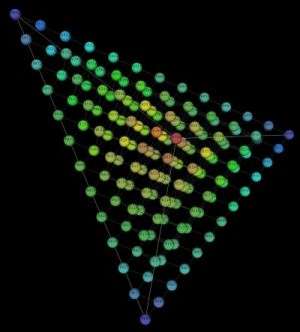
The figure shows how geometrical music theory represents four-note chord-types -- the collections of notes form a tetrahedron, with the colors indicating the spacing between the individual notes in a sequence. In the blue spheres, the notes are clustered, in the warmer colors, they are farther apart. The red ball at the top of the pyramid is the diminished seventh chord, a popular 19th-century chord. Near it are all the most familiar chords of Western music. Credit: Dmitri Tymoczko, Princeton University

The connection between music and mathematics has fascinated scholars for centuries. More than 200 years ago Pythagoras reportedly discovered that pleasing musical intervals could be described using simple ratios.

And the so-called musica universalis or "music of the spheres" emerged in the Middle Ages as the philosophical idea that the proportions in the movements of the celestial bodies -- the sun, moon and planets -- could be viewed as a form of music, inaudible but perfectly harmonious.

Now, three music professors – Clifton Callender at Florida State University, Ian Quinn at Yale University and Dmitri Tymoczko at Princeton University -- have devised a new way of analyzing and categorizing music that takes advantage of the deep, complex mathematics they see enmeshed in its very fabric.

Writing in the April 18 issue of Science, the trio has outlined a method called "geometrical music theory" that translates the language of musical theory into that of contemporary geometry. They take sequences of notes, like chords, rhythms and scales, and categorize them so they can be grouped into "families." They have found a way to assign mathematical structure to these families, so they can then be represented by points in complex geometrical spaces, much the way "x" and "y" coordinates, in the simpler system of high school algebra, correspond to points on a two-dimensional plane.

Different types of categorization produce different geometrical spaces, and reflect the different ways in which musicians over the centuries have understood music. This achievement, they expect, will allow researchers to analyze and understand music in much deeper and more satisfying ways.

The work represents a significant departure from other attempts to quantify music, according to Rachel Wells Hall of the Department of Mathematics and Computer Science at St. Joseph's University in Philadelphia. In an accompanying essay, she writes that their effort, "stands out both for the breadth of its musical implications and the depth of its mathematical content."

The method, according to its authors, allows them to analyze and compare many kinds of Western (and perhaps some non-Western) music. (The method focuses on Western-style music because concepts like "chord" are not universal in all styles.) It also incorporates many past schemes by music theorists to render music into mathematical form.

"The music of the spheres isn't really a metaphor -- some musical spaces really are spheres," said Tymoczko, an assistant professor of music at Princeton. "The whole point of making these geometric spaces is that, at the end of the day, it helps you understand music better. Having a powerful set of tools for conceptualizing music allows you to do all sorts of things you hadn't done before."

Like what?

"You could create new kinds of musical instruments or new kinds of toys," he said. "You could create new kinds of visualization tools -- imagine going to a classical music concert where the music was being translated visually. We could change the way we educate musicians. There are lots of practical consequences that could follow from these ideas."

"But to me," Tymoczko added, "the most satisfying aspect of this research is that we can now see that there is a logical structure linking many, many different musical concepts. To some extent, we can represent the history of music as a long process of exploring different symmetries and different geometries."

Understanding music, the authors write, is a process of discarding information. For instance, suppose a musician plays middle "C" on a piano, followed by the note "E" above that and the note "G" above that. Musicians have many different terms to describe this sequence of events, such as "an ascending C major arpeggio," "a C major chord," or "a major chord." The authors provide a unified mathematical framework for relating these different descriptions of the same musical event.

The trio describes five different ways of categorizing collections of notes that are similar, but not identical. They refer to these musical resemblances as the "OPTIC symmetries," with each letter of the word "OPTIC" representing a different way of ignoring musical information -- for instance, what octave the notes are in, their order, or how many times each note is repeated. The authors show that five symmetries can be combined with each other to produce a cornucopia of different musical concepts, some of which are familiar and some of which are novel.

In this way, the musicians are able to reduce musical works to their mathematical essence.

Once notes are translated into numbers and then translated again into the language of geometry the result is a rich menagerie of geometrical spaces, each inhabited by a different species of geometrical object. After all the mathematics is done, three-note chords end up on a triangular donut while chord types perch on the surface of a cone.

The broad effort follows upon earlier work by Tymoczko in which he developed geometric models for selected musical objects.

The method could help answer whether there are new scales and chords that exist but have yet to be discovered.

"Have Western composers already discovered the essential and most important musical objects?" Tymoczko asked. "If so, then Western music is more than just an arbitrary set of conventions. It may be that the basic objects of Western music are fantastically special, in which case it would be quite difficult to find alternatives to broadly traditional methods of musical organization."

The tools for analysis also offer the exciting possibility of investigating the differences between musical styles.

"Our methods are not so great at distinguishing Aerosmith from the Rolling Stones," Tymoczko said. "But they might allow you to visualize some of the differences between John Lennon and Paul McCartney. And they certainly help you understand more deeply how classical music relates to rock or is different from atonal music."

Source: Princeton University


print this article email this article download pdf blog this article bookmark this article     Stumble it Digg this share on Facebook retweet share on Reddit add to delicious
Rate this story - 4.5 /5 (142 votes)

Rank Filter

Move the slider to adjust rank threshold, so that you can hide some of the comments.


Display comments: newest first

  • OregonWind - Apr 17, 2008
    • Rank: 5 / 5 (3)
    This is fascinating. I wonder if that would start a new wave of frantic mathematics activities.
  • PeterdeBruin - Apr 17, 2008
    • Rank: 5 / 5 (7)
    Please note that Pythagoras lived more than 2,500 years ago - which is significantly earlier than 200 years ago.
  • drknowledge - Apr 17, 2008
    • Rank: 5 / 5 (7)
    PhysOrg, could you please be responsible for editing the sensational titles of articles that appear here? The article and the research itself are fine. But, as has happened a number of times recently, the title makes a "statement" which is both not what the article claims, and is misleading. It's been known for centuries that music has mathematical pinning, and that there are geometrical representations. Therefore the title indicating "researchers have discovered geometry in music" is, what's called in Wikipedia "peacock language". I.e., claims without substance. Don't degrade legitimate research by appending sensationalism in the form of titles of which the authors of the content would not approve.
  • Mercury_01 - Apr 17, 2008
    • Rank: 5 / 5 (1)
    I love this. As a DJ, I have often dreamed of converting music into a mathmatical set, and thn mathmatically changing that set to create music that hasnt been heard before. this could be used to make sounds and whole songs that follow geometrical morphology. It could be applied to a 3 dimentional effects processor that follows the position of your hands above the sensor board. someone tell KORG to make some minor software mods to thier product!
  • Tachyon8491 - Apr 17, 2008
    • Rank: 3 / 5 (6)
    As a composer of classical music but also with some decades of scientific training, the research witnessed in this article represents the worst of scientistic reductionism to me. "Music is so mathematical" such people say, and cannot begin to understand the underlying reality that music analogises in one of the most profound modelling languages that exists in revealing the mystical beauty of cosmic being. Listen to e.g. the d-minor Chaconne by J.S. Bach - then please, geometrise it - this approach equates to building a wire model of the Taj Mahal. The origin of musicality is psychodynamic and strongly relies on not just musicality and talent, but on a psychospiritual maturity which seems to become rarer as we evolve progressively towards materialistic technocracy...
  • Turbodog - Apr 17, 2008
    • Rank: 3.2 / 5 (6)
    Much praise to Tachyon8491. As a retired professional guitarist, music is math, but math is not music. Music is the expression of life and personality that can be reduced to mathematical equations. However an equalition cannot symbolize life in the way a poetic verse does!
  • earls - Apr 18, 2008
    • Rank: 5 / 5 (1)
    Is not writing notes of music the same as composing a formula to generate those notes?!
  • poopon - Apr 20, 2008
    • Rank: not rated yet
    Ah! Now if you had a picture of a song you could show it around and people could see that a new song is just really an old song with new words.
  • thales - Apr 25, 2008
    • Rank: not rated yet
    I wonder if a genetic algorithm could be used to evolve music. That would be pretty cool.
  • DeeSmith - Apr 27, 2008
    • Rank: not rated yet
    To follow up on Dr Knowledge's comment: Baroque composers employed a mathematical (geometry) basis of composition. Even the ancient Greek's musical notations are geometric in nature.

    http://www.jhu.ed...ath.html
  • Mercury_01 - Apr 28, 2008
    • Rank: not rated yet
    lets not confuse notes with how we interprit those notes. Were not trying to intalectualise music, just its patterns.

April 17, 2008 all stories

Comments: 11

4.5 /5 (142 votes)
  • Stumble this up

  • Digg this

  • share this

  • hide
  • Related Stories

  • Hunting for rhythm's DNA: Computational geometry unlocks a musical phylogeny
    created Oct 20, 2009 | popularity not rated yet | comments 0
  • Composer reveals musical chords' hidden geometry
    created Jul 06, 2006 | popularity not rated yet | comments 0
  • World's first album of Twitter music available now
    created Nov 19, 2009 | popularity not rated yet | comments 0
  • Review: 'Band Hero,' 'Lego Rock Band' -- clean rock
    created Nov 12, 2009 | popularity not rated yet | comments 0
  • 'Nature or nurture' study reveals 'musical genes' (w/ Video)
    created Nov 12, 2009 | popularity not rated yet | comments 0


  • hide
  • Relevant PhysicsForums posts

  • mean nearest neighbor distance in 3d
    created 9 hours ago
  • Column Vectors Product
    created 10 hours ago
  • A proof in powers
    created Nov 23, 2009
  • help with inverse function
    created Nov 23, 2009
  • favourite pathological examples
    created Nov 23, 2009
  • When does cos(A B)=cosA cosB
    created Nov 23, 2009
  • More from Physics Forums - General Math

Other News

Political views may skew perception of skin tone, new study finds

Other Sciences / Social Sciences

created 6 hours ago | popularity 3.3 / 5 (3) | comments 3

(PhysOrg.com) -- Political affinity could influence how some people view the skin tone of biracial political candidates, according to a new study from the University of Chicago Booth School of Business, New York University ...


In College Football, Home Field Advantage Often Overestimated

Other Sciences / Mathematics

created 7 hours ago | popularity 4 / 5 (1) | comments 0

This year, many of college football's biggest rivalry games take place over Thanksgiving weekend. A win earns bragging rights for the year. Visiting teams are often thought to be at a considerable disadvantage, especially ...


Highest jobless rate in three decades causes drop in consumer confidence

Other Sciences / Economics

created 5 hours ago | popularity not rated yet | comments 0

(PhysOrg.com) -- Florida's consumer confidence fell three points to 69 in November amid continued concerns over the state?s high unemployment rate, according to a new University of Florida survey.


Thanksgiving Combines Myths, Traditions and Truths, CU Professor Says

Thanksgiving Combines Myths, Traditions and Truths, CU Professor Says

Other Sciences / Other

created 9 hours ago | popularity not rated yet | comments 0

(PhysOrg.com) -- Over the centuries Thanksgiving in America has meant many things to many people. What we consider the traditional Thanksgiving holiday today has been around only a few decades, according ...


Strategic management theory offers fresh take on the economic crisis

Other Sciences / Economics

created 14 hours ago | popularity 4 / 5 (2) | comments 0

The recent financial crisis and resulting global economic downturn has been the most defining global economic event since the Great Depression. Now research which appears in the November issue of Strategic Organization, publis ...