The Moon and the Magnetotail
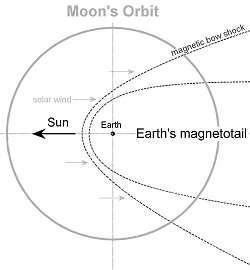
April 17th, 2008 The Moon and the Magnetotail

The Moon's orbit crosses Earth's magnetotail.

Behold the full Moon. Ancient craters and frozen lava seas lie motionless under an airless sky of profound quiet. It's a slow-motion world where even a human footprint may last millions of years. Nothing ever seems to happen there. Right?

Wrong. NASA-supported scientists have realized that something does happen every month when the Moon gets a lashing from Earth's magnetic tail.

"Earth's magnetotail extends well beyond the orbit of the Moon and, once a month, the Moon orbits through it," says Tim Stubbs, a University of Maryland scientist working at the Goddard Space Flight Center. "This can have consequences ranging from lunar 'dust storms' to electrostatic discharges."

Yes, Earth does have a magnetic tail. It is an extension of the same familiar magnetic field we experience when using a Boy Scout compass. Our entire planet is enveloped in a bubble of magnetism, which springs from a molten dynamo in Earth's core. Out in space, the solar wind presses against this bubble and stretches it, creating a long "magnetotail" in the downwind direction: diagram.

Anyone can tell when the Moon is inside the magnetotail. Just look: "If the Moon is full, it is inside the magnetotail," says Stubbs. "The Moon enters the magnetotail three days before it is full and takes about six days to cross and exit on the other side."

It is during those six days that strange things can happen.

During the crossing, the Moon comes in contact with a gigantic "plasma sheet" of hot charged particles trapped in the tail. The lightest and most mobile of these particles, electrons, pepper the Moon's surface and give the Moon a negative charge.

On the Moon's dayside this effect is counteracted to a degree by sunlight: UV photons knock electrons back off the surface, keeping the build-up of charge at relatively low levels. But on the nightside, in the cold lunar dark, electrons accumulate and voltages can climb to hundreds or thousands of volts.

Walking across the dusty charged-up lunar terrain, astronauts may find themselves crackling with electricity like a sock pulled out of a hot dryer. Touching another astronaut, a doorknob, a piece of sensitive electronics—any of these simple actions could produce an unwelcome zap. "Proper grounding is strongly recommended," advises Stubbs.

The ground, meanwhile, may leap into the sky. There is compelling evidence (see, e.g., the Surveyor 7 image below) that fine particles of moondust, when sufficiently charged-up, actually float above the lunar surface. This could create a temporary nighttime atmosphere of dust ready to blacken spacesuits, clog machinery, scratch faceplates (moondust is very abrasive) and generally make life difficult for astronauts.

Stranger still, moondust might gather itself into a sort of diaphanous wind. Drawn by differences in global charge accumulation, floating dust would naturally fly from the strongly-negative nightside to the weakly-negative dayside. This "dust storm" effect would be strongest at the Moon's terminator, the dividing line between day and night.

Much of this is pure speculation, Stubbs cautions. No one can say for sure what happens on the Moon when the magnetotail hits, because no one has been there at the crucial time. "Apollo astronauts never landed on a full Moon and they never experienced the magnetotail."

The best direct evidence comes from NASA's Lunar Prospector spacecraft, which orbited the Moon in 1998-99 and monitored many magnetotail crossings. During some crossings, the spacecraft sensed big changes in the lunar nightside voltage, jumping "typically from -200 V to -1000 V," says Jasper Halekas of UC Berkeley who has been studying the decade-old data.

"It is important to note," says Halekas, "that the plasma sheet (where all the electrons come from) is a very dynamic structure. The plasma sheet is in a constant state of motion, flapping up and down all the time. So as the Moon orbits through the magnetotail, the plasma sheet can sweep across it over and over again. Depending on how dynamic things are, we can encounter the plasma sheet many times during a single pass through the magnetotail with encounters lasting anywhere from minutes to hours or even days."

"As a result, you can imagine how dynamic the charging environment on the Moon is. The Moon can be just sitting there in a quiet region of the magnetotail and then suddenly all this hot plasma goes sweeping by causing the nightside potential to spike to a kilovolt. Then it drops back again just as quickly."

The roller coaster of charge would be at its most dizzying during solar and geomagnetic storms. "That is a very dynamic time for the plasma sheet and we need to study what happens then," he says.

What happens then? Next-generation astronauts are going to find out. NASA is returning to the Moon in the decades ahead and plans to establish an outpost for long-term lunar exploration. It turns out they'll be exploring the magnetotail, too.

Source: Science@NASA, by Dr. Tony Phillips


print this article email this article download pdf blog this article bookmark this article     Digg this Stumble it share on Facebook share on Reddit add to delicious save to Yahoo! bookmarks
4.1/5 after 8 votes

Rank Filter

Move the slider to adjust rank threshold, so that you can hide some of the comments.


Display comments: newest first

  • zevkirsh - Apr 17, 2008
    • Rank: not rated yet
    lunar regolith is just another reason to skip the moon and just go to mars.
    in fact, there's no way nasa's budgets won't be stripped of necessary funding to go to the moon. it's just a matter of time.
  • Jayem - Apr 18, 2008
    • Rank: not rated yet
    The Moon has to be our first objective over Mars, as going their will give us the necessary technical and socio-adaptive skills that we'll need for living on another planet. Going to Mars first would be more cost-effective in the long run, but more important of all, may end up costing lives.
    John -- www.moonposter.ie
  • SDMike - Apr 24, 2008
    • Rank: not rated yet
    Could the "tail" be use as a source of electrical energy?

    Don't worry about going to the moon. Obama has stated that he will take man-in-space funding from nasa and use it for a federal 0-5 indoctrination program for US children. baldwinparkdemocrat.blogspot.com/2008/02/barack-obamas-education-plan.html

April 17th, 2008 all stories
Space & Earth / Space Exploration

Comments: 3
Rank: 4.1/5 after 8 votes

  • Stumble this up

  • Digg this

  • Share it:
  • share on Facebook
  • share on MySpace
  • share on Slashdot
  • rss-newsfeed
  • share on Google
  • share on Reddit
  • add to delicious
  • save to Yahoo! bookmarks
  • share on Windows Live
  • Add to Mixx!
Rating: 4.1/5 after 8 votes

  • Related Stories

  • Mysterious Lunar Swirls
    created Jun 27, 2006 | popularity not rated yet | comments 0
  • Forty years ago man first walked on the moon
    created 19 hours ago | popularity not rated yet | comments 0
  • Lunar Reconnaissance Orbiter's first moon images available
    created Jul 02, 2009 | popularity not rated yet | comments 0
  • NASA manager pitches a cheaper return-to-moon plan
    created Jun 30, 2009 | popularity not rated yet | comments 0
  • Moon Magic: Researchers Develop New Tool To Visualize Past, Future Lunar Eclipses (w/ Video)
    created Jun 29, 2009 | popularity not rated yet | comments 0

Tags


  • Physicists Demonstrate Quantum Memory with Matter Qubits
    Physicists Demonstrate Quantum Memory with Matter Qubits
    Physics / General Physics
    created Jul 03, 2009 | popularity 4.4 / 5 (17) | comments 1
  • 'Holey' Nanosheets for Wastewater Dye Removal
    Nanotechnology / Nanomaterials
    created Jul 01, 2009 | popularity 5 / 5 (5) | comments 1
  • Jellyfish Robot Swims Like its Biological Counterpart
    Jellyfish Robot Swims Like its Biological Counterpart
    Electronics / Robotics
    created Jun 26, 2009 | popularity 4.4 / 5 (8) | comments 1
  • Could Maxwell's Demon Exist in Nanoscale Systems?
    Could Maxwell's Demon Exist in Nanoscale Systems?
    Physics / General Physics
    created Jun 24, 2009 | popularity 4.4 / 5 (18) | comments 29
  • Living Safely with Robots, Beyond Asimov's Laws
    Living Safely with Robots, Beyond Asimov's Laws
    Electronics / Robotics
    created Jun 22, 2009 | popularity 4.6 / 5 (52) | comments 40
  • Other News

    Forty years ago man first walked on the moon

    Space & Earth / Space Exploration

    created 19 hours ago | popularity 4.3 / 5 (4) | comments 2

    Forty years ago on July 20, 1969, American astronaut Neil Armstrong realized the oldest dream of human civilizations when he became the first man to walk on the moon.


    The least sea ice in 800 years

    The least sea ice in 800 years

    Space & Earth / Earth Sciences

    created Jul 01, 2009 | popularity 4.2 / 5 (62) | comments 59

    New research, which reconstructs the extent of ice in the sea between Greenland and Svalbard from the 13th century to the present indicates that there has never been so little sea ice as there is now. The ...


    Gas around young galaxy

    Intense heat killed the Universe's would-be galaxies, researchers say

    Space & Earth / Astronomy

    created Jul 01, 2009 | popularity 3.4 / 5 (21) | comments 27

    (PhysOrg.com) -- Our Milky Way galaxy only survived because it was already immersed in a large clump of dark matter which trapped gases inside it, scientists led by Durham University's Institute for Computational ...


    Scientists' Drill Hits Magma: Only Third Time on Record

    Scientists' Drill Hits Magma: Only Third Time on Record

    Space & Earth / Earth Sciences

    created Jun 29, 2009 | popularity 4.7 / 5 (22) | comments 19

    (PhysOrg.com) -- Scientists drilling a borehole deep into Iceland’s rocky crust to explore new methods of using geothermal energy hit a major roadblock on Thursday: Their drill ran into molten rock at a depth ...


    NASA manager pitches a cheaper return-to-moon plan

    Space & Earth / Space Exploration

    created Jun 30, 2009 | popularity 4.1 / 5 (8) | comments 18

    (AP) -- Like a car salesman pushing a luxury vehicle that the customer no longer can afford, NASA has pulled out of its back pocket a deal for a cheaper ride to the moon.