Ceramic, heal thyself
April 17, 2008 Simulation shows how defect-engineered zirconia repairs radiation-induced damage

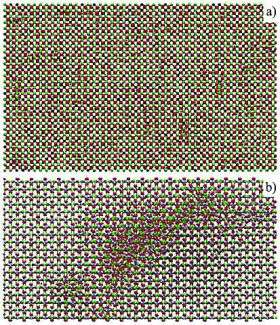
In yttria-stabilized zirconia (top), the defects produced by radiation are few and far between, having less impact on the properties of the material. In zircon (bottom), the defects are clustered, which could compromise the material's integrity. Credit: PNNL

A new computer simulation has revealed a self-healing behavior in a common ceramic that may lead to development of radiation-resistant materials for nuclear power plants and waste storage.

Researchers at the Department of Energy's Pacific Northwest National Laboratory found that the restless movement of oxygen atoms heals radiation-induced damage in the engineered ceramic yttria-stabilized zirconia.

Scientists Ram Devanathan and Bill Weber modeled how well that ceramic and other materials stand up to radiation. "If you want a material to withstand radiation over millennia, you can't expect it to just sit there and take it. There must be a mechanism for self-healing," said Devanathan.

"This research raises the possibility of engineering mobile defects in ceramics to enhance radiation tolerance," Weber said. He noted that materials capable of handling high-radiation doses also "could improve the durability of key equipment and reduce the costs of replacements."

The researchers approached their investigation in three steps. First, they analyzed yttria-stabilized zirconia, a compound of yttrium and zirconium oxides that contains random structural defects called "vacancies." The defects occur because yttrium has a smaller electrical charge than zirconium. To correct the charge imbalance, zirconia gives up oxygen atoms. But the loss of these oxygen atoms leaves empty oxygen sites. The remaining oxygen atoms constantly jump in and out of those sites.

"It is like a classroom full of fidgety kids," said Devanathan. "When the teacher turns her back, the kids constantly jump into empty chairs, leaving their own chairs vacant until another kid leaps into the seat."

Next, the scientists simulated an atom undergoing alpha decay. An alpha particle shoots out of the atomic nucleus with such force that the remainder of the atom recoils in the opposite direction. The recoiling atom can cause significant damage to surrounding atomic structures.

Finally, the researchers used data analysis algorithms developed at PNNL to look for atoms knocked out of place. The results showed that displaced oxygen atoms in the yttria-stabilized zirconia "found seats" in the pre-existing vacancies throughout the ceramic.

Although the self-healing activity does not completely repair the material, the defects are less apt to cause problems because they are spread out. This characteristic indicates that yttria-stabilized zirconia, which is used today in such items as solid oxide fuel cells and oxygen sensors, might be suitable for nuclear applications.

The researchers also simulated the impact of radiation on zircon, a ceramic that is a candidate for immobilizing high-level nuclear waste. The simulation defects clustered together in simulations of zircon, changing the properties of the material. "Clustered defects are much more difficult to repair than isolated defects, Devanathan said.

The scientists now are refining the simulations and applying them to other materials.

Reference: Ram Devanathan and William J. Weber. "Dynamic annealing of defects in irradiated zirconia-based ceramics," published in the Journal of Materials Research, March 2008, 23(3):593-597.

Source: Pacific Northwest National Laboratory


print this article email this article download pdf blog this article bookmark this article     Stumble it Digg this share on Facebook retweet share on Reddit add to delicious
Rate this story - 4 /5 (12 votes)


April 17, 2008 all stories

Comments: 0

4 /5 (12 votes)
  • Stumble this up

  • Digg this

  • share this

  • hide
  • Related Stories

  • A Kinoform's Best Friend: Diamond Refractive Lenses for Nanofocusing
    created Aug 03, 2009 | popularity not rated yet | comments 0
  • Now That's Cool: Engineers Out to Thaw the Mysteries of Ice
    created Aug 07, 2008 | popularity not rated yet | comments 0
  • The structure of XPD sheds light on cancer and aging
    created May 29, 2008 | popularity not rated yet | comments 0
  • Findings a step toward making new optical materials
    created Apr 22, 2008 | popularity not rated yet | comments 0
  • Hidden order found in a quantum spin liquid
    created Jul 26, 2007 | popularity not rated yet | comments 0


  • hide
  • Relevant PhysicsForums posts

Other News

The LHC tunnel

Peckish bird briefly downs big atom smasher

Physics / General Physics

created 2 hours ago | popularity 3.7 / 5 (3) | comments 3

A peckish bird briefly knocked out part of the world's biggest atom smasher by causing a chain reaction with a piece of bread, the European Organisation for Nuclear Research (CERN) said Monday.


Ginzburg helped develop the Soviet Union's hydrogen bomb in the late 1940s and early 1950s

Russian bomb physicist Ginzburg dead at 93

Physics / General Physics

created 3 hours ago | popularity 5 / 5 (2) | comments 0

Nobel Physics prize winner Vitaly Ginzburg, who helped develop the Soviet hydrogen bomb, has died at the age of 93, the Russian Academy of Sciences said Monday.


Stars Fueled by Dark Matter Could Hold Secrets to the Universe

Stars Fueled by Dark Matter Could Hold Secrets to the Universe

Physics / General Physics

created Nov 03, 2009 | popularity 4.5 / 5 (51) | comments 41

(PhysOrg.com) -- The first stars in the universe may have been very different from the stars we see today, yet they may hold clues to understanding some of the mysterious features of the universe. These "dark ...


Second Law of Thermodynamics May Explain Economic Evolution

Second Law of Thermodynamics May Explain Economic Evolution

Physics / General Physics

created Nov 02, 2009 | popularity 4.3 / 5 (31) | comments 28

(PhysOrg.com) -- Terms such as the "invisible hand," laissez-faire policy, and free-market principles suggest that economic growth and decline in capitalist societies seem to be somehow self-regulated. Now, ...


High-performance plasmas may make reliable, efficient fusion power a reality

High-performance plasmas may make reliable, efficient fusion power a reality

Physics / Plasma Physics

created Nov 02, 2009 | popularity 4.7 / 5 (40) | comments 34

In the quest to produce nuclear fusion energy, researchers from the DIII-D National Fusion Facility have recently confirmed long-standing theoretical predictions that performance, efficiency and reliability ...