URI analysis of rare textiles from Honduras ruins suggests Mayans produced fine fabrics
April 17, 2008 URI analysis of rare textiles from Honduras ruins suggests Mayans produced fine fabrics

Very few textiles from the Mayan culture have survived, so the treasure trove of fabrics excavated from a tomb at the Copán ruins in Honduras since the 1990s has generated considerable excitement.

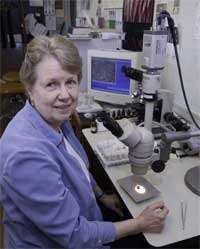
Textiles conservator Margaret Ordoñez, a professor at the University of Rhode Island, spent a month at the site in 2004 examining 100 textile samples found in a tomb, and since then she has been analyzing tiny fragments of 49 samples she brought back to her lab to see what she could learn from them.

The tomb, one of three excavated by archaeologists from the University of Pennsylvania, was of a woman of high status who was buried during the 5th century.

“What was most amazing was that there were as many as 25 layers of fabrics on an offertory platform and covering pottery in the tomb, and they all had a different fabric structure, color, and yarn size, so it’s likely that the tomb was reopened – perhaps several times -- and additional layers of textiles were laid there years after her death,” said Ordoñez.

One fabric in particular had an especially high thread count – 100 yarns per inch – which Ordoñez said is even considered high for modern textiles. “It speaks to the technology they had at the time for making very fine fabrics. It’s gratifying that we’ve been able to document that the Mayans were quite skillful at spinning and weaving.”

Analyzing these ancient textile samples is a complex and laborious process, particularly because the remnant samples are so small.

Ordoñez pulled out about 30 plastic containers the size of a film canister, and inside each was what looked like a rock or bit of compressed mud about an inch in diameter. Within each piece were flecks of what only an expert could tell are tiny fragments of fabric.

“Sometimes you really have to use your imagination to tell that there’s a textile in there,” she said.

Handling each piece very carefully so it doesn’t crumble, Ordoñez uses a stereomicroscope to examine the yarn structure, the fabric structure, and the finish on each sample. She then brings the sample to the URI Sensors and Surface Technology Laboratory to use a scanning electron microscope to look in more fine detail at the plant material from which each piece of yarn was made.

“I can look at the cell structure of the yarn and compare it to reference materials to identify the kind of plant each thread is made from,” explained Ordoñez, who may spend as many as three days examining each fragment. “We’ve found threads made from cotton, sedge grasses, and all kinds of other plant fibers.”

After completing the analysis of the textile samples in her lab this summer, the URI professor plans to return to the Copán ruins in 2009 to examine more fragments from the woman’s tomb and other sites. She said the working conditions at the site are challenging and the research facilities are primitive, but the site provides the best opportunity to learn more about the Mayan culture.

She may even do a study of Mayan statuary at the site to see what she can learn from the way that sculptors represented textiles from the period.

Source: University of Rhode Island


print this article email this article download pdf blog this article bookmark this article     Stumble it Digg this share on Facebook retweet share on Reddit add to delicious
Rate this story - 4.3 /5 (7 votes)


April 17, 2008 all stories

Comments: 0

4.3 /5 (7 votes)
  • Stumble this up

  • Digg this

  • share this

  • hide
  • Related Stories

  • Forensics firm builds on genomic discovery to advance DNA-based identification
    created Oct 13, 2009 | popularity not rated yet | comments 0
  • Tulane University Anthropologist Helps Unravel Mummy Mystery
    created Jul 18, 2008 | popularity not rated yet | comments 0
  • Academic uncovers Holy Grail of palaeontology
    created Dec 03, 2007 | popularity not rated yet | comments 0
  • Museum: Galileo's fingers, tooth are found
    created Nov 21, 2009 | popularity not rated yet | comments 0
  • Researcher: Faint writing seen on Shroud of Turin (Update)
    created Nov 20, 2009 | popularity not rated yet | comments 0


  • hide
  • Relevant PhysicsForums posts

  • Selenocysteine in pH=7
    created 12 hours ago
  • What is the formula for calculating the speed of thought?
    created 17 hours ago
  • What does word "absorption" mean in the intestine?
    created 17 hours ago
  • What is transpulmonary pressure?
    created Nov 24, 2009
  • More from Physics Forums - Biology

Other News

The skyline of Tokyo in Japan, where scientists have criticised the new government for plans to slash research budgets

Japan scientists attack govt research cut plans

Other Sciences / Other

created 7 hours ago | popularity 5 / 5 (1) | comments 0

Top Japanese scientists, including four Nobel laureates, have criticised the new government for plans to slash research budgets, warning the country will loose its high-tech edge.


Message gone viral? Blame it on altruistic, yet image-conscious Internet  'e-mavens'

Message gone viral? Blame it on altruistic, yet image-conscious Internet 'e-mavens'

Other Sciences / Economics

created 14 hours ago | popularity 3.5 / 5 (2) | comments 0

(PhysOrg.com) -- Why do some online ad campaigns go viral while other online marketing messages gather "cyber-dust" on the information superhighway? The key may lie in the motivation of Internet users to email ...


Researcher: Faint writing seen on Shroud of Turin (AP)

Researcher: Faint writing seen on Shroud of Turin (Update)

Other Sciences / Archaeology & Fossils

created Nov 20, 2009 | popularity 2.3 / 5 (31) | comments 44

(AP) -- A Vatican researcher has rekindled the age-old debate over the Shroud of Turin, saying that faint writing on the linen proves it was the burial cloth of Jesus. Experts say the historian may be reading ...


Explained: The Discrete Fourier Transform

Explained: The Discrete Fourier Transform

Other Sciences / Mathematics

created Nov 25, 2009 | popularity 4.3 / 5 (26) | comments 8

(PhysOrg.com) -- In 1811, Joseph Fourier, the 43-year-old prefect of the French district of Isčre, entered a competition in heat research sponsored by the French Academy of Sciences. The paper he submitted ...


Climate change could boost incidence of civil war in Africa

Other Sciences / Social Sciences

created Nov 23, 2009 | popularity 2.4 / 5 (16) | comments 9

Climate change could increase the likelihood of civil war in sub-Saharan Africa by over 50 percent within the next two decades, according to a new study led by a team of researchers at University of California, Berkeley, ...