Researcher finds fossilized shell-breaking crab
April 17th, 2008 Researcher finds fossilized shell-breaking crab

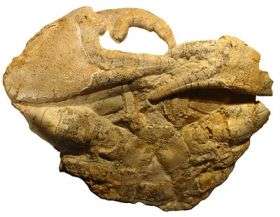
In a museum display case, Cornell paleontologist Greg Dietl recognized a 69 million-year-old crab fossil with an oversized right claw, a feature previously thought to appear more than 20 million years later. Credit: Cornell University

While waiting for colleagues at a small natural history museum in the state of Chiapas, Mexico last year, Cornell paleontologist Greg Dietl chanced upon a discovery that has helped rewrite the evolutionary history of crabs and the shelled mollusks upon which they preyed.

In a museum display case he recognized a 67- to 69-million-year-old fossil from the Late Cretaceous period of a big crab with an oversized right claw. Such crabs with claws of different sizes were not known to exist until the early Cenozoic era, about 20 million years later.

Aside from being larger than most known Late Cretaceous crabs (about the size of today's Florida stone crabs) and having asymmetrical claws, this ancient crab also sported a curved tooth on the movable finger of the larger right claw. This was another specialized adaptation that paleontologists thought developed millions of years later for peeling snail shells open.

"I immediately had to point it out to my colleagues around me," said Dietl, an adjunct professor in Cornell's Department of Earth and Atmospheric Sciences and director of collections at the Cornell-affiliated Paleontological Research Institution in Ithaca. "I was really excited when I found it. The fossil re-opens the question of the role crabs played in the well-documented restructuring of marine communities that occurred during the Mesozoic era [251 million years ago to 65 million years ago]."

The discovery led to a study, published March 10 in the online version of the Royal Society's Biology Letters journal, coauthored by Francisco J. Vega, a geologist at the Universidad Nacional Autónoma de México.

The museum's staff showed Dietl and colleagues another fossil of the same species in a back room. Both specimens, found near the town of Ocozocoautla in southeastern Mexico, are the oldest fossils with these unique features on record and represent a new species, Megaxantho zogue .

The large right "crusher" claw generated a great deal of force to break shells, while the smaller left cutter claw moved faster and could manipulate prey into position. Also, the curved tooth increased the power of the claw.

Dietl hopes the discovery will spur other researchers to search for similar examples of these curved tooth structures from the Late Cretaceous period, just prior to the extinction of the dinosaurs.

Although Megaxantho crabs became extinct around 65 million years ago, these features evolved again in other crab species throughout the Cenozoic era, leading to present-day crabs, according to the study. The repeated evolution suggests that such power-enhancing adaptations may evolve during times and places where resources are abundant and accessible, Dietl said.

The study may be relevant to the current stresses of habitat loss, overfishing, climate change and other human-influenced activities that are reducing the productive capacity of the environment.

"We may be diminishing the capacity of organisms to adapt in novel ways," a consideration that conservationists may need to account for in future strategies for protecting natural areas, he said.

Source: By Krishna Ramanujan, Cornell University


print this article email this article download pdf blog this article bookmark this article     Digg this Stumble it share on Facebook share on Reddit add to delicious save to Yahoo! bookmarks
3.8/5 after 6 votes


April 17th, 2008 all stories
Other Sciences / Archaeology & Fossils

Comments: 0
Rank: 3.8/5 after 6 votes

  • Stumble this up

  • Digg this

  • Share it:
  • share on Facebook
  • share on MySpace
  • share on Slashdot
  • rss-newsfeed
  • share on Google
  • share on Reddit
  • add to delicious
  • save to Yahoo! bookmarks
  • share on Windows Live
  • Add to Mixx!
Rating: 3.8/5 after 6 votes

  • Related Stories

  • Shell-breaking crabs lived 20 million years earlier than thought
    created Apr 22, 2008 | popularity not rated yet | comments 0
  • Crab claws pack strengthening bromide-rich biomaterial
    created Feb 25, 2009 | popularity not rated yet | comments 0
  • Origin of claws seen in 390-million-year-old fossil
    created Feb 05, 2009 | popularity not rated yet | comments 0
  • Size doesn't matter to fighting fiddler crabs
    created Dec 19, 2007 | popularity not rated yet | comments 0
  • Giant fossil sea scorpion bigger than man
    created Nov 21, 2007 | popularity not rated yet | comments 0

Tags


  • Physicists Demonstrate Quantum Memory with Matter Qubits
    Physicists Demonstrate Quantum Memory with Matter Qubits
    Physics / General Physics
    created Jul 03, 2009 | popularity 4.4 / 5 (17) | comments 1
  • 'Holey' Nanosheets for Wastewater Dye Removal
    Nanotechnology / Nanomaterials
    created Jul 01, 2009 | popularity 5 / 5 (5) | comments 1
  • Jellyfish Robot Swims Like its Biological Counterpart
    Jellyfish Robot Swims Like its Biological Counterpart
    Electronics / Robotics
    created Jun 26, 2009 | popularity 4.4 / 5 (8) | comments 1
  • Could Maxwell's Demon Exist in Nanoscale Systems?
    Could Maxwell's Demon Exist in Nanoscale Systems?
    Physics / General Physics
    created Jun 24, 2009 | popularity 4.4 / 5 (18) | comments 29
  • Living Safely with Robots, Beyond Asimov's Laws
    Living Safely with Robots, Beyond Asimov's Laws
    Electronics / Robotics
    created Jun 22, 2009 | popularity 4.6 / 5 (52) | comments 40
  • Other News

    Creation Museum president Ken A. Ham

    Paleontologists brought to tears, laughter by Creation Museum

    Other Sciences / Other

    created Jun 30, 2009 | popularity 4.3 / 5 (41) | comments 120

    For a group of paleontologists, a tour of the Creation Museum seemed like a great tongue-in-cheek way to cap off a serious conference.


    Mummified dinosaur skin yields up new secrets

    Mummified dinosaur skin yields up new secrets

    Other Sciences / Archaeology & Fossils

    created Jul 01, 2009 | popularity 4.7 / 5 (14) | comments 10

    (PhysOrg.com) -- Scientists from The University of Manchester have identified preserved organic molecules in the skin of a dinosaur that died around 66-million years ago.


    Liberal? Conservative? Stanford study says mental nudge can make voters flip-flop

    Liberal? Conservative? Stanford study says mental nudge can make voters flip-flop

    Other Sciences / Social Sciences

    created Jul 02, 2009 | popularity 3.8 / 5 (5) | comments 4

    (PhysOrg.com) -- No doubt you’ve worked hard for your success. But chances are you’ve also had some help and lucky breaks along the way.


    Probing Question: How do Ponzi Schemes work?

    Other Sciences / Economics

    created Jul 02, 2009 | popularity 5 / 5 (1) | comments 2

    Imagine the shock, the horror, and the sheer panic that would come with learning that the financial plan you’d sunk your life savings into was a sham, the financial experts you trusted were crooks, and all your money was ...


    Tourists enjoy a "Pineapple Tour" in Costa Rica

    Costa Rica tops happiness, 'green living' poll

    Other Sciences / Social Sciences

    created Jul 04, 2009 | popularity 2 / 5 (2) | comments 0

    Costa Rica is the happiest place on earth, and one of the most environmentally friendly, according to a new survey by a British non-governmental group.